
OUTER ANCHORAGE OF CTG PORT
Shortage of lighterage vessels hampers cargo unloading
Supply disruptions feared ahead of Ramadan
NAZIMUDDIN SHYAMOL | Saturday, 17 January 2026
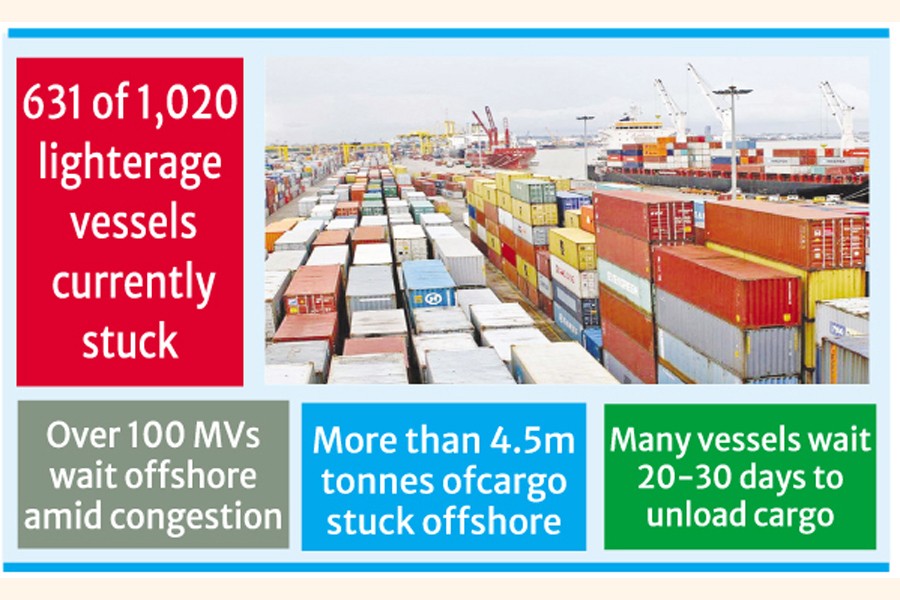
CHATTAGRAM, Jan 16: Cargo handling operations at the outer anchorage of Chattogram port have been severely hampered due to an acute shortage of lighterage vessels, raising concerns over possible supply disruptions ahead of the holy month of Ramadan.
The disruption has slowed the unloading of goods from mother vessels at the country's principal seaport, putting pressure on the supply chain for essential commodities and reviving fears of shortages and price hikes in local markets, similar to last year.
Officials of the Chittagong Port Authority (CPA), ship handling operators and importers said congestion at the outer anchorage has reached alarming levels, with more than 100 mother vessels currently waiting offshore to discharge cargo.
Daily discharge capacity has fallen sharply due to the scarcity of lighterage ships.
Port data show that as of January 16, a total of 103 cargo vessels were anchored at Chattogram's outer anchorage and the Kutubdia channel, carrying more than 4.5 million tonnes of cargo.
Of these vessels, 53 are carrying general cargo, while 20 are loaded with around 1.2 million tonnes of Ramadan-specific food items, including wheat, corn, soybean, chickpeas, lentils and edible oil.
Another five vessels are carrying over 200,000 tonnes of sugar, six are loaded with fertiliser and 24 with cement clinker.
Under normal conditions, a mother vessel carrying around 50,000 tonnes of cargo completes unloading within seven to ten days using lighterage vessels.
However, many ships have now been waiting offshore for 20 to 30 days, with some barely discharging any cargo for days.
An importer, speaking on condition of anonymity, said unloading has frequently been suspended due to the shortage of lighterage vessels, forcing importers to incur demurrage charges on a daily basis.
According to the Bangladesh Water Transport Coordination Cell (BWTCC), demand was recorded for 104 lighterage vessels on January 16 to service the 103 anchored mother vessels, but only about 50 could be supplied.
To prioritise food shipments, authorities have temporarily suspended lighterage allocation to large companies that operate their own fleets.
Even so, six government-imported fertiliser vessels have reportedly received no lighterage support for more than a week.
Officials warned that prolonged delays could soon lead to fertiliser shortages at government warehouses, affecting agricultural production.
Ship handling operators pointed to a severe mismatch between demand and supply.
While 150 to 200 lighterage vessels are needed daily to maintain normal operations, only 30 to 40 are currently being deployed.
Officials at the WTCC cited multiple factors behind the shortage. Dense fog in recent weeks has disrupted river navigation, slowing inland movement.
At the same time, 630 lighterage vessels are currently stuck at 41 ghats nationwide, including 138 engaged in transporting government-imported fertiliser.
Delays in bagging, shortages of trucks and labour, and congestion at warehouses have prevented these vessels from returning to service.
WTCC convener Haji Shafi said, "Out of around 1,020 registered lighterage vessels, if more than 630 are stuck, a shortage is inevitable. Another 200 to 300 vessels are already engaged in carrying cargo elsewhere."
He described the scale of congestion as unprecedented.
"Normally, 30 to 50 ships wait at the anchorage. In my 30 years, I have never seen this many at once. We are under immense pressure, but the vessels simply are not available," he said.
Khairul Alam Sujan, former director of the Bangladesh Shipping Agents' Association, warned that the practice of using lighterage vessels as floating warehouses must be stopped.
"The Ministry of Shipping should bring all stakeholders together. Otherwise, food shortages during Ramadan are a real risk," he said.
Sarwar Hossain Sagar, president of the Bangladesh Ship Handling and Berth Operators Association, said the situation has almost paralysed unloading operations.
"Ships are arriving faster than we can clear them."
nazimuddinshyamol@gmail.com