
Shun business-as-usual attitude, Mozena urges RMG makers
FE Report | Wednesday, 12 February 2014
Bangladesh's readymade garment (RMG) manufacturers should shun their existing 'business as usual' attitude regarding safety standards and workers' rights for sustaining their business in the global market, US Ambassador Dan W Mozena said Tuesday.
"I call on all owners ... all owners ... to reject 'business as usual' and to lead enthusiastically and creatively the transformation of the sector," the US envoy said.
Mr Mozena made his observation, citing the meeting between government officials and apparel manufacturers, where some factory owners opposed bringing their factories to international standards for workers' safety and labour rights, claiming the standards were too high.
"To me, the unstated but clear message from these owners is that since orders keep coming, since profits keep mounting, why should we incur additional costs in meeting these higher standards … To me, the message seemed to be - let's go back to business as usual," he explained.
He went on: "Business-as-usual is a recipe for more Tazreen Fashions and Rana Plaza tragedies, which will destroy prospects for Bangladesh's apparel sector in the global marketplace."
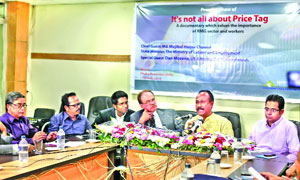
The envoy was speaking at the launching ceremony of a documentary on the country's readymade garment industry titled 'It's not all about price tag', directed by journalist Mohammad Mufazzal at the Dhaka Reporters Unity in the city.
State Minister for Labour and Employment Mojibul Haque Chunnu was the chief guest at the programme moderated by former Bangladesh Bureau Chief of Associated Press (AP) Farid Hossain.
Shirin Akhter, MP, Policy Research Institute of Bangladesh (PRI) Executive Director Dr Ahsan H Mansur, BGMEA Vice President Reaz-bin-Mahmood, Bangladesh Fire Service and Civil Defence Director General Brig Gen Ali Ahmed Khan and the documentary producer journalist Mohammad Mufazzal, among others, spoke on the occasion.
Regarding restoration of the GSP, Mr Mozena said Bangladesh had taken some steps following the roadmap toward the shared goal of securing Bangladesh's role as a preferred supplier in the global RMG marketplace and transforming the apparel sector so it could grow and prosper.
But there were other challenges including recruiting, training and deploying large corps of safety and labour inspectors, creating a publicly-accessible database to show inspection results on each factory, he said.
Reforming and implementing the labour law and making it applicable to the EPZs, creating conditions in all factories so real and responsible and unions that would truly represent the workers and take root free of intimidation and recrimination to advance the industry by improving workers' well-being were the challenges, he added.
"I believe Bangladesh will overcome all these challenges and choose and follow the path to transform the apparel sector and bring it to international safety and labour standards," he added.
Speaking on the occasion, the state minister for labour and employment Mojibul Haque said good relation between garment factory owners and workers could resolve all the existing problems and the government was working to bring back the confidence of the two sides.
He also blamed some workers' foundations for violating the trade union rules.
Mr Ahsan H Mansur stressed the need for effective and coordinated efforts by factory owners, the government and civil society members to stop recurrence of Tazreen and Rana Plaza-like tragedies and take lessons from these.