
SATKHIRA'S KALAROA UPAZILA
Shyamsundar Temple still stands strikingly in Sonabaria village
OUR CORRESPONDENT | Tuesday, 19 May 2026
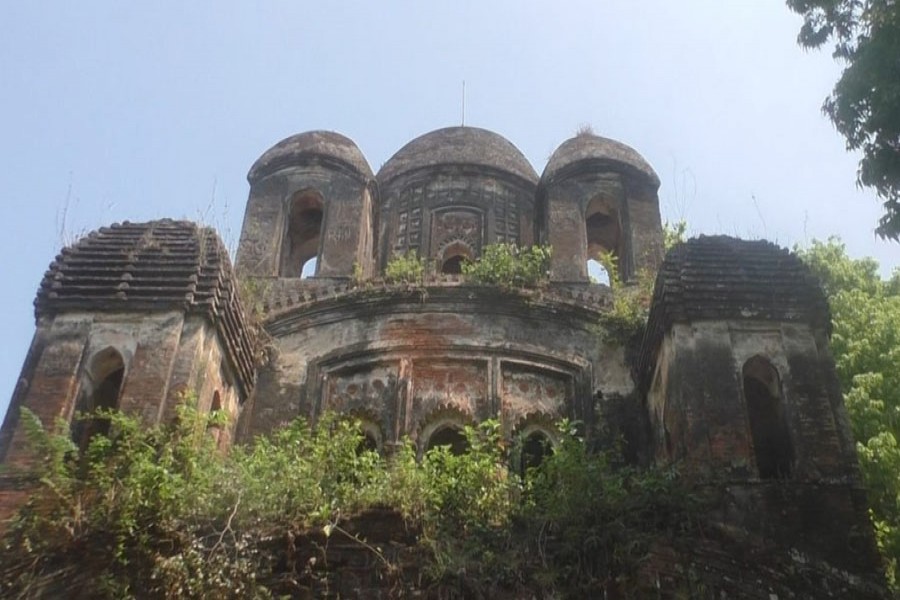
BENAPOLE, May 18: In the village of Sonabaria under Kalaroa upazila of Satkhira, there still stands strikingly a remarkable piece of heritage - the Shyamsundar Temple, also locally known as Sonabaria Mathbari.
This 400 -year-old structure is considered as one of the finest instances of terracotta architecture in the region.
The three-storey, pyramid-shaped Navaratna temple rises about 60 feet hight and is renowned for its intricate terracotta plaques.
Though it is currently a protected archaeological site under the Department of Archaeology, the temple suffers from neglect despite its historical and aesthetic significance.
Built by Hariram Das in 1767, the temple measures 33 feet by 33 feet and continues to attract visitors and pilgrims every day.
According to local beliefs, revered mystic Ramakrishna Paramahamsa once stayed at the temple for about two months, adding to its religious importance among Hindu devotees.
Folklore suggests that the temple was constructed overnight by supernatural beings. Originally designed as a Navaratna temple with nine minars (towers), it now resembles a monastery.
The outer walls are adorned with exquisite terracotta panels, many of which are now getting damaged due to lack of maintenance.
Located about 27 kilometres off Satkhira sadar and seven kilometres off Kalaroa upazila, the temple complex also includes Durga and Shiva shrines.
The structure is divided into multiple sections: a surrounding corridor on the ground floor, a mandapa, and inner chambers.
A staircase on the eastern side leads to the upper level, where domes rise in tiers, crowned by a central pinnacle - a defining feature of Navaratna temple.
Despite regular footfall, the site lacks basic facilities such as food store and accommodation.
Locals and
visitors alike have called on the government to take immediate steps for its conservation and development.
Caretaker Suprasad Chowdhury, who has inherited responsibility for the temple, said that protecting the divinity property with a boundary wall is crucial. Although the Department of Archaeology once visited the site, they claim no further initiative has been taken since.
They also mentioned that an Indian deputy high commissioner had once promised to build a guest house at the site, noting its historical importance. However, that commitment remains unfulfilled.
Another Caretaker Deb Prasad Chowdhury said an inscription on the temple walls confirms that it was constructed in 1767. Historical accounts also attribute its construction to Hariram Das, also known as Durgapriya Das. Today, the Shyamsundar Temple stands as a silent testimony to the region's rich cultural heritage - awaiting proper care and recognition.
benapolejessore@gmail.com