
'Small step' & 'giant leap': India's moon moment
Imtiaz A Hussain | Thursday, 31 August 2023
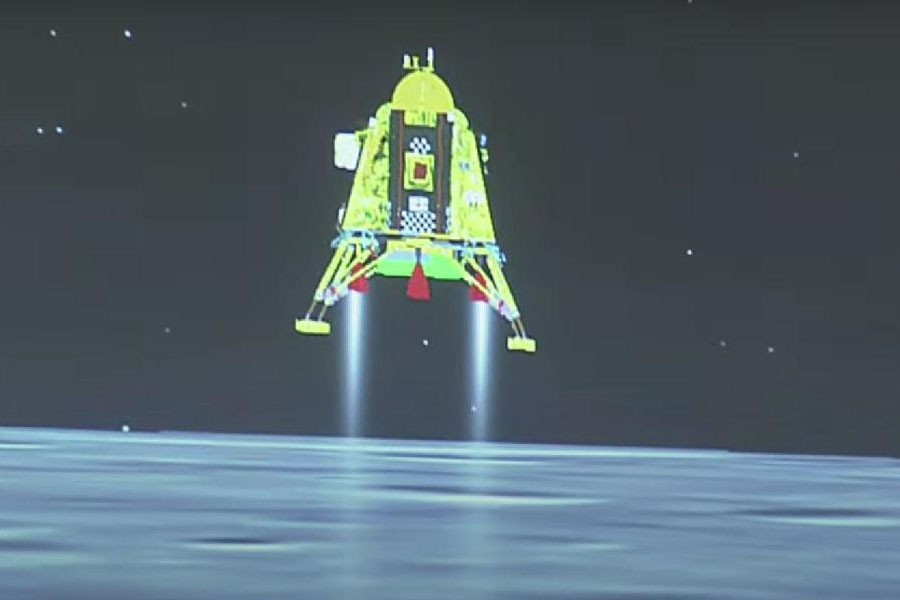
Within weeks of displacing China as the world's most populated country, India has just out-done Russia in a no-conflict race to become the first to land on the moon's south side. Given how the south side holds promise of sustaining life on an otherwise arid moon, could this be the goose laying the golden egg of India's world leadership?
Russia's unmanned Luna-25 crashed before landing last Sunday (August 20, 2023), denying Russia the last gasp of a space-rivalry comeback. With the war in Ukraine, a recovery is not foreseeable, and not because President Vladimir Putin has virtually ignored space rivalry: as seems to be any dictator's dictum, gains on the ground here and now count multiple times more than extraterrestrial hopes.
That is a tough indictment of the kind of a leader from whom space-rivalry first began. Joseph Stalin not only invested enough on such an extraterrestrial hope to produce Yuri Gagarin, the first human to enter space (on April 12, 1961). He also gave the Soviet Union leadership in the space race until Alan B. Shepherd neutralised that space-entry advantage on May 5, 1961. Yet, Gagarin's was not a space-exploring expedition. Stalin urgently needed a space platform to launch a missile upon the United States. Even though the Soviet Union launched the world's first intercontinental ballistic bomb (ICBM) in 1957 (when the first space mission from any country was also launched, Sputnik I, by the Soviet Union), its reach was only 3,700 miles, barely touching the United States. But the space race revved up.
Fast-forwarding to the August 20, 2023 crash, Russia has been more plagued by crashes than pioneer outer space explorations. It threatened the International Space Station, where 14 countries send scientists to collaborate over space harnessing (including Russia itself), when destroying one of its satellites in a November 2021 missile capability test. Dangerous debris was also released into outer space.
On June 30, 1971, Georgy Dobrovolsky, Vladislav Volkov, and Viktor Patsayev (whose birthday was the first celebrated in outer space), became the only humans to have died in outer space (after spending a then-record 22 days in outer space): Soyuz-11's three compartments accidentally separated simultaneously on the extraterrestrial side of the Kármán Line (the boundary between earth and space some 60 miles in the sky), when that separation should have come in three incremental steps. All three cosmonauts were asphyxiated to death immediately. Even in Nedelin catastrophe when an ICBM to be tested suddenly exploded in Baikonaur Cosmodrome (equivalent of the U.S. Cape Canaveral), in October 1960.
Although the United States has had its own share of serious space-related tragedies, the point to be made is that the Chandrayaan-3 (term means 'moon vehicle') landing allows India a smooth and the most commercial start to a game that now will beckon many more countries. The vehicle carries a 6-wheeled Pragyaan rover to collect information from an iced-water crater 1,600 miles across and five miles deep. That is a massive amount of water molecules trapped on the polar side of the moon, that is, the side untouched by the sun's radiation. Central to India entering the space race (becoming only the fourth country to land on the moon after the United States, Russia, and China, in chronological order), is the leading role of the private sector. Mixing water and the private sector in an uninhabited terrestrial body is akin to Cristóbal Colón (Christopher Columbus) discovering the American continent in 1492 for the west (China's Ma He, renamed Zheng He, also discovered the Americas, but in 1433: he avoided land-conquest (an overlooked theme of China's foreign forays from the Great Silk Route two thousand years ago: establish commercial links without western-type conquests).
Though Chandrayaan-2 tried this same mission in 2019, when the land-rover could not land, it was Chandrayaan-1 (India's first lunar probe) in 2008 that actually discovered the possibility of water molecules on the moon. These were built upon the Indian Space Research Observatory (ISRO), established by Jawaharlal Nehru in 1962 to develop new space-related technologies and systems, and conduct research and development. It works with NewSpace India Limited (NSIL) and Indian National Space Promotion and Authorisation Centre (INSPAC). At far lower costs, this triumvirate is emerging as the most pivotal collaborator and challenger of the U.S. National Air and Space Administration (NASA).
With 6 billion USD allocated only last year (out of 292b for military expenditures), China remains the most potent rival for India, with a 2025 target for a moon-landing. Although both countries often lock horns across the Himalayas, on the day Chandrayaan-3 moon-landed, both countries were holding hands in Johannesburg at the 'BRICS & Africa' Summit. Putin's physical absence at the Summit and Luna-25 crashing on the moon in the same week symbolise Russia's eclipse from the forefront of global power-play. Its tail-gate actions, as in Ukraine, may be about the loudest roar of a fatally wounded bear.
India's extraterrestrial emergence is similarly symbolic. It is not just overtaking China in population counts, but India also pipped Great Britain to become the world's fifth largest economy. It also alerted China of the deepening friendship with Japan and the United States. Whether these friendships represent love from the heart, mind, and soul or 'arranged marriages' may ultimately matter: much of what is unfolding among the populist extremists within India have already raised U.S. eyebrows, more so in civil society than with political pundits: how India denied visas to a U.S. Commission on International Religious Freedom (USCIRF) was not taken lightly in Washington. Next year's election campaign may shed more light upon India's claim to democracy.
Chandryaan-3 accomplishments will also influence those voters. That India has come of age as a global power resonates both domestically and globally. If Indian democracy survives, western supporters will grow, just as they are crashing of a competitive China and belligerent Russia. Whether Narendra Modi can champion that crusade along with pushing neo-liberalism aggressively, as he uncannily did all century long, in Gujarat and New Delhi, only the election will say.
Globally, India faces an Achilles Heel. It must sooner or later have to decide more objectively on Russia. A friend since almost the birth of an independent India, Russia depends on Indian purchases and diplomatic goodwill to survive as honourably as possible. Will dynamics in the Johannesburg BRICS Summit and the moon achievements of the week change that, especially since a BRICS without Russia is an emerging possibility?
Amid power-rivalry, we must not overlook the economic consequences of Chandrayaan-3 landing. Human settlement on the moon has never been closer, the current question being more of how feasibly. Where there is water, there is supposed to also be either the seeds of life or thick supplies of other resources. While India carries the burdens of continued democracy and fame-changing world rivalry, it may now be unwittingly inviting other countries to piggy-back its discoveries. Suddenly, as with Gagarin and Shepherd, then with Neil Armstrong and Buzz Aldrin, extraterrestrial space is alive and kicking, this time with a gregarious South Asian glow.
Imtiaz A. Hussain, Professor, Global Studies & Governance (GSG), Independent University, Bangladesh (IUB).
imtiaz.hussain@iub.edu.bd