
CHALAN BEEL, OTHER WATERBODIES IN PABNA
Snail killing puts biodiversity, cropland fertility under threat
Wednesday, 26 November 2025
OUR CORRESPONDENT
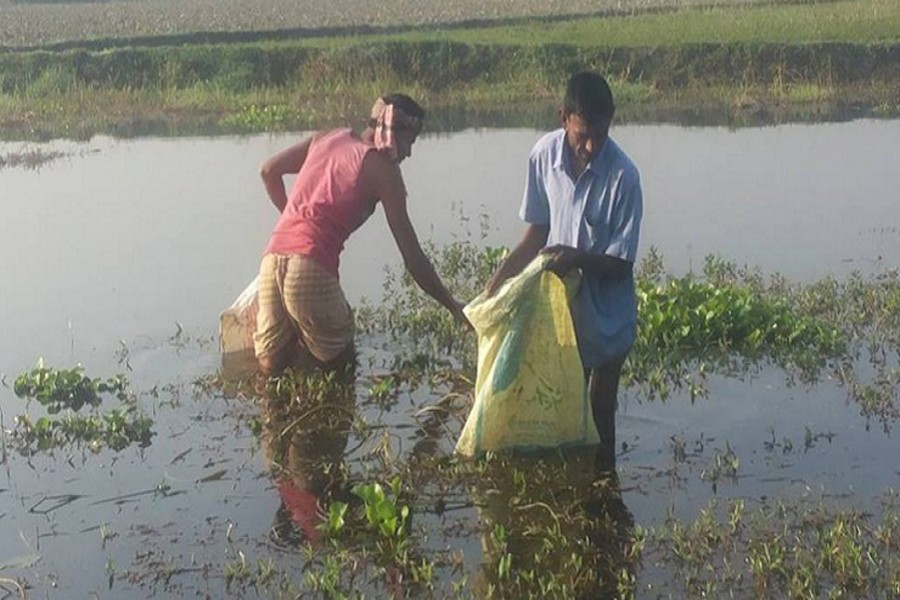
PABNA, Nov 25: Snail killing is going on unhindered in various canals, wetlands, Chalan Beel and different other waterbodies in Bera, Chatmohar and Santhia upazilas of Pabna district, which has a good name for its food grains and fish reserves.
The local Department of Agricultural Extension (DAE ) office is concerned that the indiscriminate killing of snails would not only threaten the biodiversity of the canals but also reduce the fertility of the cropland.
Official sources said as per government rules, collecting, destroying, eating, transporting, buying and selling, importing and exporting snails are punishable offenses.
The sources added these aquatic creatures are hunted in various waterbodies of Bera upazila from the middle of the monsoon season until the water recedes.
It was found that as the water level started falling, several thousand tonnes of snails were caught from various canals and wetlands, including Chalanbeel in Chatmohar, Muktarbil in Santhia upazila, Beel Gangbhanga, Gazaria, Ariadahbeel, Jordahabeel, Natun Bharenga, Tangragari, Kajalkura, Dhalai and Bakkar Beel of Bera upazila in the district.
The number of snails in the water bodies has remarkably decreased in the past four to five years. Many people, without knowing it, go out in boats every day to hunt snails for extra income. From morning to afternoon, they collect snails using ladder nets, hessian nets, and hands and load them into boats. Later, those snails are being sold to wholesalers at a price of Tk 5 to 7 per kg.
Meanwhile, snails and mussels are now on the verge of extinction somewhere due to excessive use of pesticides in farmlands.
Zoologists fear that if snails, known as nature-friendly creatures, are collected in this indiscriminate way, the natural balance will be destroyed. They believe that if snails are collected in this way, they will eventually disappear from nature. This will disrupt the balance of the environment. As a result, problems will arise in the normal life cycle of various types of fish and aquatic animals. Therefore, they believe that snails should not be killed in this way to protect the natural balance.
It can be seen on the ground that women and men are collecting snails from different streams in Notun Bharengo village of Bera upazila and bringing them by boat to sell them at a price of Tk 5-7 per kg. And wholesale traders sell them to various poultry and fish farmers at a price of Tk8 to 10 per kg. Around 1,500 to 2,000 kgs of snails are traded here every day.
Monowar Hossain, a snail hunter from Bharenga area, told the FE that there is not much work to do during the rainy season. So they collect snails using ladder nets and hessian nets. When the water level is low, snails can also be caught by hand. They sell them to traders at a price of Tk 5-6 per kg.
Maleka Begum, a snail hunter from Tarapur area, said, "We are poor people. I take my younger daughter and a boat to collect snails from the stream near my house to earn a living. I collect 70-80 kg of snails every day. This fetches an income of Tk 350 to 400.
Ajit, a businessman from Bakchar village, said
that during rainy season, a lot of snails are available in their area. People from the riverbank collect snails of different sizes. they buy these snails and sell them in bags in Khulna.
"We sell an average of 300 bags of snails from here every day. However, traders buy more snails in other places of Bera,"
he added. He also said that they did not know at all that buying and selling snails were punishable crimes.
Meanwhile, many have
been worried about nature getting imbalanced this way due to the unplanned destruction of one of the components of the biodiversity through the killing of these creatures in the local canals and wetlands.
The DAE believes that the natural environment would be under threat and fertility of the cropland may also decrease if the practice of snail killing is not stopped.
Bera Upazila Fisheries Officer Nasir Uddin told The Financial Express, "Snails filter the water. They are also food for large fish. Just as snails are needed in the water, they can also be killed if there are excesses. However, if there are excess snails anywhere, it is necessary to survey them and collect them in that way."
Md. Jahangir Alam, deputy director of the DAE in Pabna, told the FE, "Snails protect water in the waterbodies from rotting. A snail constantly refreshes the water. Snails are harmless aquatic animals. Snails also maintain the balance of the environment and clean the water. They are friends of nature and humans."
Assistant Director of the Department of Environment, Pabna, Md. Molin Mia, told the FE, "Excessive harvesting of snails can destroy the natural balance and food chain. I am not aware of the collection of snails in that area. Steps will be taken to protect the natural balance after investigation."
Contacted, Wildlife Inspector of the Rajshahi Divisional Wildlife Management and Nature Conservation Dr Md Jahangir Kabir said, "Snails are
called natural water filters. Snails live by drinking dirty water, which keeps the water clean. If there are no snails in the water, the natural purification capacity of the water decreases. Snails also act as fertiliser in the paddy fields in
the water."
According to the Wildlife (Conservation and Safety) Act-2012, collecting, destroying, eating, transporting,
buying and selling, importing and exporting snails, etc. are punishable offenses. The maximum penalty is two years' imprisonment and a fine of up to Tk 0.1 million (1 lakh).
motiarfe@gmail.com