
Social costs of economic migration
Afsan Chowdhury | Friday, 21 July 2023
There are several kinds of migration but economic migration dominates in Bangladesh. People migrate in order to survive economically in internal migration. And in external migration they do so to improve their standard of living. Early migration of Sylhetis to the UK was such an example. It was also a permanent migration like in case of current migration to UK, USA and Canada.
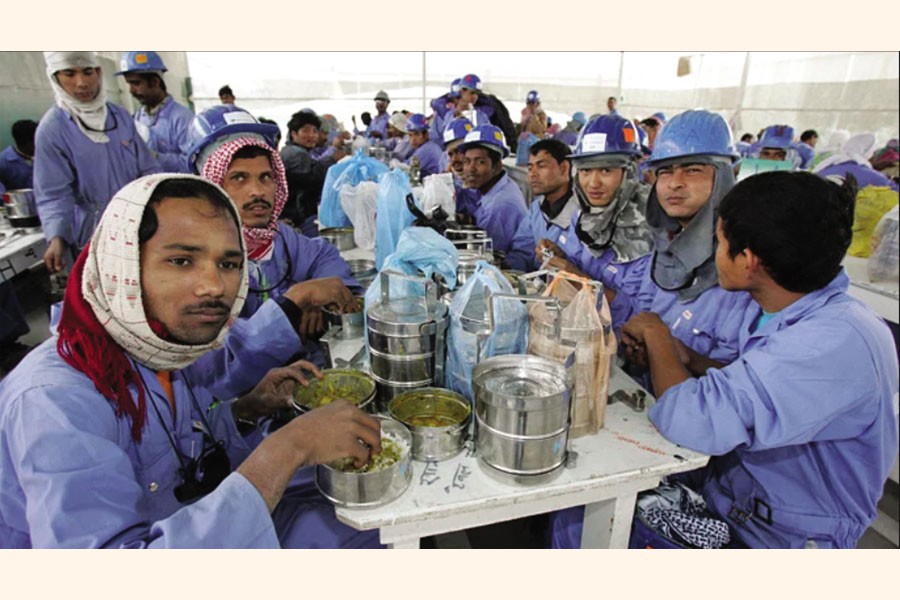
However, most economic migration is short term. The objective is to find well paid work abroad and remit money home. This type of migration is also class driven. Most remittance migrants who go to the Middle East and SouthEast Asia are not from the better off classes but aspire to become one.
REMITTANCE AND FAMILIES OF MIGRANTS : Migration is not just the second largest foreign exchange (forex) earning sector but also one of the most socially influential one particularly in rural areas. However, while everyone pays attention to the remittance rate, particularly through official channels, very little interest is seen on the social cost and life of migrants. The social challenges and difficulties that migrants and their families face back home are ignored.
Shoriful Islam, Associate Director of BRAC's Migration pragramme says, the social cost is not being taken into account. "These migrants are away from home and families for years. This creates distance among family members due to denial of the right to family life to all members. Many fathers are away much of their life and while their economic role is fulfilled, the rest are not. Both children and spouses of migrants face many crises that are unable to resolve. It needs urgent attention."
These thoughts are echoed by Pervez Siddiqui , Focal point, Migrants constituency, Asia Pacific CSO Engagement Mechanism (APRCEM). He expressed dismay over the lack of concern for social and personal issues surrounding the migrants.
"We have been studying the impact of migration, both external and internal, on social and cultural life for some time. We think focusing mostly on the economic aspect has actually caused many issues to emerge that have led to higher rate of failed migration."
"Family life is threatened due to various factors produced by migration. Most problems are not discussed at all. A family member who is away for years can't be part of the family and thus the socio- familial structure is under immense pressure in Bangladesh for all migrants. "
CAN MIGRATION GOVERNANCE STRUCTURE HANDLE THIS? : The Migration Governance Framework was a joint effort between IOM and the Government of Bangladesh (2017). It was intended to "guide the policy direction of the Government of Bangladesh and facilitate the implementation of results-based planning and reporting on the efforts and progress made towards migration governance in the country. The overall goal of the framework is to establish a mechanism to ensure safe migration."
This plan shows that the priority is on safe departure rather than a safe migration linked to the entire life cycle of a migrant. It's true that the Government of Bangladesh (GOB) has added some social benefits including stipends/scholarships to the children of migrants and a few other benefits but they are inadequate. IOM is the promoter of this policy but their focus is on safe migration not a safe family life of the migrant family at home or abroad. Thus a safe departure and significant length stay ensuring that economically benefits the family and the national coffer is the focus of the policy.
Shoriful Islam adds, that their workers try to ensure that migrant's families can avail the existing benefits properly they are entitled to but they need more. " They are entitled to many more benefits but they are not treated right at any level , not even at the airport. We need to develop a macro policy covering all aspects of a migrants life."
NOT JUST DEPARTURE FACILITATION : Given existing research and surveys, the migration sector is large, financially successful but socially ignored. This needs to change for the benefit of migration itself. Both Shoriful and Pervez agree that the cost of ignoring social costs are high and may dampen the sector itself. Given Bangladesh's dependence on migration income, this is a high risk matter.
There are many costs that are being added by migrants' social and family life crisis that are also costly in the long term to themselves and to their family members. The need for a comprehensive policy that stretches from the phase of intent to migrate, to safe migration, to management of life at origin and reintegration after returning home.
It must be put in a single comprehensive framework to make this sector viable in the long term. That adds value to everyone's life and not just the dollar reserve which itself will be threatened if high social costs beyond tolerance becomes part of the external migration brand.
afsan.c@gmail.com