
Solar roadmap can slash SME costs up to 50pc
Says Change Initiative report
FE REPORT | Sunday, 29 March 2026
Bangladesh's SMEs can achieve a 30-50 per cent reduction in operational costs through decentralised rooftop solar while securing long-term export competitiveness by meeting environmental and natural standards, said a report of Change Initiative on Saturday.
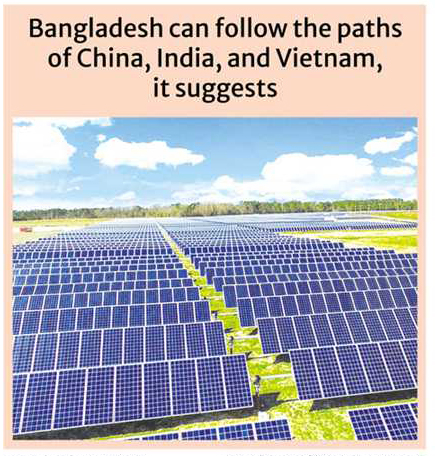
On this purpose, Bangladesh can follow the paths of China, India, and Vietnam, suggested the study report.
Bangladesh's small and medium enterprises' (SMEs), center of the country's climate and industrial future, targeted some interventions in Bangladesh Small and Cottage Industries Corporation (BSCIC) industrial estates that could unlock over 14.09 million tonnes of CO2 emission reductions and generate up to 0.40 million USD revenue through carbon credit annually, the study added.
The study findings were shared at a press conference in the city, including a detailed factory-level assessment of energy use and CO2 emissions across selected SME clusters.
SMEs account for more than 90 per cent of industrial units, employ around 85 per cent of the industrial workforce, and generate 25-30 per cent of GDP, yet operate within an energy system where approximately 95 per cent of electricity is fossil-fuel based, which is highly exposed to global volatility.
The research focuses on four high-impact sectors within BSCIC industrial estates, tannery, plastic manufacturing, plastic packaging, and light engineering, which together are estimated to emit 46.99 MtCO2e (Million Tonnes of Carbon Dioxide Equivalent) annually, with a technically feasible reduction potential of 14.097 MtCO2e per year.
Sectoral analysis reveals significant efficiency gaps and intervention opportunities: Tannery up to 19-33 per cent emission reduction potential, light engineering: 19-31 per cent reduction potential, plastic manufacturing with highest potential at 33-49 per cent, packaging 15-28 per cent reduction potential.
The key finding highlights the transformative potential of estate-scale solar deployment.
Allocating just 10 per cent of BSCIC estate space could install approximately 57 MW of installed solar capacity, generate 82,968.88 MWh annually, and reduce emissions by 51,440.71 tCO2e 4per year.
M Zakir Hossain Khan, lead researcher, emphasised the structural implications of the findings: "While global conflicts threaten to turn out our lights and air pollution steals years from our lives, our factory rooftops sit idle."
BNP's renewable energy vision must move beyond targets to ensure energy sovereignty, by reducing import dependence and delivering reliable, affordable power to SMEs, which drive Bangladesh's economy and employment, he said.
The keynote presentation was delivered by Co-Researchers Sabrin Sultana and Najifa Alam Torsa. The study combines machine-level energy assessments, production mapping, and verified electricity data to build a robust emissions baseline.
Khan said, "We have 14 million tonnes of carbon at stake and a 50 per cent cost-saving opportunity at hand. We must stop importing our energy and start generating our sovereignty. Tax breaks, incentives and innovative financing tools like progressive carbon tax and philanthropy grants can play vital role in reducing fiscal burdens and debt trap risks."
nsrafsanju@gmail.com