
Meeting energy demand by 2025
Solar system cheapest option for BD: BNEF
FE REPORT | Tuesday, 3 October 2023
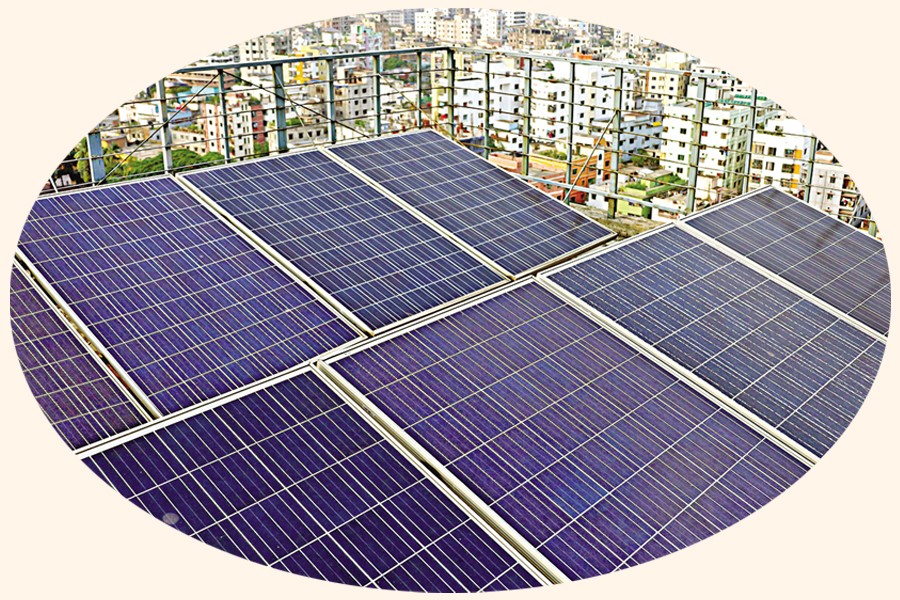
Renewables, particularly solar energy, are set to be the cheapest option for Bangladesh to meet growing electricity demand by 2025, according to a new report by research firm BloombergNEF (BNEF).
Solar system becomes the cheapest option, thanks to continued technology-cost reduction by 2025, reports the BNEF.
By 2030, it said, solar system, paired with batteries, would also achieve a cheaper levelised cost of electricity (LCOE) than new thermal power plants.
Electricity from onshore winds, paired with batteries, would also become cheaper than new thermal plants by the mid-2030s.
The report styled 'Bangladesh Power Sector at the Crossroads' was released during an online press briefing on Monday.
The cost of electricity generation from a new solar power plant is already competitive with those of new coal and gas power plants in Bangladesh.
LCOE, a financial measure used by developers and investors, for a new utility-scale solar project in Bangladesh costs at $97-135/megawatt hour (MWh) as of Monday, according to BNEF analysis.
On the other hand, it costs $88-116/MWh for a combined cycle gas turbine (CCGT) and $110-150/MWh for a coal-fired power plant.
The report, however, said Bangladesh's heavy reliance on fossil-fuel thermal power plants has reduced its energy security, while draining its foreign currency reserves and increasing local pollution.
In addition, further expansion of fossil-fuel thermal power plants would jeopardise the country's energy security and affordability.
Despite cost competitiveness of renewables, Bangladesh is considering building more thermal power plants on the assumption that such power plants can run on cleaner fuels such as hydrogen or ammonia post 2030.
The BNEF analysis shows that retrofitting thermal power plants for hydrogen or ammonia will not be more economic than building renewables.
By early 2030s, new utility-scale solar power plants will be cheaper than even the cost of running existing thermal power plants.
The same will occur for onshore wind by early 2040s.
"Deploying renewables presents economic and environmental benefits for Bangladesh," said Caroline Chua, co-author of the report.
"Renewables can improve the country's energy security by lowering dependence on LNG and coal imports while also creating new job opportunities."
"Our sensitivity analysis shows that even if fossil fuel prices decline, renewables will still be more economic than thermal power plants," added Ms Chua.
"Building more thermal power plants on the assumption that they can be retrofitted for clean hydrogen or ammonia in the future will saddle Bangladesh with significant financial risk," said Isshu Kikuma, another author of the report.
"Bangladesh is better off accelerating deployment of renewables and limiting additions of thermal power plants."
Shahriar A Chowdhury, director for the Centre for Energy Research at the United International University in Bangladesh, said, "In the recent past, the growth and interest of renewable energy like solar and wind power have accelerated in Bangladesh."
"They [renewables] have gradually become more cost-effective options for electricity generation."
In contrast, technologies like hydrogen, ammonia and carbon capture, which are highlighted in the draft Integrated Energy and Power Master Plan (IEPMP), have no similar track record till now.
Therefore, proven technologies like solar and wind should be focused in any power or energy-sector master plan, with clearly defined significant shares in the energy mix, added Mr Shahriar.
He, however, said it appears from the draft IEPMP that the country's renewable energy potential has been ignored or underestimated.
"The IEPMP should highlight the needs of the present and predictable future, and outline the strategy to fulfill the energy needs of Bangladesh, while not making commitments to industries and technologies which evolve rapidly and unpredictably."
arafataradhaka@gmail.com