
South Asia: navigating through Trump tariffs
Muhammad Mahmood | Monday, 8 September 2025
As President Donald Trump pursues global tariffs, working families in the US face higher costs and a weaker job market. Paul Krugman noted that key US economic indicators are taking on an increasingly stagflationary tone. He further observed that there is widespread agreement among economists that tariffs tend to fuel inflation. Jeffrey Sachs described Trump's tariffs as a self-defeating policy that harms U.S. strategic interests.
Trump's Tariff measures signify the destruction of the post-war trading order put in place after the disaster of the 1930s and WWII. The post-war trading order was based on the lowering of tariffs and the removal of restrictions. These measures were not only aimed at promoting economic growth but had also a profound geopolitical content. These were based on an understanding drawn from the experience of the 1930s that a world economic order in which countries sought to protect and advance national interests through tariffs and other restrictive measures led inexorably to military conflict.
Trump has used US consumer access as a key bargaining tool to pursue economic, technological, environmental, and geopolitical goals. Trump administration's push for domestic manufacturing is making the US market less accessible to foreign sellers. Trump is also moving from bilateral tariffs to widespread implementation of tariffs covering such key sectors as pharmaceuticals, semiconductors, autos, and metals.
The US has activated tariffs on imports from more than 90 countries ranging from 10 per cent to 50 per cent - the highest average tariff since 1933.It is estimated that these tariffs will cost $ 2,400 to an average US household.
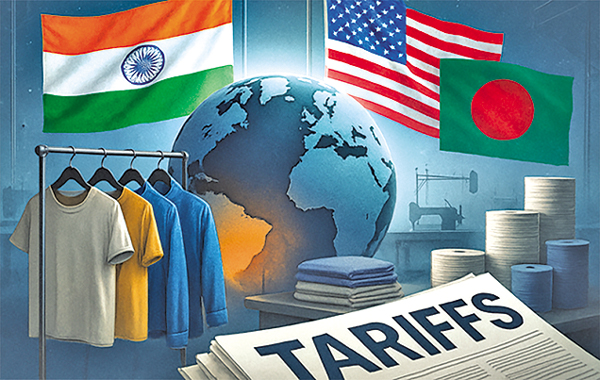
Bangladesh has negotiated a 20 per cent tariff on exports to the U.S., down from the 37 per cent initially proposed. It is claimed that the deal balanced support for US agriculture and protection of Bangladesh's garments exports to the US. The effective tariff on garments is about 36 per cent when existing duties are included. In 2024, Bangladesh exported goods worth nearly $8.4 billion to the US, of which US$7.34 billion were ready-made garments (RMG). More than four million people work in the RMG industry in Bangladesh. The chief negotiator said, "Protecting our apparel industry was a top priority, but we also focused our purchase commitments on U.S. agricultural products. This supports our food security goals and fosters goodwill with U.S. farming states."
One of the objectives of Reciprocal Tariff is to expand market access for US agricultural products to bridge trade gap. In fact, Bangladesh mostly imports agricultural products from the US among others.
In 2023, the share of agriculture in Bangladesh's gross domestic product (GDP) was 11 per cent, but the sector is a significant employer, with approximately 45 per cent of the total labour force engaged in agricultural activities. Also, a high proportion of rural women are engaged in farm activities.
Therefore, importation of highly subsidised US farm products could pose a threat to the livelihood of marginal to small farmers and farm labourers notwithstanding the impact on country's drive to attain food grain self-sufficiency. As Bangladesh considers importing highly subsidised agricultural products, it should communicate to the US administration that such products will be subject to Countervailing Duties (CVD), also referred to as anti-subsidy duties.
It appears Pakistan has emerged as one of the few winners in the region from tariff negotiations. Pakistan was successful in securing 19 per cent tariff rate coming down from the initially proposed rate of 29 per cent. 60 per cent of Pakistan's exports to the US is made up of textile products, as such it is now in an advantageous position compared to regional competitors.
Sri Lanka was successful in negotiating a reduced tariff rate from 44 per cent to 20 per cent. The US is Sri Lanka's single largest export market accounting for a quarter of its total exports globally.
Nepal received a lower baseline tariff rate of 10 per cent. Tariff effects will be minimal, but concerns are rising about other countries using Nepal for transshipment to the US. The United States is likely to examine these practices, which could have implications for Nepalese exports to the US.
The U.S. tariff rate on the Maldives is a universal 10 per cent. Maldives was not explicitly named as a country facing the new tariffs in a list of countries with small export volumes to the U.S. This tariff is relatively low compared to others, and Maldivian officials believe it will have little direct impact on their main export--fish products.
The case of India in this regard is far different from other Asian countries. The US imposed 25 per cent tariffs on most goods arriving from India after the two countries failed to conclude a trade deal. This was followed by an additional 25 per cent punitive duty for New Delhi's continued purchases of crude oil from Russia resulting in a total import tax of 50 per cent. The Trump administration insists that it wants India to stop buying and then reselling discounted Russian crude oil to bypass US sanction. India's imports of crude have indeed soared.
Reacting to the US stance on India, Indian trade minister Piyush Goyal said New Delhi would not "bow down" to Washington's pressure and would instead focus on finding new markets. Moscow, meanwhile, has denounced US tariffs on India, stressing that sovereign nations have every right to choose their trading partners. Trump's Trade Adviser Peter Navarro has retorted citing India as the "Maharaja of Tariffs", and accused New Delhi of running a "profiteering scheme" by continuing to import Russian oil. Navarro further added, "Prior to Russian invasion of Ukraine in February 2022, India virtually bought no Russian oil… It was like one per cent of their need. The percentage has gone up to 35 per cent…They do not need the oil. It is refining profit-sharing scheme."
On The News Today, former RBI Governor Raghuram Rajan, referring to Trump tariff on India, terms the move "deeply distressing" and a blow to US-India relations that will harm Indian exporters of shrimp and textile products. Rajan suggests this is a critical moment for introspection, stating, "This may be the wake-up call to get us to do that." He advocates for India to diversify its trade dependencies, avoid reacting in anger, and use this as an opportunity to accelerate domestic reforms to enhance the ease of doing business and achieve higher economic growth.
President Trump has once again criticised New Delhi after Indian Prime Minister Narendra Modi took part in bilateral and multilateral meetings in Tianjin, China with Russian President Vladimir Putin and Chinese President Xi Jinping. Trump said Washington's relationship with New Delhi has been "one sided" for decades.
But Modi has no intention to rupture the relationship with the US. On way to the SCO meeting in Tianjin, he stopped in Tokyo where he praised the QUAD-- a military pact with Australia, Japan and the US designed against China.
In the 2024-25 fiscal year, bilateral trade between India and the US stood at US$131.8 billion, with a trade surplus of US$41.18 billion in favour of New Delhi. Trump further alluding to the recently signed deal with Pakistan to jointly develop that country's oil resources rubbed more salt to India's wound and said, "Who knows, maybe they'll be selling oil to India someday".
Modi, however, has maintained close security ties with the US through the QUAD, an alliance aimed at countering China's economic rise while simultaneously acting as a principal architect of a more assertive BRICS, a grouping of countries for which Trump has extreme hostility. India is also involved in the Shanghai Cooperation Organisation (SCO) and the Asian Infrastructure Investment Bank (AIIB), where China holds a leading role including BRICS.
Under the Modi government, especially during the last five years, India has integrated itself into a web of bilateral. trilateral and quadrilateral military-security ties with the US. In fact, for two decades Indian government whether under Modi's BJP or the Congress party have made New Delhi's "global strategic partnership" with the US the cornerstone of India's foreign policy.
With the Trump tariff likely to take a heavy toll on India's exports, it is indeed difficult to foresee whether the current state of bilateral relations will linger on, or will there be a new twist given the geo-political perspective.
muhammad.mahmood47@gmail