
South Asian cooperation in handling migrants in crisis
Md. Ansar Uddin Anas | Tuesday, 5 May 2015
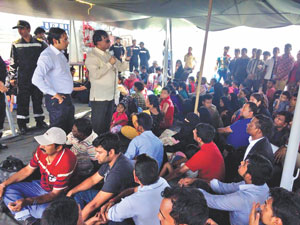
Finally, Bangladeshi migrant workers, trapped in war-torn Yemen, have escaped from hazards of the war but at a high price. They can not forget the nightmare of Sana. And now they will be haunted by the lost dream of a better life.
Since December 2014, the Arab countries and North African region have been at the centre of international attention as a series of uprisings are threatening the stability of some governments. Added to these is emergence of Islamic State militants in vast territories. This conflict, termed as Arab Civil War (Shia-Sunni war), has posed great challenges for hundreds of thousands of migrant workers based in this region. Incidentally, most of them come from South Asia.
The crisis in the whole region has been further escalated by the recent open war between Saudi-led Arab forces and Huti militia of Yemen. Governments of migrant countries of origin have been pressed to respond mounting large-scale and simultaneous operation to evacuate their citizens from the volatile cities like Eden, Sana and other strife-torn areas.
In the face of these growing conflicts and war in large areas of Arab countries, crisis of the migrants is at the centre of international attention today. Different non-state actors like Islamic State (IS), Huti militia, Ansar e-Din and many others have emerged as a new threat not only to the involved states or region, but also to the migrant workers working there in those countries.
In the same fashion, many Bangladeshi and Indian workers were held hostage by the IS in Iraq and Libya despite their non-involvement in political processes and changes in those countries of the Arab World. With these growing numbers of terror groups and kidnapping for ransom on the rise, protection of migrant workers has become a burning issue especially in South Asia that sends them in large numbers abroad.
In 2011, more than 40,000 Bangladeshi migrant workers were forced to flee the raging war zones in Libya. Thousands more had to return home due to the growing conflict and insurgency in Syria and Iraq. In Yemen alone, around 50,000 civilians were forced to flee, according to the IOM whereas a significant number of these migrants are South Asians including Bangladeshis.
All these migrants are now exposed to a number of policy and procedural issues like whom we should make responsible (origin or destination country), how the problem should be addressed and how to trace the undocumented labour force to provide services during crisis periods. South Asian countries are facing these common problems that have emerged from the Arab crisis.
Just think about the recent Yemen crisis. The Bangladeshi expatriates in Yemen found themselves helpless amid the ongoing violence. They had been waiting to escape but did not dare to come out of their houses for fear of falling in the line of fire.
The Bangladesh authorities were at first a bit confused as to how to tackle the problem as Dhaka has no embassy or mission in Yemen and there was lack of information. Through G2G (government-to-government) negotiation, the Bangladesh government eventually persuaded India to bring back the Bangladeshis home.
Thanks to the Indian government for helping Bangladeshi migrant workers escape from Yemen. Such a goodwill gesture by Delhi has further strengthened our bilateral relations.
India's evacuation of nearly 5000 migrants, including Bangladeshis, from Yemen has shown the way how governments of the South Asian region should handle such a situation collectively. A joint commission should be formed by the SAARC member-states to address emergency crises of their migrant communities.
The SAARC members should also agree on regular sharing of information during crisis period and appointing permanent evacuation staff under the embassies.
A memorandum of understanding (MoU) should be signed by the member-states to address the issues of humanitarian responses during emergencies. An emergency fund should be created by member-states to deal with issues of compensation, rescue operation and financial assistance for the affected migrant workers.
The SAARC member-states should agree to act promptly to face the crisis where there are no embassies in countries of conflict. As this crisis is more perilous, the circumstances are more turbulent, and diplomatically it is always a tightrope walk, let us agree on cooperation and strong coordination among the member-states of the SAARC in the field of migrants who are mostly from the region.
The writer works with the Refugee and Migratory Movements
Research Unit (RMMRU).
anasbd1990@gmail.com