
A CLOSE LOOK
Sports and games: where one ends, the other begins blurring the margin
Nilratan Halder | Saturday, 12 July 2025
 There may hardly be a healthy child on this planet, who has not taken part in any kind of games and sports in childhood. But when it concerns outdoor games and sports, only a small fraction of the urban children are fortunate to participate in such physical and entertaining activities. Sadly the number is fast declining courtesy of the smartphone and the computer on which a different digital variant of game is played.
Usually sports and games are uttered together in the same breath. Do the two words mean the same thing? To most people there is no difference between game and sport. But, of course, there is a subtle difference between them. Games are all competitive physical or mental activities with entertainment values. But those can be played between and among friends and even members of a family in order to pass time. It is competitive but mostly a fun. The participants enjoy the physical or mental contests usually in a light but on rare occasions in serious mood. There is no question of winning a trophy unless a tournament is organised even in a village or an urban borough or a ward. However, games can turn into sports when a school's annual sports meets are held. Significantly, it is never annual school games.
What transpires from this difference is that physical or mental competitions are categorised as games and sports. Broadly, such competitions are games when they are played indoors but those can remain games even if they are played outdoors. A game of cards is normally a pure entertainment affair unless it is used for gambling or betting. If its bridge variety is a four-people affair, patience solitaire can be played by a single person. Bridge competitions can be held at local level as well as the world level. There are many other forms of card games. Yet none of those is a sport rather falls under the category of game. So are a host of indigenous contests ---both indoors or outdoors. It may be what is known as "Bagh Bandi" (Trapping of tiger) which requires hardly any tool except a plain surface on earth where lines are drawn with anything handy like a brick chip to fashion the court and a few small pieces of stick or chips similar to the one used to draw the lines. Then there is a whole range of games such as ha-do-do or kabadi, gollachhut, dariabandha etc.
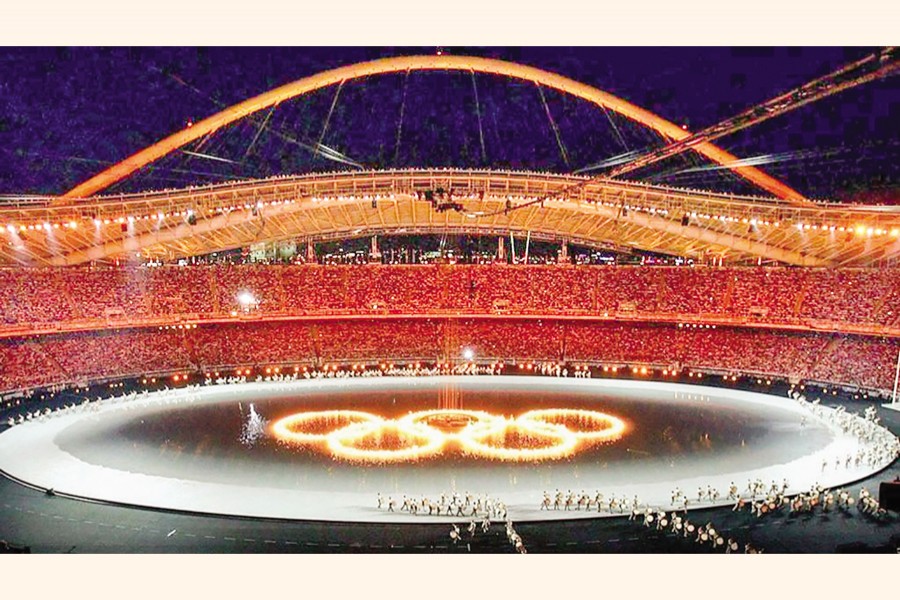
Usually, individual outdoor physical contests qualify to be sports. Athletics are synonymous with sports. From 100m sprint to marathon, from long jump to high jump to pole vault ---all are sports. The Olympics held every four years is the ultimate venue of athletics at the highest level and yet, intriguingly, the word carries with it the burden of games. They are known as Summer Olympic Games or Winter Olympic Games. In Olympic competition, individual skill and excellence are exhibited at their best. But then the inclusion of badminton, tennis, volleyball and even football ---all of which have circuits or leagues or other more elevated competitions such as grand slams in tennis--- round the year where competitors earn fabulous sums of money. Yet an Olympic medal is a highly coveted one not even the best in the business in such games and sports would like to ignore. They would very much want to add the gold medal to their trophy case.
There is another distinct definition. Even the top footballers are players, not athletes. Similarly, the masters of hockey, volleyball, basketball and tennis are all players. But if the physical fitness, skill, endurance and stamina of tennis players are taken into consideration, theirs is on a par, if not more, with the gruelling process of the more demanding discipline of athletics. When they play five sets for five hours or more to win over a rival, it takes the ultimate test of a person's physical and mental abilities. Boxing may be a brief affair but it too is highly taxing. It is also a sport not game. A sprinter or a javelin thrower or a pole vaulter is never a player but certainly an athlete.
At times the difference between game and sport may blur when team games are considered on their own merits. Archery may be a sport but beach volleyball can be both game and sport. Swimming and diving are thus aquatic sports where gymnastics are the finest sports on apparatuses.
Sadly this country is engrossed only with cricket; and football comes next. The problem with such tunnel vision is that sportsmanship has not flourished here. Even sports journalism appears to be primitive because most of the time the sports pages of newspapers give the impression that there is no other game except cricket and football. Right at the moment Wimbledon tennis, one of the four grand slams, is in progress and about to come to an end. But the sports pages are so miserly in carrying the tennis news that speaks volume for the poor state of sports enthusiasm.