
Stakeholders push tax incentives, mandatory listings to deepen market
FE REPORT | Thursday, 2 April 2026
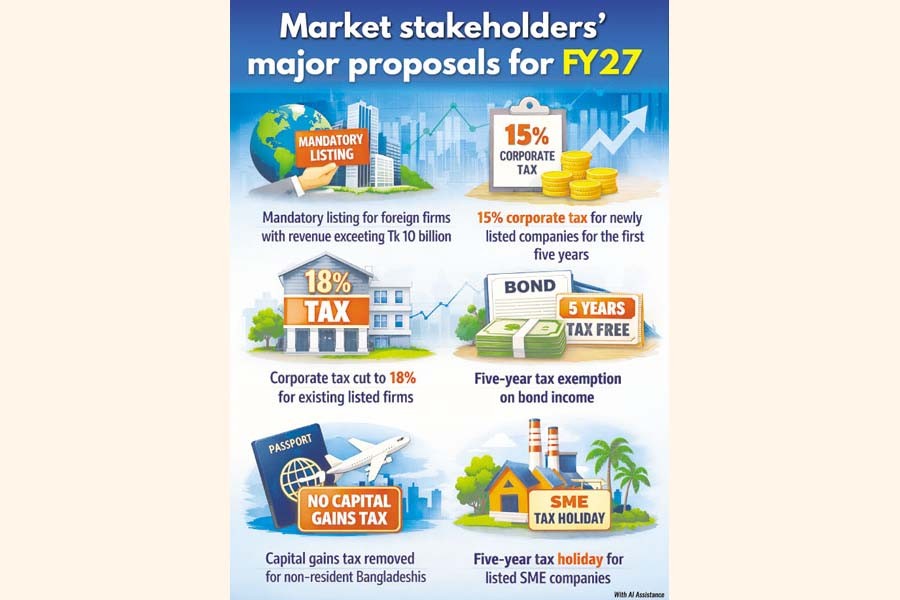
Capital market stakeholders have proposed a set of fiscal and policy recommendations for the upcoming national budget, aimed at boosting corporate listings, attracting investors, and deepening market liquidity.
Despite steady GDP growth and the expansion of the corporate sector, the number of listed companies and overall market capitalisation in Bangladesh remain low compared with peer economies in Asia.
At present, the country's market capitalisation represents approximately 15-18 per cent of GDP, while comparable markets maintain ratios between 40-80 per cent.
Leaders of the Bangladesh Merchant Bankers Association (BMBA), Dhaka Stock Exchange (DSE), Chittagong Stock Exchange (CSE), and DSE Brokers Association of Bangladesh submitted their proposals for FY27 to NBR Chairman Abdur Rahman Khan.
At a pre-budget meeting on Wednesday, they also proposed a specific tax strategy for the qualitative development of the capital market.
The NBR chief, however, said tax benefits alone could not help develop the market; rather, good governance is necessary to regain investor confidence.
Large foreign companies must be listed: BMBA
Many large corporations, including conglomerate subsidiaries, infrastructure firms, and multinational affiliates, operate profitably yet remain unlisted, the BMBA said, stressing that the lack of large, high-quality securities discourages both institutional and foreign investment.
The BMBA proposed that foreign companies with long-term local operations and revenue surpassing Tk 10 billion be listed, with at least 20 per cent of shares issued to the public.
Moreover, firms with paid-up capital above Tk 5 billion, annual turnover over Tk 10 billion, or bank borrowings exceeding Tk 5 billion must be listed.
If they remain unlisted, they should face a 3-5 per cent surcharge, according to the BMBA proposal.
The association highlighted that the country's financial system remains bank-centric, with most corporate financing sourced from banks rather than equity or bond markets.
The BMBA proposed a wider tax gap between listed and non-listed companies to motivate corporations to enter the capital market.
It suggested reducing corporate tax to 18 per cent for listed firms and to 15 per cent for newly listed companies for the first five years.
"This policy will provide clear financial incentives for companies to list on the stock exchange," said the BMBA.
Several regional economies-including India, Malaysia, and Indonesia-have successfully implemented similar policies to deepen their capital markets.
Currently, listed firms-other than banks, insurers, financial institutions, mobile operators, and tobacco companies-that have issued more than 10 per cent of shares to the market pay 20 per cent corporate tax, while their non-listed peers pay 25 per cent, subject to compliance with certain conditions.
No new initial public offerings (IPOs) have entered the secondary market in the past two years.
To encourage new listings, the BMBA proposed temporary tax relief for listings before 2030, including a 50 per cent corporate tax reduction for the first three years and a 25 per cent reduction for the following two years.
DSE suggests tax exemption on capital gains, bond income
The DSE has placed a seven-point proposal, including a five-year exemption from capital gains tax for non-resident Bangladeshis to boost foreign investment inflows and market liquidity.
Foreign investors have continued to withdraw funds from Bangladesh's equity market over the past few years amid persistent macroeconomic uncertainties.
"Non-resident investors may be exempted from capital gains tax on securities for five years, which is expected to boost foreign fund inflows and market liquidity," said DSE Chairman Mominul Islam in a budget proposal.
Additionally, the prime bourse also sought a reduction in capital gains tax to 5 per cent for individual investors, considering the current market situation.
Currently, individual investors have to pay 15 per cent capital gains tax if their income from share trading exceeds Tk 5 million.
The DSE also proposed a five-year tax holiday for listed SMEs to support new business growth and employment.
The prime bourse further proposed removing investment limits on mutual funds, ETFs, and unit funds, allowing retail investors greater access and helping stabilise market volatility.
DSE Brokers Association presses for removal of double taxation
The DSE Brokers Association (DBA) insisted on removing double taxation to ensure stability and sustainable growth of the capital market.
Individual investors currently face double taxation on dividend income-they pay tax at source and again in their income tax returns.
As a result, the effective tax rate can reach up to 40.5 per cent. "This discourages sponsors and directors from declaring cash dividends and leads high-net-worth investors to move away from dividend-based investments," said Saiful Islam, president of the DBA.
To address this, he proposed treating the tax deducted at source as the final tax liability for individual investors. "We believe this will simplify the tax framework and eliminate the burden of double taxation."
The DBA has also emphasised removing tax inequities in the mutual fund sector. Currently, only investments up to Tk 500,000 qualify for tax incentives for retail investors.
The DBA proposed removing this limit so that any amount invested can benefit from tax relief. "This measure is expected to boost institutional investment and ensure stable fund flows in the market."
Association of Bankers Bangladesh calls for removal of 'super tax'
The Association of Bankers Bangladesh (ABB) has proposed tax reforms to boost investment and develop the bond market.
It called for removing the Tk 0.5 million cap on tax-related investment in government securities and making capital gains from Treasury bills and bonds tax-free instead of the current 15 per cent rate.
The ABB also sought the withdrawal of the 10 per cent "super tax" on stock dividends and retained earnings transfers by listed companies. Currently, companies face additional tax if stock dividends exceed cash dividends or if retained earnings transfers exceed 70 per cent of post-tax net income.
The association argued that such taxes hinder banks' ability to strengthen their capital base, noting that scheduled banks are required to maintain a minimum capital adequacy ratio of 12.5 per cent of risk-weighted assets.
CSE seeks five-year tax holiday for commodity exchange
The CSE recommended introducing a five-year tax holiday for a newly formed commodity exchange to facilitate its implementation and related infrastructure development.
It pointed out that high withholding tax and VAT on technical and software services significantly increase operational costs. It proposed reducing tax rates and establishing a clear framework for importing essential stock exchange software, noting that the current tax burden exceeds 40 per cent.
babulfexpress@gmail.com