
EXPORTS STAGNATE IN INDIA
Steel manufacturers eye market diversification
JASIM UDDIN | Thursday, 19 March 2026
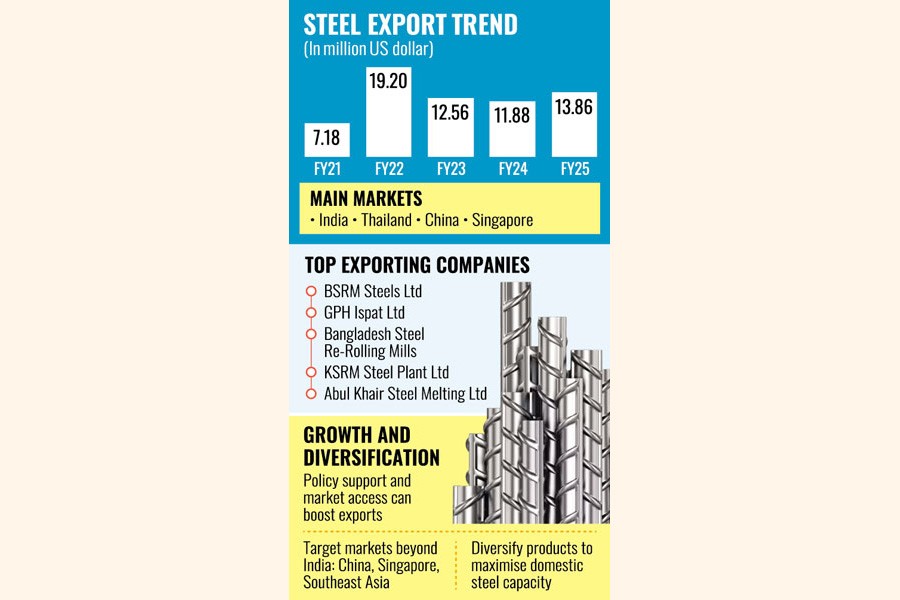
Bangladesh's iron and steel exports have experienced significant fluctuations over the past five fiscal years, with India remaining the dominant destination -- raising concerns over market concentration and stagnation.
Industry stakeholders have stressed the need for policy support, product diversification, and strategic market expansion to ensure sustainable growth in Bangladesh's steel exports.
According to data from the National Board of Revenue (NBR), export earnings from iron and steel (HS Code: 72142000) stood at $7.18 million in FY2020-21, before rising sharply to $19.20 million in FY2021-22.
However, the momentum could not be sustained, as exports fell to $12.56 million in FY2022-23 and further to $11.88 million in FY2023-24.
In FY2024-25, export receipts recovered modestly to $13.86 million, indicating only a partial rebound amid weak external demand.
Industry insiders attributed the volatility to shifting regional demand, pricing challenges, and supply-side constraints, including higher raw material and energy costs.
India has consistently remained the principal export destination for Bangladeshi steel products.
Although Thailand briefly emerged as a market in FY2020-21, exports have since become heavily concentrated in India -- particularly in the country's northeastern "Seven Sisters" region -- highlighting limited diversification.
Data show that a handful of large manufacturers dominate exports, including BSRM Steels Limited, GPH Ispat Limited, Bangladesh Steel Re-Rolling Mills, KSRM Steel Plant Limited, and Abul Khair Steel Melting Limited.
Sector insiders noted that despite Bangladesh's expanding domestic steel capacity, export potential remains underutilised due to limited product variety and overdependence on a single market.
Former secretary general of the Bangladesh Steel Manufacturers Association, Md Shahidullah, told The Financial Express that the country's steel exports remain largely dependent on India.
"The northeastern states of India are still the main market for Bangladeshi steel," he said.
He noted that a few years ago, China also imported MS billets from Bangladesh as intermediate goods.
"There is still strong potential to expand exports to other countries if the government provides policy support and facilitates market access," added Shahidullah, who is also the managing director of Metrocem Group.
GPH Ispat pioneered Bangladesh's MS billet exports, making the country's first bulk shipment to China in October 2020.
Using advanced Quantum Electric Arc Furnace technology, the company exported more than 86,000 tonnes of billets to China during FY2020-21 and later expanded to markets such as India and Singapore.
Shekhar Ranjan Kar, FCA, head of Finance & Accounts and company secretary at GPH Ispat Ltd, said the company used to export around 300 tonnes of steel per month to Agartala, India, but shipments have slowed in recent months.
"We are now working to develop new customers in potential markets beyond India. If successful, this will help diversify our export basket and reduce dependence on a single market," he said.