
Stocks extend slide as investors await policy signals from new govt
FE REPORT | Thursday, 19 February 2026
Stocks plunged for another session on Wednesday as investors cautiously assessed the potential policy direction and regulatory environment under the newly elected government.
The BNP-led government formed after oath-taking on Tuesday is yet to disclose any work plan regarding the capital market, said Akramul Alam, head of research at Royal Capital.
"Perhaps investors are waiting for a clear direction" before investing their money into stocks, Alam said.
Investors, who were active in the market immediately after the 13th parliamentary election, preferred to bag profits on quick-gaining stocks, which led to market erosion, he added.
Following the BNP's landslide victory, the market index jumped 200 points on the next trading day, February 15, as investors showed over-enthusiasm for undervalued blue-chip stocks.
Meanwhile, institutional investors are anticipating major changes in the top positions at the Bangladesh Securities and Exchange Commission (BSEC) after the political shift.
Intense lobbying has already gripped the securities regulator, with some influential persons scrambling for top positions as the BNP-led government assumed office.
In his party manifesto, BNP Chairman and now Prime Minister Tarique Rahman, however, pledged to appoint qualified, honest, and skilled individuals as chairman and commissioners at the BSEC.
Mr Rahman also promised to restore good governance, strengthen institutional capacity, and formulate investment-friendly tax policies to encourage stock market investment.
Many stocks had gone up by more than 15 to 20 per cent before the election-driven market rally retreated for the third consecutive session on Wednesday.
Wishing not to be named, a BSEC official said that if the government could spend Tk 50 billion to compensate depositors, why could a fraction of that not be spared to compensate investors?
The BSEC also recommended considering the assets of the NBFIs, collaterals deposited by borrowers, and the assets of those responsible for embezzlement when determining the value of compensation for general shareholders.
The market witnessed day-long volatility as profit-taking dominated amid weak buying support.
The prime index of the DSE finally settled at 5,519, losing 51 points or 0.92 per cent from the previous day. The DSEX has lost 81 points in total over the past three days.
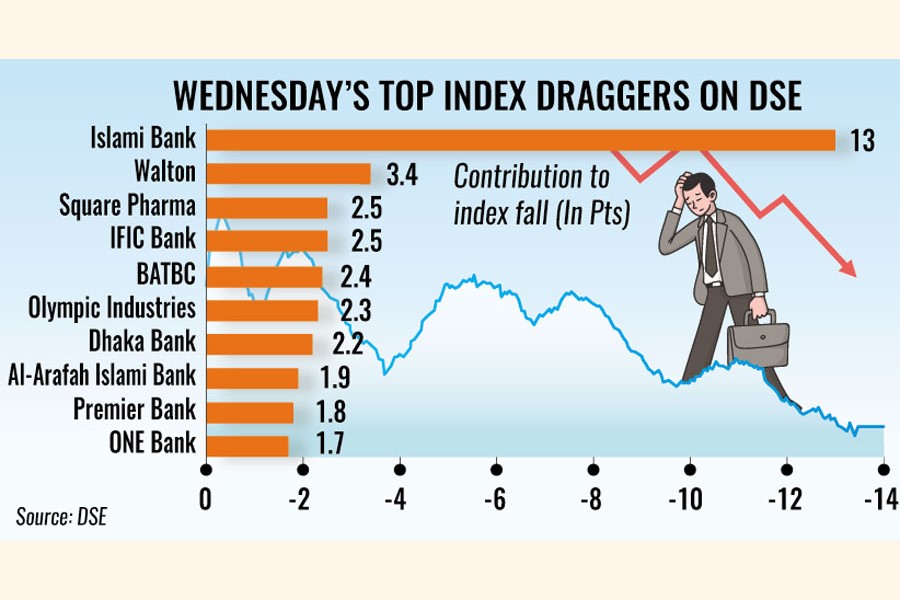
The share prices of blue-chip stocks also faced major corrections. The price erosion of selective blue-chip stocks such as Islami Bank, Walton, Square Pharma, IFIC and BAT Bangladesh largely contributed to the market plunge. These five stocks accounted for a 24-point fall in the DSEX.
Islami Bank alone accounted for a 13-point fall in the prime index as the bank's stock plunged 4.5 per cent on the day.
Subsequently, the blue-chip DS30 index, a group of 30 prominent companies, lost 16 points to 2,110, and the DSES index, which represents Shariah-based companies, shed 12 points to 1,105.
Market turnover also fell below the Tk 10 billion mark after three sessions, declining by 23 per cent from the previous day to Tk 9.36 billion.
Major-cap sectors posted negative performance. Non-bank financial institutions experienced the highest loss of 2.56 per cent, followed by food, banking, power, pharma, engineering and telecom sectors.
Losers strongly outnumbered gainers, as out of 393 issues traded, 286 declined, 82 advanced and 25 remained unchanged on the DSE floor.
Square Pharma became the most-traded stock, with shares worth Tk 365 million changing hands, followed by Asiatic Laboratories, Dhaka Bank, City Bank and Pragati Life Insurance.
The Chittagong Stock Exchange also ended lower, with its All Shares Price Index (CASPI) shedding 84 points to 15,429, while the Selective Categories Index (CSCX) lost 62 points to 9,463.
babulfexpress@gmail.com