
Stop Jan 5 polls, urge top civil society members
FE Report | Sunday, 29 December 2013
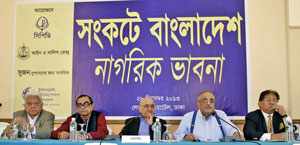
Civil society members Saturday demanded postponement of the January 5 parliamentary election and suggested finding out a solution by holding dialogue between chiefs of the two major political parties.
They said the ruling party can defer the election within the present constitutional framework. They feared if the election is held as per schedule on January 5, it would violate people's constitutional rights of voting and threaten democracy.
These opinions came up at a dialogue titled 'Bangladesh in Crisis:
Citizens Thought', jointly organised by the Transparency International Bangladesh, the Centre for Policy Dialogue, the Ain O Salish Kendra, and the Sushasoner Jonno Nagorik held in a city hotel.
The dialogue, presided over by leading economist Prof Rehman Sobhan, was conducted by CPD distinguished fellow Dr Debapriya Battacharya.
Some speakers proposed holding of a gathering on January 1, 2014 in front of the national parliament and observance of a hunger strike but other civil society members did not agree with such a programme at this time.
"The government must defer the January 5 polls to put an end to the ongoing political crisis and reach a consensus with the BNP to hold a participatory, credible and acceptable election," Mahfuz Anam, Editor of The Daily Star said.
Peoples' voting rights are on the brink of infringement as voting will only take place in 146 out of 300 constituencies because 154 candidates have already been elected unopposed, observed the civil society groups at an opinion-exchange programme in the capital.
Syed Manzur Elahi, leading industrialist and former caretaker government advisor, said everyone wants to boycott the general election for which the civil society should propose a package deal to the two parties to overcome the crisis.
"If political parties fail to perform their responsibilities, then religious extremist groups will surface," Mr. Manzur Elahi said.
Noted educationist Prof Anisuzzaman suggested developing a permanent system for transfer of power. The country's economy is being destroyed due to repeated political violence taking place during transfer of power after every five years, he said.
Prominent educationist Abdullah Abu Sayeed said the main reason for today's political bloody confrontation is the amendment of the Section 70 of the Constitution.
"The people of the country have established a 'democratic autocracy' by uprooting military autocracy. It is easy to evict military autocracy but difficult to get rid of democratic autocracy," he observed.
Mr Abu Sayeed proposed establishment of a two-layer parliamentary system aiming to decentralise power. He said two major political parties have been damaging life and property of the people since last 23 years.
Former caretaker government advisor Barrister Mainul Hosein termed the 15th Amendment of the Constitution as a means to kill democracy. The upcoming general election is going to be an incident of killing democracy in the way it did in 1975.
"The 15th Amendment of the Constitution is a system of ensuring one- party rule. This is Baksal in another shape", he pointed out. He urged the people to stage a movement against the 15th Amendment to the Constitution.
Barrister Rafiqul Haque said the government cannot cancel the election but it can only defer it. "There is still time for deferment of the polls since the national election, as per the constitutional provision, should be within 90 days after dissolution of the parliament," he said.
The solution of the ongoing political turmoil will not come with the help of outside people. Ultimately leaders of the two major parties should find a solution by discussing among themselves, he added.
Metropolitan Chamber of Commerce and Industry (MCCI) president and former advisor to the caretaker government Rokia Afzal Rahman said businessmen want a credible general election. But the g2
overnment is heading towards an arranged election, she said.
"The government can postpone the polls for the greater interest of the country. The economy is being shattered. Banking sector, agriculture and poultry are being damaged grievously," she added.
Leading industrialist and former advisor to the caretaker government Tapan Chowdhury said, "It is our misfortune that we divided the nation into two sides. This divide has given a chance to the forces against our 1971 freedom struggle to come to the scene".
He called for practising democracy in the political parties as he observed that the major political parties don't have any in their own parties.
Minister for Posts and Telecommunication Rashed Khan Menon said a solution will not come even if the election is postponed or if Sheikh Hasina quits as the chief of the polls-time government.
This crisis is not only political or a problem for democracy, he said adding it is the problem of Bangladesh's existence. The religion-based fundamental groups have emerged to destroy the country.
Shamsher Mubin Chowdhury, senior vice-chairman of the BNP, said the leader of the opposition is virtually under house arrest at her Gulshan residence as police either bars anyone from entering her house or arrests anyone daring to go to her residence.
He said the Constitution is not a religious book that it could not be amended. The government can bring further changes and can take action to stop the election, he suggested.
He said the UN-sponsored dialogue has failed because the Awami League did not agree to defer the election date.
BNP standing committee member Lt Gen (retd) Mahbubur Rahman called for protecting democracy. He said election is the final destination of democracy which can only be institutionalised through free and fair election.
Former caretaker government advisor Hossain Zillur Rahman proposed an assembly of the civil society members in front of Manik Mia Avenue on Janaury 1, 2014 to press home the demands to be met by the government. He also urged the civil society to start process of forming a new political party.
The Daily Star editor Mahfuz Anam proposed a polls-time government which will be led by the present president and will hold an election within three months.
The Election Commission should also be reconstituted as the Commission has already lost its credibility, he said. "If the government agrees with the proposal, the opposition parties should stop all their political movements," he further suggested.
The main sprit of the general election as per the Constitution is a participatory polls which will not happen on January 5, he said.
He wondered whether the Supreme Court or the High Court will take it into cognizance and give a ruling that this voter-free election is against the sprit of the Constitution. The ruling Awami League is going to assume a very bad image by holding this farcical election, he added.
Communist Party of Bangladesh president Manzurul Ahsan Khan said a group of 'looting class' people has been created during the last 23 years of democracy. They amassed huge wealth by misusing power, he said adding that for this reason, none wants to leave power.
Mr. Khan advised the opposition parties to take action against terrorism as well as refrain from fighting between the two parties. He suggested rigid action to ban the Jamaat-e-Islami Bangladesh.
Civil society member Syed Abul Maksud said the nation did not witness such a deep crisis after independence. The civil society can undertake some movements against the current situation, he added.
Former FBCCI chief Annisul Haque said no ways are now seen for solution of the current political impasse.
Senior journalist Reazuddin Ahmed, Motiur Rahman Chowdhury, former adviser to the caretaker government ASM Shahjahan, Ambassador Faruque Sobhan, chief executive of the Bangladesh Environmental Lawyers Association Syeda Rizwana Hasan, BRAC University Professor Dr Piash Karim, architect Mobasser Hossain, Prof Asif Nazrul of the Law Department, University of Dhaka, former president of the Bangladesh Knitwear Manufacturers and Exporters Association Fazlul Haque and Advocate Rana Das.
Former general secretary of the Bangladesh Mohila Parishad Ayesha Khanam, Executive Director of the Bangladesh National Women Lawyers Association Advocate Salma Ali, eminent dance researcher Lubna Maraium, journalist Asraf Kaiser and general secretary of the Bangladesh Indigenous People's Forum Sanjeeb Drong also spoke on the occasion.