
Students keep redefining history
Serajul I. Bhuiyan | Friday, 19 September 2025
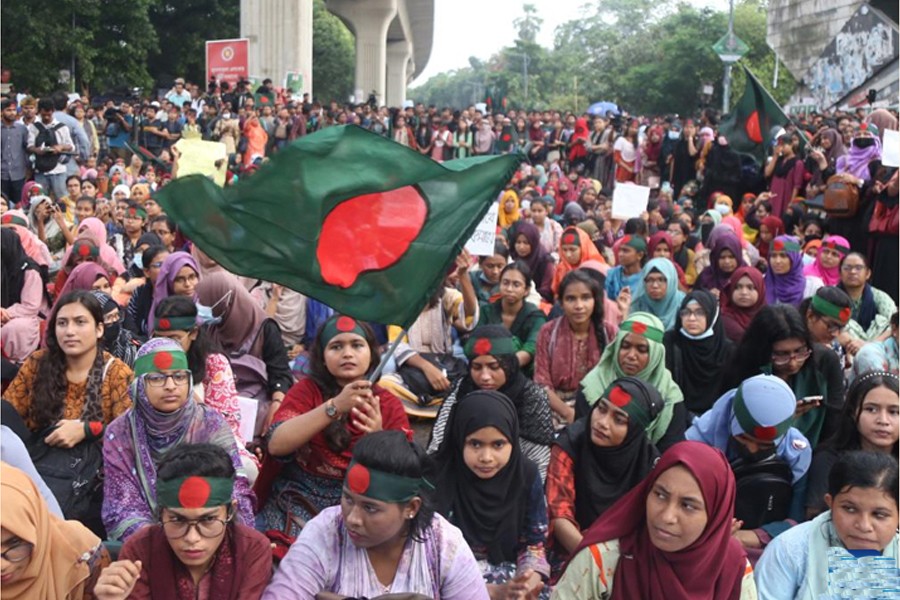
Across South Asia, few forces have profoundly shaped the course of national politics. Student activism is one such forces. From the Language Movement martyrs of Dhaka to the uprisings in Kathmandu and Colombo, students have played the role of political catalyst-standing up to military rulers, and now, increasingly, authoritarian governments.
In Bangladesh, student politics is more than just a fixture of university life-it has been a mirror of the country's democratic health. The long-delayed Dhaka University Central Students' Union (DUCSU) election in 2019, held after nearly three decades, reignited this legacy again on September 9, 2025.
DEFINING 'STUDENT POLITICS': A CONCEPTUAL FRAMEWORK: To grasp why students, matter so much, three perspectives are valuable.
Resource Mobilisation Theory (RMT) reminds one that ideals alone can't move mountains-movements are successful if they can mobilise networks, leadership, and organisational capacity. Bangladesh students' unions have consistently done the same since 1952 up to the present day.
Next comes Political Opportunity Structure (POS) which is concerned with the state. Open systems absorb the voice of students; closed regimes push them to the streets. From Pakistan under General Ayub Khan through Bangladesh under Sheikh Hasina, suppression has led to the radicalisation of the movement of the students.
Finally, the theory of Generational Change carries youth protest beyond politics-it is the proclamation of an awakened generation. Students today are not students of 1971 or 1990; their movement is the product of unemployment, online abuse, climate anxiety, and freedoms denied. They seek something more, and the possession of that is what their strength is.
A HISTORY WRITTEN BY STUDENTS: Bangladesh's own history is unthinkable without the activism of the students. The Language Movement of 1952 cemented Bengali identity in the blood of youth martyrs. The mass agitation of 1969 toppled the military autocracy of Ayub Khan, and that too was student-agitation-ridden. And when independence was established, once more, students, in 1990, toppled General Ershad and re-established multiparty democracy.
Since the 1990s, that culture has seen few twists. Rising dominant parties took an increasingly large proportion of student politics for themselves. Awami League-affiliated Bangladesh Chhatra League (BCL) and BNP-affiliated Jatiyatabadi Chhatra Dal swept the campuses into partisan battlefields, where party loyalties were rewarded and violence became second nature. Reform and justice were replaced by patronage and brute strength.
The 2019 DUCSU election was going to be a renaissance. Students were, for the first time since 1990, free to vote. Most portfolios went to the Chhatra League, but the surprise was experienced when Nurul Haq Nur, the leader of the quota reform movement of 2018, won the Vice Presidency. His victory was perceived as an assertion of opposition against dominant-party hegemony. But ballot-rigging and intimidation marred the process.
SEPTEMBER 9 DUCSU: A SYMBOLIC REFERENDUM: The DUCSU election held on September 9 took place under a changed, stormier scenario. The country was shaken by protests, led by students, over unemployment, corruption, and suppression by the former government party. The election was more than an intra-campus contest-it became an unofficial referendum on the regime itself.
The September 9 election gave shape and content to an adolescent movement already going into the streets. It brought into cohesion university democracy and national protest at accountability, and it roused a generation dedicated to regaining its historic role as Bangladesh's moral conscience.
BANGLADESH STUDENT POLITICS SUCCESSES: Bangladesh's student politics was a force of leadership, democracy, and identity. The Language Movement defined the country's cultural bedrock. The movements of 1969 and 1990 spoke up for democracy when few others would. The student unions were gates of national leadership.
SOUTH ASIA'S SHARED STORY: Bangladesh's narrative resembles, but is also different from, that of its neighbours.
Even today, intense student politics persists, from Jawaharlal Nehru University in Delhi to Jadavpur University in Kolkata. Groups such as the AISF and the ABVP contest over questions of secularism, identity, and opposition to Hindu nationalist projects, keeping the campuses vibrant as spaces for democracy.
In Pakistan, the politics of students were the vanguard of the movement against Ayub and Zia, but the prohibition of 1984 sapped the life from university democracy. Attempts at resurrection today face state distrust and the specter of extremism.
In Nepal, the students were the driving force behind the overthrow of the monarchy and the declaration of a republic. Party-backed wings of students remain leadership prospects, setting youth squarely in politics.
In Sri Lanka, the Inter-University Students' Federation (IUSF) continues to be a well-organized and frequently leading the charge of resistance against privatisation, neoliberalisation, and state oppression. Their perseverance is a testament to the resilience of the student movements.
CHALLENGES: The 2019 and September 9 DUCSU elections, though symbolic, revealed the extent to which the campus democracy had fallen into disrepair. Accusations of rigging and manipulation let down a significant section of the students. Reform is the necessity of the day if student politics is going to become important again.
TOWARDS A REIMAGINING: The answer is not to curb student politics but to reclaim it. Regular, free, and fair elections are the starting point. Student unions must shift from party loyalty to cause-based mobilization on socio-economic issues affecting the lives of the common people.
WHEN YOUTH RISE, NATIONS FOLLOW: When the youth stand up, the nation moves forward. There is only one question -- whether societies will be brave enough to follow them. Students' role today is not just to protest, but to re-envision politics itself-without the partisan stranglehold, grounded in concerns close to them, and open to the imagination of justice and belonging of the emerging generation.
Dr. Serajul I. Bhuiyan is a professor of Journalism and Mass Communications at Savannah State University, Savannah, Georgia, USA. sibhuiyan@yahoo.com