
Sundarbans\\\' Bengal tiger may disappear: Experts
Thursday, 30 July 2015
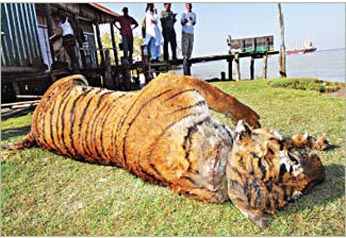
Though the tiger population is falling fast in Sundarbans in Bangladesh, the proposed ‘Tiger Project Sundarbans’ have remained tangled in red tape for over a quarter of a century. With only 106 tigers are existing in the Sundarbans authorities concerned have not yet finalised the project meant to protect tigers in the mangrove forest. An expert at the Save the Sundarbans Foundation said the crucial project has remained tangled in red tape for the last 25 years. The Forest Department earlier prepared a five-year project – ‘Tiger Project Sundarbans’ – from fiscal 1990-1994 involving Tk100million (Tk10 crore) and submitted it to the Ministry of Environment and Forests, but there has been no progress in approving the project, official sources said. However, the Indian government has introduced a Rs4000 million (Rs400 crore) tiger conservation project with support from the World Wildlife Conservation Fund to save tigers in the Indian part of the Sundarbans. A new census reveals that only 106 tigers are left to live in the Bangladesh part of the world’s largest mangrove forest. The number is much lower than that of the previous census. According to the tiger census conducted by the government in 2004, the Bangladesh part of the Sundarbans was a home to 440 tigers. Wildlife experts, forest department and local sources said poaching is the main reason behind sharp decline in number of tigers in the Sundarbans. Would Wide Nature Fund for Nature-India Dr KM Ranajit Singh in an article said the tiger is the most unprotected animal in the animal world and it has been declining day by day. “If no comprehensive measure is taken to save tigers, the rare species will be disappeared from the Sundarbans soon,” he warned. Save the Sundarbans Foundation chairman Dr Sheikh Faridul Islam said the tiger population in the forest is declining gradually for various reasons – extreme climatic events, liver diseases of tigers caused by salinity, deforestation, food crisis, animal-human conflict and of course, rampant poaching as well. He said although tigers are being killed alarmingly in the Sundarbans, there is no effective step to save tigers and increase its population. According to the Forest Department data, at least 49 tigers were killed in the last 14 years (2001-2014) since the illegal poaching of wildlife and tiger-human conflict is on the rise in the Sundarbans, the country’s only natural tiger habitat with a range of 6,017 square kilometers. About the killing of tigers, another expert at the Would Wide Nature Fund for Nature said Sundarbans Bengal tiger may extinct within two to three decades if emergency measures to protect the species are not taken, according to a news agency.