
Sweltering heat disrupts life in city, elsewhere in country
FE Report | Tuesday, 22 April 2014
The almost unbearable bout of sweltering heat has jeopardised normal life in the country. Besides the scorching sun and dry weather, shortage of electricity and water supply has added to the people's sufferings in the urban areas. The ongoing 'heat wave' is also taking its toll on some selected agricultural crops.
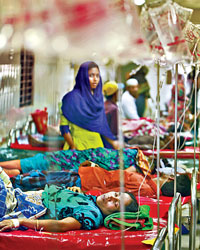
Besides, it has also led to the outbreak of diseases like diarrhoea, compounding the ordeals of the people in many city areas.
However, the people are unlikely to get respite from the current hot spell soon, as the Met office ruled out Monday any possibility of rain.
Officials at the state-run weather forecast centre said higher temperature had been prompting the significant drop in rainfall.
According to the Met office, the country's highest temperature was recorded at 40.5 Celsius on Sunday at Rangamati. It was also the highest this year.
The temperature was recorded at 39.5 (highest) both in Khulna and Rajshahi divisions yesterday (Monday).
Officially, a moderate heat wave is sweeping over Dhaka, Rajshahi, Rangpur and Khulna divisions, and the regions of Rangamati, Sylhet, Barisal and Patuakhali. It may continue for the next few days, Met office officials said.
Director of the office Md Shah Alam said that Rajshahi region, where normal rainfall in April is recorded at 75-80 millimitre (mm), had remained rainless over the month.
The same happened in Dhaka, Chittagong and some other places across the country, he said.
Only 61 mm of rain was recorded in the last 20 days in Dhaka, when the average rainfall in April is 147 mm, the weatherman said.
The Met office's forecast for the next 24 hours (from Monday evening) showed that there was no possibility of rain, and the weather might remain dry across the country.
The summer heat has paralysed normal life of people, especially those in mega cities like Dhaka and Chittagong.
Supply shortage of water has increased their sufferings manifold, with many passing days together without water in parts of the capital.
People in the areas of Mohammadpur, Mirpur, Moghbazar, Central Road, Noyatola have been facing severe water crisis over the couple of days.
Dhaka WASA (Dhaka Water Supply and Sewerage Authority officials said the situation has come to this pass due to some technical problems coupled with the fall in ground water level.
Fahmida Korobi, a resident of Kazipara at Mirpur, told the FE: "We are it serious trouble due to no supply of water to our house. The owner of our building has tried to pump out water from the main line, but it did not work as the there is no water in the pipe."
"We can not perform our household chores and are even unable to take bath," she said.
Shiuli Akter, a resident of Central Road said: "We have been facing the shortage of water since the start of summer and from the end of March the crisis of water has turned severe."
Dhaka WASA managing director Taqsem A Khan told the FE: "There are 670 pumps, but 12 to 15 of them became non-functional due to technical problems. For this reason, people in many areas are gripped by shortage of water."
"Within a few days we will be able to resolve the technical problem, but if the water level drops further then we will be able to pump less amount of water," he added.
The water demand of Dhaka and its adjacent areas is 220 litres per day. It reaches 230 litres a day at times. The 'production' capacity of water on the part of Dhaka WASA is 242 litres per day, but it can pump around 230 litres a day.
Dhaka WASA MD said ten vigilance teams were monitoring the pumping of water. "We are providing plastic water tanks to some areas, where people are facing crisis of water," he added.
He expressed the hope that this situation would be under control when rain started.
Meanwhile, extreme summer heat has pushed up consumption of electricity forcing the authorities to go for frequent load-shedding in the capital and elsewhere in the country.
The Power Development Board (PDB) recorded 113 megawatt (MW) of load-shedding on April 17 across the country. It increased to 375 MW on April 19 and came down to 269 MW on April 20.
No load-shedding was reported on April 18 (Friday) as the demand of electricity was low at the weekend.
On April 20, while Chittagong experienced 72 MW load-shedding, Khulna faced 80 MW load-shedding, Rajshahi 75 MW, Comilla 54 MW, Mymensingh 40 MW, Barisal 13 MW and Rangpur 41 MW, while the total load-shedding was 375 MW.
The PDB said there was no load-shedding in Dhaka and Sylhet on April 20.
Reports from different areas revealed that load-shedding has been higher than the PDB's claim.
Consumers in many city areas said there is three to five hours of load-shedding a day. The situation outside Dhaka is worse.
The high temperature and poor rainfall are taking a toll on agriculture also, with a drought-like situation prevailing in many areas of the country.
Higher temperature is causing an increase in fungus in paddy fields, mango and litchi orchards in some places of the country, our correspondents said.
Jute production may be hit hurt by the dry condition, experts predicted.
An official at the Department of Agriculture Extension said the country has targeted growing 7.7 million bales of jute on 0.725 million hectares of land.
He said April rain is very useful for jute as it helps in its growth.
Alternative irrigation should be ensured for the sound growth of jute plants, he said.
The heat also raised the ferocity of diseases.
As per ICDDR,B data, daily patient load during the last week was 578 on 14 April, 773 on 15 April, 676 on 16 April, 615 on 18 April, 666 on 19 April, 700 on 20 April .
The number of diarrhoea patients has more than doubled, reaching 700, which was on an average 300 to 325 daily during normal times, chief physician of ICDDR,B Dr PK Bardhan told the FE Monday.
"Still the situation is neither unusual nor unexpected. The number of patients will increase until the end of May," he added.
Dr Bardhan mentioned unsafe food and drinks which people are consuming orally as the main reasons for the outbreak of diarrhoea in this summer. As there is excessive heat, people take roadside drinks and foods, and are attacked with diarrhoea germs.
Besides, they are attacked with dehydration due to excessive heat and become sick as they cannot discharge the extra heat, the physician observed.
Dr Bardhan advised the people to remain alert to any food they were taking irrespective of homemade or outdoor items, because those get stale very quickly due to excess heat. Also people should drink enough safe water to stay well in this summer, the physician suggested.
The ICCDR,B authorities have set up a tent on its premises to accommodate patients
The hospital had to set up two makeshift treatment centres to accommodate the growing number of patients during the last two weeks, hospital sources said.
The sales of air conditioners (ACs), air coolers, electric fans, IPS, UPS, have marked a sharp rise at the city markets amid the hot spell.
Talking to the FE, shop owners at the Stadium and Baitul Mokarram markets said sales of ACs and fans almost doubled in the last ten days.
Following the higher demand, prices of these products had increased by 15 to 25 per cent, they admitted.