
Sylhet flood causes Tk 1.2b loss in livestock
Sunday, 3 July 2022
OUR CORRESPONDENT
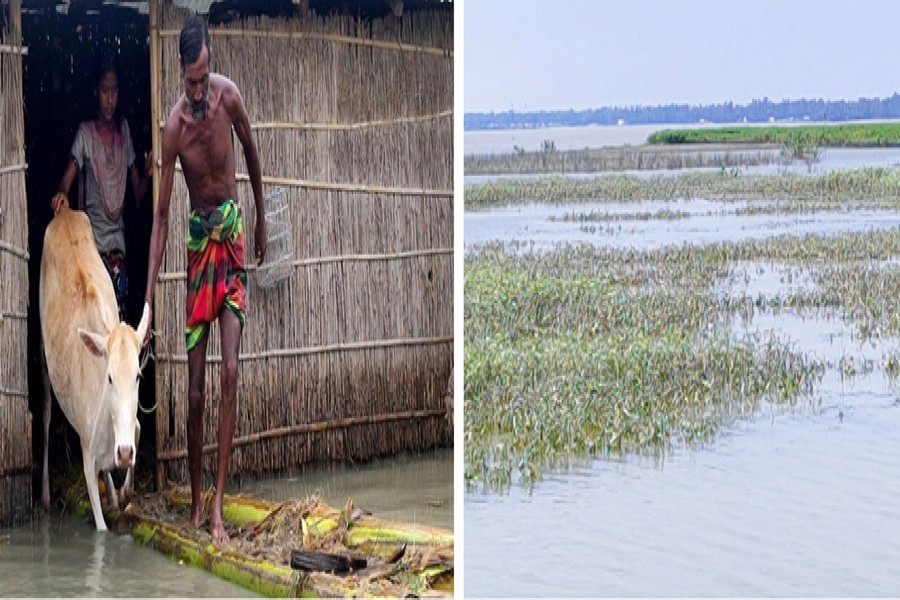
SYLHET, July 02: The devastating flood north-eastern Bangladesh experienced recently, not only displaced the people of rural Sylhet division, but also caused great loss of livestock.
As of Friday (July 1), the loss in the livestock sector has been estimated at Tk 1.2 billion (120 crore), according to Sylhet Divisional Livestock Office.
A total of 5590 firms in 238 unions of 34 upazilas out of 40 in the Sylhet region had been badly affected by the flood, said livestock officials.
The number of lost, dead or affected cows and bullocks is 671,145 along with 43,223 buffalos, 210,236 goats, 146,656 sheep, 4,131,664 poultry and 3,672,333 ducks, they added.
Livestock officer Dr Rustom Ali said, "In Sylhet district, a total of 721 dairy firms have been affected by the flood in addition to 368 poultry firms. Besides, 291 tonnes of straw and 2,982 tonnes of grass have also been damaged in the district."
Compared to the past few years, the number of sacrificial cattle in the division is less than the demand for the upcoming Eid-ul-Azha.
If people sacrifice more animals than the previous year, there would be a shortage of animals this year, the official said.
Director of Sylhet Livestock Department, Md. Zakir Hossain, said, "A total of 486 cattle and over 1,500 goats and sheep died in the flood. Currently, as many as 76 medical teams are working in the region for treating the livestock", he added.
UNB adds from Kurigram, farmers in Kurigram have been hugely hit, with the recent floods wrecking havoc on their crops. Agriculture is one of the mainstays of Bangladesh's booming economy, but the devastation to crops in Kurigram district has put the livelihoods of many farmers on the brink.
In fact, the losses in the agriculture sector caused by the floods in Kurigram has been estimated at Tk 1.27 billion (127.54 crore), according to the Department of Agricultural Extension (DAE).
According to the DAE, a total of 80,035 cultivators have been affected by the floods, with 15,851 hectares of cropland in the district being partially or fully destroyed in the natural calamity.
This season, the farmers of the district cultivated 34,310 hectares of agricultural land. But due to the flash floods and heavy downpour, around 15,851 hectares have been inundated. Of these, 7,351 hectares have been damaged fully during the fortnight-long floods.
Apart from this, around 8,427 hectares of cropland have been damaged partially by the floodwaters. As a result, the production of a total of 35,055 tonnes of crops has been affected, which is 25.57 per cent of the total crops.
The Aus paddy and jute have been affected the most, followed by vegetables.
Floodwaters have damaged 9,521 hectares of cultivated jute land of 16,577 hectares, 3,580 hectares of Aus paddy of 8,480 hectares, and 1,161 hectares of vegetables of 4,034 hectares of cultivated land in Kurigram.
The damaged crops in the district include Aman seedbed, jute, Aus paddy, sesame, vegetables, peanuts, banana, corn, chili, ginger, turmeric, onion, sugarcane and lentil.
Shamsul Alam, a vegetable grower of Chararpar village under Kurigram sadar upazila, said, "I invested Tk 50,000 from my pocket and borrowed Tk 30,000 from an NGO. Also, I borrowed Tk 20,000 from a local lender at a high rate of interests. I have suffered huge losses."
Another farmer, Jabbar Ali of the same village, said, "We hoped to make big bucks this year. But the flash floods washed away our dreams."
Contacted, Md Abdur Rashid, deputy director of Kurigram DEA, said, "We have informed the higher authorities after estimating the losses. The affected farmers will be brought under incentive packages."
"We have already received an allocation to bring 7,000 farmers under incentives which will help them recover some amount of losses," he added.
forsylhet@gmail.com