
Tariff Commission for providing support to raise rice bran, mustard oils output
FE Report | Tuesday, 16 June 2015
The Bangladesh Tariff Commission (BTC) has recommended providing necessary support to increase production of rice bran oil and mustard oil to meet the country's future demand for the essentials.
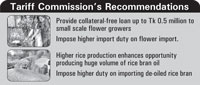
While considering the flower and foliage gardening as a potential sector for export, the commission recommended providing loans up to Tk0.5 million without collateral to small scale flower growers.
The recommendations came Monday at the launching ceremony of two researches on edible oil and flower and foliage cultivation, organised by the commission at its office.
State minister for the planning and finance ministry M A Mannan spoke as the chief guest while chairman of the commission Dr Md Azizur Rahman presided.
The commission conducted research on edible oil tiled "An Analysis of Assistance to Edible Oil Manufacturing Industry and Examining Export Possibilities," led by its member Md Abdul Quaiyum.
Another research titled "Analysis of Domestic Market and Export Potentials of Cultivated Flowers and Foliage' was also carried out by the commission led by its deputy chief Mohsina Begum.
The analysis on edible oil identified the rice bran oil as most potential one for meeting future demand as well as to emerge as an exportable item.
Mr Quaiyum's paper showed that the country presently imports 1.3 to 1.4 million tonnes of edible oil against a demand for 1.5 million tonnes.
The paper said per day edible oil consumption is now 26.57 gram per person while the government has fixed a target to increase it to 40 gram per day by 2021.
Country's population will be more than 170 million by 2021 and the need for edible oil will scale up to 2.47 million tonnes considering the 40 gram per day per capita consumption, the paper said.
The paper showed the rice production in the country has been increasing which is a great opportunity for producing a huge volume of rice bran oil. The paper also recommended imposing higher import duty on de-oiled rice bran to encourage the local bran oil manufacturers.
The paper showed that the refining capacity of the local soybean and palm oil refiners is now 2.97 million tonnes from 5.07 million tonnes while they utilised 48.64 per cent of their capacity in the financial year 2013-14 (FY'14).
Analysing the import trend, volume, refining method, price and marketing, the paper recommended for permitting only the refiners and a government entity like Trading Corporation of Bangladesh (TCB) to import crude edible oil to ensure minimum prices for the consumers.
Ms Begum presented the key points of the research on flower and foliage which showed the country's 0.2 million farmers are now directly involved in flower gardening at10000 hectares of land. The paper showed flower gardeners reap profits five times more than the rice growers and two times more than the vegetable cultivators.
The research recommended imposing higher import duty on flower import.
It also recommended reducing the bank interest rate to 5.0-6.0 per cent from the existing 11 per cent.
The BTC analysis suggested the government for providing collateral-free loan (up to Tk0.5 million) for the farmers to boost flower gardening in the country .
The commission also suggested setting up a flower and foliage research centre at Jessore and set up a permanent flower wholesale at Gabtali area to facilitate the traders.
Mr Mannan said it was unbelievable two decades back that flowers and water will be trading items. He said this indicates that our economy is gradually expanding.
He assured the flower growers that the government would consider their demand for separate space for wholesale market. BTC chairman said the commission is conducting a separate research on rice bran oil which will be made public in the next few weeks.
BTC member Afroza Parvin presented the welcome address while Flower Growers and Exporters Association president Md Ahsan Ullah, among others, also spoke.
tonmoy.wardad@gmail.com