
Teaching morality: the missing foundation
A S M Abdul Baten | Saturday, 6 September 2025
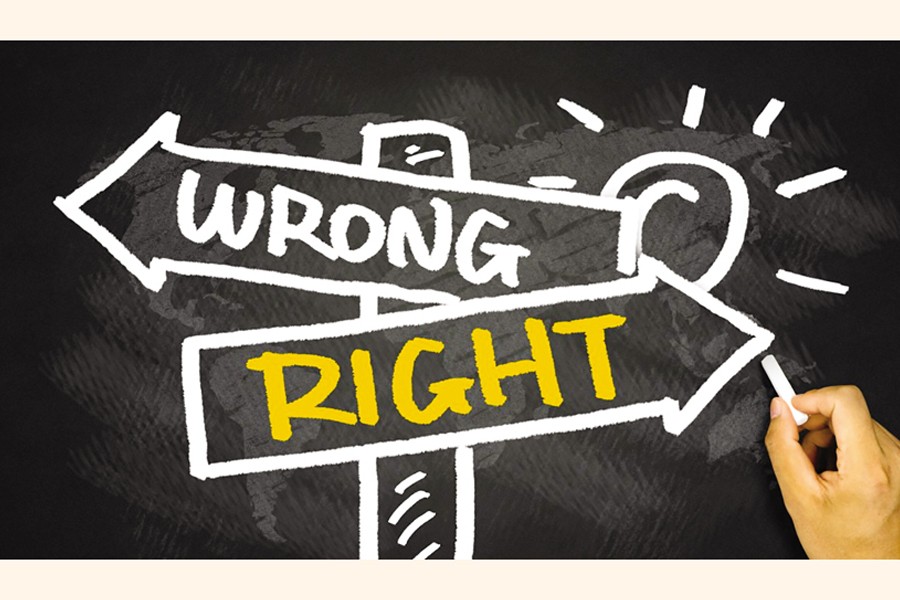
 Over the last three decades, Bangladesh’s education sector has witnessed significant improvements, including higher literacy rates, nearly universal enrolment, and the increasing use of digital tools in classrooms. Yet one question continues to haunt our advancement and progress: Are we producing citizens who are efficient/skilled, and ethical? The answer, if we are honest, is troubling. Exam cheating, rising intolerance on campuses, corruption in public jobs, and a lack of ethics in professional life show a serious gap we can no longer ignore. As a result, we are neither capable nor honest. With some self-realisation, I presume, the previous government formulated the National Integrity Strategy (NIS) of Bangladesh, in 2012. This was a government initiative aimed at promoting good governance, transparency, and accountability in both the public and private sectors to combat corruption in Bangladesh. After much hype and enormous public expenditure, the official launch of the programme had been done, yet the concept of morality remains a distant dream. As for morality and ethics, their absence from the very roots of our education system resonates like high-pitched, heart-wrenching music echoing from every corner of the country. Morality is not a luxury; it is a national necessity. Without it, even the most sophisticated economic or technological achievements can crumble under the weight of mistrust, injustice, and disunity. As Bangladesh moves towards its Vision 2041 goal of becoming a developed nation, teaching morality must become as central to our classrooms and government offices as teaching of any other fundamental subject of science, technology or sociology.
Why Morality, Why Now: Our development challenges today are not merely technical; they are profoundly moral. The recent surge in misinformation on social media poses a threat to our democratic discourse. Bribery and favouritism undermine public trust in state institutions. Short-term gain often trumps long-term responsibility in business and politics. As philosopher Amartya Sen argues in ‘The Idea of Justice’, real progress depends on reducing injustices that ordinary people experience daily.
Global wisdom reinforces this urgency. Aristotle taught in Nicomachean Ethics that virtue is formed by habit: “We become just by doing just acts.” Moral education, therefore, is not about lofty lectures but about embedding repeated opportunities to act with integrity. Confucius, twenty-five centuries ago, emphasised that morality develops in relationships: within respectful families, responsible communities, and leaders who model what they preach. In the Islamic tradition, Imam Al-Ghazali, in Ihya’ Ulum al-Din, reminded us that true integrity requires both outward conduct and inner sincerity—a lesson as relevant in Dhaka as in any other part of the country.
Our own heritage carries equally powerful voices. Rabindranath Tagore insisted that education must unite truth, beauty, and goodness—developing the heart and soul in tandem with the mind. Begum Rokeya, through her writings, such as Sultana’s Dream, warned that any society that excludes women from equal dignity and opportunity cannot be truly moral. And Mahatma Gandhi’s enduring lesson—means are as necessary as ends—should guide both classrooms and boardrooms in the country.
Where We Are Falling Short: In many schools and colleges, morality is reduced to a few lines in civics textbook or to rote memorisation of “good conduct” rules. This approach fails for three reasons:
No real-life application. Students memorise values but rarely practice them.
Poor role models. When they see teachers manipulating grades or public officials taking shortcuts, the lessons ring hollow.
No systemic support. Ethical behaviour is often punished rather than rewarded; whistleblowers face retaliation, and honest students are sidelined in a culture of unfair advantage.
The result is a generation skilled in passing exams but ill-equipped to navigate moral dilemmas—be it in technology, commerce, governance, or daily life.
A Framework for Change: To reverse this trend, we need a practical, nationwide framework that embeds morality into the foundation of education and governance. Drawing from great thinkers and successful practices worldwide, the following may be cornerstones:
Curriculum Integration. Ethics must be plaited into every subject—not taught in isolation. A physics class can discuss environmental responsibility in energy use; a literature class can explore justice and compassion through Bengali classics; ICT courses must address data privacy and digital citizenship. Local case studies—such as river pollution in Buriganga, exam fraud in Borguna, and climate migration in Satkhira—make morality concrete and relevant.
Experiential Pedagogy. John Dewey, the American philosopher, rightly observed that “schools are mini-societies.” Students learn morality through action, not just by listening. Role-play, community service, and structured debates build habits of compassion, rational, and responsible action. Maria Montessori’s principle of “freedom with responsibility” reminds us that giving students meaningful choices fosters self-discipline better than rigid enforcement.
Assessment Reform. We measure what we value. If we continue to reward routine memorisation, we will get more of it. Instead, we need portfolio-based assessments, scenario-based exams, and 360-degree feedback from peers, teachers, and community partners. Students should graduate not only with grades, but with a documented record of ethical engagement.
Teacher and Leader Development. Teachers cannot teach what they do not represent. Ethics training for educators must go beyond subject matter to include bias awareness, fairness in grading, and professional integrity. School heads and government leaders should sign and publicly uphold integrity deeds—making themselves accountable first. Nelson Mandela’s insight is crucial here: “Lead from the front—but don’t leave your base behind.” Leadership must inspire, not intimidate.
Culture of Integrity. Institutions must create environments where ethical behaviour is the norm. This includes anti-bullying policies, restorative justice practices, and honour codes co-created by students and staff. A great successful leader’s spirit of truth and reconciliation can guide conflict resolution—acknowledging harm, fostering forgiveness, and ensuring accountability.
Systemic Governance. Finally, moral education collapses if surrounded by systemic corruption. Government organisations should adopt transparent systems— a Transparent admission and recruitment process, an open budget and financial disclosure, digitalisation for accountability, and whistleblower protection. Values-based hiring and promotion criteria can ensure that integrity is not a career liability but a career asset.
Implementing Vision: A national Ethics Education Task Force could spearhead this initiative, comprising educators, parents, students, faith leaders, and private sector partners. Start with pilot schools and government offices in both urban and rural areas. Introduce ethics modules, honour codes, and service-learning projects. Measure success through clear indicators: reduction in cheating, improved attendance, community impact of student projects, and independent audits of institutional integrity. Such reforms need not be costly. What they require is commitment and consistency. Simple practices—like beginning meetings with a five-minute ethical dilemma, or displaying institutional promises on a “transparency wall”—can transform culture over time.
A Call to Action: The late Nelson Mandela once said, “Education is the most powerful weapon which you can use to change the world.” But that weapon is only as powerful as the values that guide it. Bangladesh stands at a crossroads. We can continue to chase numbers—GDP, enrolment rates, exam scores—while leaving character behind. Or we can take the harder, nobler path: raising a generation that is not only competent but also conscientious.
Our history is rich with moral courage—from the Language Movement of 1952 to the Liberation War of 1971 and the July revolution against the fascist government in 2024. Let us honour that legacy by ensuring that our schools and state institutions cultivate honesty, empathy, and justice. As Aristotle reminded us, “The good for man is an activity of the soul in accordance with virtue.” The time to nurture that virtue—in every child, teacher, and public servant—is now.
The writer is a retired Rear Admiral and founder Vice Chancellor of Maritime University, Bangladesh