
Tech-driven land management is long overdue
Wasi Ahmed | Wednesday, 8 July 2026
One of the areas where a technology-driven system has long been felt most urgent is land management. Although the slogan of "Digital Bangladesh" has occupied a prominent place in public discourse for years, the reach of digital technology is still far from encompassing land administration, a sector where its application, though complex and demanding, could bring about a transformative change in public service delivery.
The urgency of modernising land management was highlighted once again at a programme held recently at the Bhumi Bhavan. Speaking at the event, the prime minister rightly observed that land is not merely a piece of property; it represents security, economic stability and future certainty for millions of people. He also pointed out that the steady rise in land-related disputes, litigation, and administrative complications, driven by population growth and shrinking land availability, has made the adoption of technology in land administration imperative.
What this essentially means is the digitisation of land records and all related documentation. Such a reform has the potential to spare citizens of the immense suffering, uncertainty, and harassment that often accompany land transactions in Bangladesh.
Ever since digitisation emerged as a solution to many administrative inefficiencies, land records have been among the sectors most deserving of technological intervention. Yet the management of land documents across the country remains rooted in practices inherited from the British colonial era. The custodians of these valuable records often continue to rely on traditional methods of preservation and retrieval, with limited exposure to modern technologies that could ensure both the security and authenticity of documents.
For generations, land administration has been synonymous with endless litigation, bitter disputes and social conflict, particularly in rural areas. It has also been a domain where the powerful have frequently exploited weaknesses in the system to dispossess the vulnerable. The antiquated method of maintaining records manually in ledgers and registers leaves ample room for manipulation, forgery, and error. It is not uncommon for the same piece of land to be sold multiple times, creating confusion and exposing buyers to considerable risk.
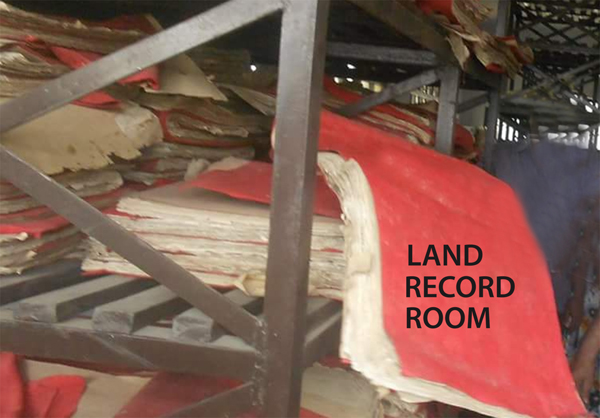
The consequences are evident in the staggering number of land-related cases pending in courts across the country. Many of these disputes originate from inaccurate, inaccessible, or conflicting records. The cumbersome nature of the existing system often makes obtaining reliable information an arduous task. The greatest victims are ordinary citizens who, unfamiliar with bureaucratic procedures, become easy prey for touts, brokers, and middlemen who have thrived within this flawed structure for decades.
The physical condition of many sub-registry offices further illustrates the urgency of reform. In most government institutions, obsolete files and documents are periodically disposed of in accordance with established guidelines. Land records, however, are an exception. There is virtually no such thing as an outdated land document. Records dating back fifty years or more may still hold legal significance today.
As a result, many sub-registry offices, especially those located outside district headquarters, are overflowing with stacks of papers and fragile documents stored in cramped rooms, on dusty shelves, and aging racks. In such an environment, retrieving a record from a decade ago can take days or even weeks. Sometimes, documents simply cannot be found.
Against this backdrop, the advantages of digitisation should hardly require elaboration. Yet progress towards that goal has been disappointingly slow. According to media reports, two major government initiatives aimed at digitising land records have encountered serious obstacles.
One project, approved in 2010 and financed from domestic resources, sought to digitise land documents, maps, mouzas, and khatians in nearly 60 upazilas. However, reports suggest that the use of inadequate software severely undermined its effectiveness, yielding little meaningful progress. Another initiative, the Asian Development Bank-funded Digital Land Management System project, covering 44 districts, has also suffered repeated delays due to funding bottlenecks and implementation challenges.
Such setbacks are most unfortunate. Few areas of public administration affect citizens as directly and as profoundly as land management. Delays in modernising this critical sector prolong public suffering and undermine confidence in governance. More surprisingly, the issue appears to have faded from public debate. Media attention has also diminished, leaving citizens largely unaware of the current status of these projects or the reasons behind their sluggish progress.
The experience of many countries demonstrates that digitising land administration is not only feasible but also highly beneficial. Even developing nations have successfully moved away from manual record-keeping systems, recognising that secure and accessible land information is fundamental to economic development and social stability.
Admittedly, digitising land records over the decades is a mammoth undertaking. It cannot be completed overnight or within the rigid timelines typical of infrastructure projects. What is required is a clear strategy, sustained political commitment, adequate funding and effective technological support.
The ultimate objective of digitisation is not merely administrative efficiency. More importantly, it is about reducing human suffering. It would simplify procedures, enhance transparency and provide citizens with easier access to information. Most importantly, it would spare countless people the frustration, expense, and uncertainty that have long characterised dealings with land administration.
The challenge now is to regain the momentum that appears to have been lost. All stakeholders must work together to remove obstacles, strengthen implementation and ensure that this long-overdue reform is finally brought to fruition for the benefit of the people.
wasiahmed.bd@gmail.com