
Thai junta summons ousted leaders, imposes travel ban
Saturday, 24 May 2014
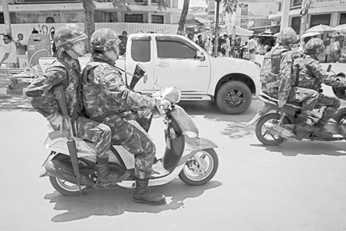
BANGKOK, May 23, (agencies): Thailand's ruling military on Friday summoned the entire ousted government and members of the politically influential family at the heart of the country's long-running conflict, a day after it seized control of this volatile Southeast Asian nation in a non-violent coup.
There was virtually no military presence on Bangkok's streets, which were less crowded than usual but still filled with vendors and people heading to work after a 10 p.m. - 5 a.m. curfew the night before. There were no reports of overnight violence.
Countries including the United States, Japan and Australia expressed concern and disappointment over the coup, with the U.S. saying there was "no justification" for the takeover, Thailand's second in eight years.
It was unclear why more than 100 people - including the ousted prime minister and several members of the influential Shinawatra family - were ordered to report to the army, which said it was summoning the high-profile figures "to keep peace and order and solve the country's problems."
Former Prime Minister Yingluck Shinawatra, sacked earlier this month for nepotism by the Constitutional Court, and her temporary replacement Niwattumrong Boonsongpaisan, arrived at an army compound in Bangkok by midday Friday, Yingluck's aide confirmed. After about 30 minutes, Yingluck left the facility and was taken to another army location by soldiers, the aide said.
Vowing to halt months of political bloodshed, coup makers led by the tough-talking army chief declared a nationwide night-time curfew and ordered masses of rival demonstrators off the streets.
Former prime minister Yingluck Shinawatra, who was removed from office in a controversial court ruling earlier this month, arrived at an army facility in Bangkok in her private bullet-proof vehicle after a summons from the military regime.
Dozens of prominent figures from both sides of the political divide, including Yingluck's successor Niwattumrong Boonsongpaisan, were ordered to show up. It was unclear what awaited them.
"If the prime minister and many of these personalities are not apprehended, then there would be the threat that they might set up a government in exile," said Paul Chambers, a Southeast Asia expert at Chiang Mai University in northern Thailand.
The army said 155 prominent figures, including the ousted government leaders, were banned from leaving the country without permission.
The military regime headed by General Prayut Chan-O-Cha suspended most of the constitution, drawing rebukes from Washington, Europe and UN chief Ban Ki-moon, who all called for civilian control to be restored.
Secretary of State John Kerry said there was "no justification" for a coup that would have "negative implications" for US relations, and demanded early elections. The Pentagon said it was reviewing military cooperation with America's oldest ally in Asia.
Southeast Asian neighbours urged caution, with Malaysia warning its nationals to defer non-essential travel to Thailand.
Japan, Thailand's biggest foreign investor, stopped short of a travel warning but called for a "prompt restoration of a democratic political system".
Toyota and Honda had curtailed night-time shifts at their Thai plants because of the curfew, but a spokesman for Toyota said it had "received authorisation" to resume operations for the time being.
Thailand has been locked in a political crisis since a 2006 military coup that deposed Yingluck's elder brother Thaksin Shinawatra, a billionaire tycoon-turned-populist politician who clashed with the royalist establishment.
Bangkok was calm on Friday although its usually bustling streets were quieter than usual with schools ordered to temporarily close across the country.
Small anti-coup protests broke out in the city, while some people took to the Internet to vent their anger, posting messages such as "Thailand's democracy was murdered by the coup".
In contrast to the previous coup eight years ago, there was no sign of tanks or significant troop numbers deployed around the capital.
While some people welcomed the coup as a possible way out of the crisis, others voiced unease at the power grab.
"The army can do anything now and the people will not know," said Wanit, a 50-year-old taxi driver who gave only one name.
A day earlier as the coup unfolded, there were dramatic scenes at a military-hosted meeting between the kingdom's political rivals as army trucks blocked exits.
Inside, Prayut abruptly announced he was taking power after the two sides failed to reach a compromise, according to an official at the talks who did not want to be named.
"Because you cannot agree and the situation is likely to escalate into violence I declare that I seize power, so soldiers detain everyone inside this room," the source quoted Prayut as saying.