
The Arab Spring divide encourages Israel
Muhammad Zamir | Monday, 11 August 2014
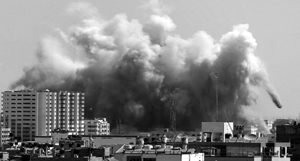
Efforts to arrange a humanitarian ceasefire between Israel and Hamas have failed despite efforts by the United Nations, USA, Qatar and Turkey. Israeli Prime Minister Benjamin Netanyahu's insistence that the Israeli military would continue dismantling Hamas' tunnel network (Operation Protective Edge) "with or without a ceasefire" and irresponsible air attacks on civilian targets has ended up eventually in the failure of the sought-after international effort aimed at enabling innocent civilians to gain a much-needed reprieve from violence. This has stopped Gaza inhabitants from receiving needed humanitarian relief, and also in creating the opportunity to carry out vital functions, including burying the dead, taking care of the injured and restocking food supplies.
Since Israel began its offensive in Gaza on July 08, nearly1, 900 Palestinians (including 340 children) have been killed - most of them civilians. Sixty-two Israeli soldiers have also died. Two Israeli civilians have been killed, as well as a Thai national in Israel. What an unfortunate scenario!
Israel says its operation in Gaza has been designed to defend its population from attacks by Palestinian militants. Hamas wants a blockade of Gaza, maintained by both Israel and Egypt, to be lifted. Both sides have given strong reasons to support their claims but Israel has demonstrated through brute force that political will is inconsequential.
It would be fitting at this point to refer to some statistics about living conditions in Gaza. About 1.7 million Palestinians live in Gaza, 4,505 per square kilometer. Of them, 225,178 are now living in UN or public buildings and more than 240,000 are sheltering with families. It has also been estimated that 299,000 children out of total Gaza's population need psychosocial help. Critics of Israel have pointed out that its military action has made it impossible for the 1.7 million people of Gaza to find shelter from air and artillery strikes
It may be recalled here that Israel occupied Gaza in the 1967 Middle East war and only pulled its troops and settlers out in 2005. Israel considered this as the end of the occupation, but it still exercises control over most of Gaza's borders, water and airspace. Egypt controls Gaza's southern border. This dual control and sea blockade have created a miserable scene where the Gaza population today has only one hour of electricity a day, practically no running water and very little food. This has been the longest conflict between Israel and militants in Gaza, but public backing in Israel for the army's offensive has continued to remain strong. That could, however, start to change if the number of Israeli casualties increases significantly while pursuing the stated aim of destroying the cross-border tunnels.
One aspect in the current international political dynamics has been troubling sane citizens all over the world. They have been wondering why the United Nations has failed to be more pro-active in ending the violence in Gaza - or, for that matter, in the conflicts that are raging in Syria, Iraq, the Central African Republic, South Sudan, Libya, Afghanistan or Ukraine. This is leading to frustration. The world is confronted today by many seemingly intractable crises, and the body designed to resolve and mediate them appears to be thoroughly incapable of doing so.
There has been no shortage of diplomatic effort with regard to Crimea. In February, the UN Security Council evidently had its busiest month since its creation in 1946, mainly because of a succession of meetings on the annexation of Crimea. This pace has, however, not been noticed with regard to what is happening in Gaza. This has been so because decision making around the iconic horseshoe table in the Security Council at the UN's highest level has been hamstrung by discord between major world powers. This has resulted in, according to some analysts, UN Secretary General Ban Ki-moon being perceived as 'the ineffectual head of an ineffectual organisation'. However, the main reason appears to be that some of its member-states are not only lacking in constructive political cooperation but are also busy working against each other. The consequence has inevitably resulted in deadlock and dysfunction. Relations between the US and Russia, who both have Security Council vetoes, have seriously deteriorated in the recent past and this is exacerbating an already bad situation. UN agencies like OCHA (Organisation for the Coordination of Humanitarian Affairs) and UN bodies like the Security Council are suffering because of diplomatic divisiveness.
The UN, in the present Gaza conflict, has been sheltering more than 225,000 people in its schools. It has, however, not received the strategic security support that it deserves. Nearly ten UN employees have been killed while working in Gaza. This humanitarian angle of UN engagement has also been stifled with regard to OCHA wanting but waiting for months to deliver aid (over the borders of Syria without the permission of the Assad regime) to some 2.0 million internally displaced persons in that war-torn country. It took months of tortuous negotiations to secure a Security Council Resolution because of Russian concerns (an ally of Assad) about the violation of Syrian sovereignty. This has resulted in an acerbic online observation that 'often the international press corps stationed outside of the UN Security Council spends more time covering inaction rather than action'.
This has led analysts to believe that the institutional deficiencies of the UN unquestionably exacerbate its dysfunction and the veto power is 'a recipe for gridlock'.
The United States has used its veto 14 times since the Cold War ended, while Russia has wielded it eleven times. Both countries have used their vetoes to protect allies: Israel in the case of America, and Syria, more recently, in the case of Russia. The right of veto has enabled the permanent members of the Security Council to reject anything that threatens their strategic political interests, despite the organisation's lofty principles, notably its mandate to protect civilians when their own state authorities cannot. Consistent with this policy, the US Senate has now, despite Israel's superiority, rushed through a US Dollar 225 million bill to replenish Israel's already strong and effective missile defense system. It will enhance their aggressive posture.
Associated with the United Nations since 1974, this scribe knows that many draft Security Council resolutions do not even make it to a vote, because of the threat of veto. The Security Council today appears to be associated more with caustic invective and sound bites, where a country airs grievances and trades accusations rather than engaging in constructive diplomacy. As a result, according to Gérard Araud, former French ambassador to the U N, "The United Nations, ends up being in charge of crises that are of no interest to anybody."
Returning to Gaza, battling Palestinian militants in Gaza two years ago, Israel found itself pressed from all sides by unfriendly Arab neighbours and had to end the fighting. Not this time.
Post-Morsi Egypt now leads a new coalition of Arab States, including Jordan, Saudi Arabia and the UAE. They all appear to be not too much against what Israel is doing in the Gaza Strip. Saudi King Abdullah has slammed the silence of others about this merciless killing spree but the loathing and fear of political Islam appears to be so strong that it is outweighing the allergy to Netanyahu. Comparably, six Latin American countries - Brazil, Peru, Ecuador, Chile, Bolivia and El Salvador have openly condemned Israel. The silence among the Arab countries has been deafening. This appears to have developed not only from their common opposition to Iran, a rival regional power that has had a history of funding and arming Hamas, but also from the belief that Hamas cannot be allowed to triumph and emerge as the most powerful player within the Palestinian paradigm.
This new dynamic has inverted all expectations that had evolved through the Arab Spring uprisings. Instead of sympathy for the Palestinians and hatred for Israel, the response is going the other way. The diatribe against Hamas is being carried out also in some Egyptian talk shows which have since been re-broadcast by Israel into Gaza. Egypt's policy of keeping border crossings closed, according to analysts, has exacerbated the scarcity of food, water and medical supplies in Gaza. For Israeli hawks, the change in the Arab states has been relatively liberating.
Egyptian officials have denied such accusations and have claimed that in addition to delivering medical supplies to Gaza, they have kept open lines of communication with Hamas, including allowing a senior Hamas official, Moussa Abu Marzouq, to reside in Cairo. Analysts have, however, observed that some of the face-saving gestures by Egypt and its Arab allies have arisen out of their awareness of their citizens' emotional support for the Palestinians. This balancing act could grow more challenging as the Gaza carnage and its endless loop of violence continue to mount.
Muhammad Zamir, a former Ambassador and Permanent Representative to the EU, is specialised in foreign affairs, right to information good governance. mzamir@dhaka.net