
The case for deferring the LDC graduation
Tanim Asjad | Tuesday, 16 September 2025
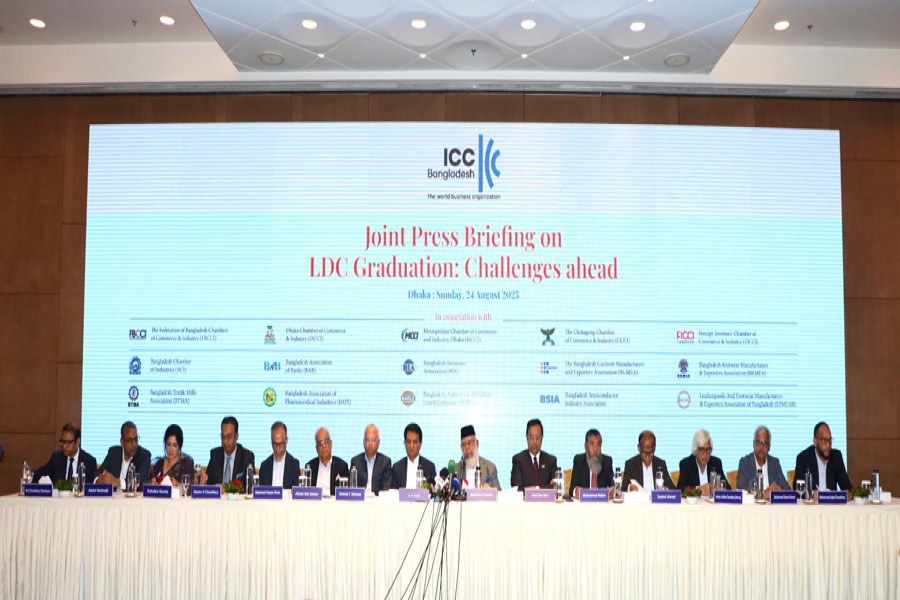
For the last couple of months, the demand for delaying or deferring the country's scheduled graduation from the Least Developed Country (LDC) category has become louder especially by the business community. A series of seminars, press briefings and discussions have taken place to highlight the rationale of the demand. So far, the government seems indifferent to the demand hinting that it is unlikely to move to seek the extension of the scheduled graduation in November next year.
The decision to get the country out of the LDC category was taken almost a decade ago by the autocratic regime of Hasina and a number of steps were taken to move ahead. Bangladesh has met all three criteria -- GNI, Human Assets Index, and Economic Vulnerability Index -- for graduation in 2018 first and later in 2021 for the second time. Following these two consecutive reviews, the United Nations (UN) recommended for graduation in 2021 with a 5-year preparatory period setting the deadline on November 24, 2026.
As the time of meeting the deadline is approaching, the business community along with a section of civil society have raised voices to defer the graduation deadline for five to six years. In the last month, business organisations and trade bodies called for the deferment through three separate seminar and press conferences. The biggest event was organised by the by ICC Bangladesh together with FBCCI, DCCI, MCCI, CCCI, FICCI, BCI, BAB, BGMEA, BKMEA, BTMA, BAPI, BAPLC, BIA, BSIA & LFMEAB at the last week of August. At the event, leaders of these trade bodies presented various risk factors involving the scheduled graduation and urged the interim government to take pro-active measures. They argued that delaying the graduation is necessary for adequate preparation to absorb the post-graduation shocks and make the graduation a success.
Business leaders pointed out that once the country is come out from the LDC category, it will loss the existing duty-free market access to the European Union (EU), United Kingdom (UK) and other key export destinations and tariffs may rise up to 12 per cent unless the unless Bangladesh secures bilateral free trade deals. There is, however, three-year transition period in EU market till 2029. In the UK market, it is also 2029 and 92 per cent of exports afterwards; in Canada, the duty-free market access will continue until 2034.
One graduated, Bangladesh will also see the end of special trade benefits under the World Trade Organization (WTO) such export subsidies and relaxed rules of trade-related intellectual property rights (TRIPs). Business leaders apprehend that this will make patent rules stricter for the pharmaceutical sector and increase compliance costs.
There will be stricter rules of origin which will make the export-oriented apparel sector vulnerable and so the overall exports as the sector accounts for over 81 per cent of the country's total export value. Business leaders, however, acknowledged that export diversification is crucial for Bangladesh to reduce over-dependence on RMG and build resilience against global market shocks. To diversify the exports beyond garments, the country needs some more time and so it is logical to delay the graduation, they opined.
They are also concerned that pharmaceutical industry will face a big blow after the LDC graduation. Bangladesh's pharma industry supplies 98 per cent of local demand and exports to more than 150 countries, but it needs a TRIPS waiver extension. Without at least six more years to prepare, prices of lifesaving drugs such as those for cancer and viral infections may jump significantly which will undermine public health and export competitiveness. At present, Bangladesh TRIPS waiver is valid until January 1, 2033 (or until LDC graduation, whichever is earlier). So, once the country graduates (scheduled in November 2026), this protection will lapse, exposing the pharmaceutical industry to full patent enforcement. There is, however, a counter argument that no impact on about 85 per cent of the generic drugs and on Big Pharma producing under inventor contracts.
Another risk factor is costlier external financing as the country will shift from concessional loans to market-based borrowing and likely to face debt-servicing pressure. The counter argument is that LDC gradation is likely to improve the country's credit rating and so external financing will be competitive.
Business communities of the country further argued that there is a number of examples that the LDCs deferred or delayed their graduations. For instance, Maldives postponed its graduation by eight years, citing vulnerabilities related to its small size and limited development capacity. Vanuatu delayed its transition by a remarkable 20 years, largely due to the socio-economic impacts of tropical cyclones and other external shocks. Samoa and Equatorial Guinea both extended their preparation period by five years. Nepal secured a five-year extension, reflecting both natural disaster recovery efforts and the need for economic readiness. The Solomon Islands were granted a six-year delay. Myanmar met the UN graduation criteria in years such as 2018, 2021, and 2024. However, due to political instability following a military coup, the UN Committee for Development Policy (CDP) deferred its graduation until 2027.
It is to be noted that none of these countries, except Myanmar, are comparable to Bangladesh in terms of size of economy and geography and population. Moreover, the country has better graduation thresholds than Nepal and Lao PDR and also not a land-locked nation like these two countries.
The business communities, however, stressed the need for five to six year extension of the deadline of the graduation as a transition period and suggested a number of measures to be completed within the period. These include: (i) secure trade deals with major trading partners to offset US tariff shocks; (ii) drive export diversification into pharma, IT, leather, agro-processing, and light engineering; (iii) build human capital for Industry 4.0 -- automation, AI, advanced manufacturing; (iv) Attract quality FDI -- investors who bring technology and sustainability, not just cheap capital; and (v) strengthen governance and climate resilience, ensuring competitiveness in a turbulent global economy.
Whether all these are achievable during the five to six years of proposed transition period is a matter of debate especially when the country could not move significantly towards the diversification of exports or negotiate any free trade deal in the last ten years. One, however, needs to keep in mind that the autocratic regime did not allow to raise voices for logical demands. Moreover, the regime was totally gripped by corruption and bad governance undermining the country's true potential of advancement. For the ousted regime, LDC-graduation was more of a showcase of its flawed development, not of real progress. One of the examples was the government-sponsored celebration in 2018 after the country formally get the UN acceptance for meeting the three criteria. The then government did not focus on adequate preparation to absorb the post-graduation shocks and critical challenges like IPRs.
Against the backdrop, the interim government needs to examine the demand for deferment of the LDC graduation of Bangladesh intensively.
asjadulk@gmail.com