
The colours, and feelings, of evenings and mornings
Shihab Sarkar | Friday, 2 June 2023
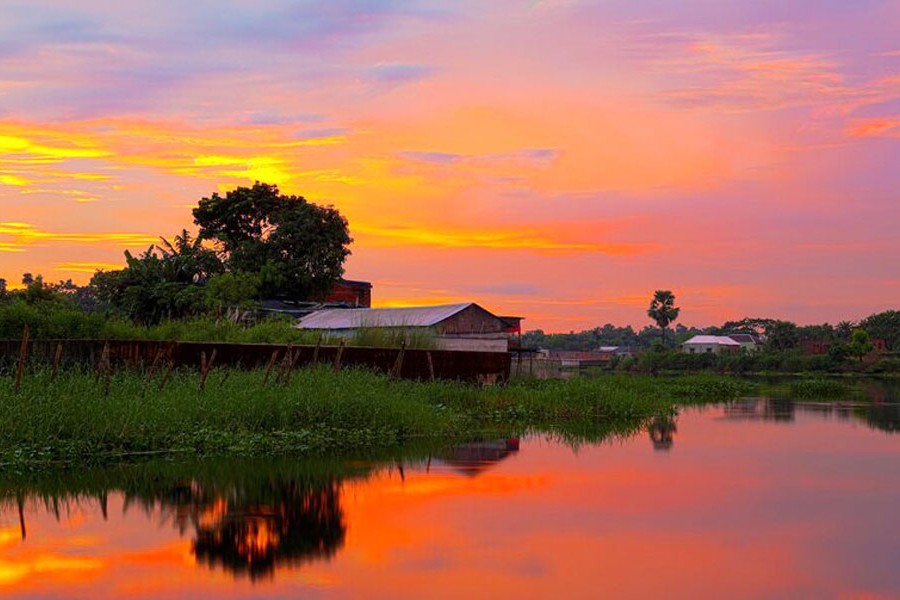
The fast impending evening makes many feel sad. By sunset they are drained of all their positive thoughts. A sense of doom overtakes many sensitive people if they happen to be in a secluded place. Perhaps in accordance with this, a large section of the elderly people is found engrossed in reflections on death. Philosophy-laced thoughts, thus, revolve round death and the end of living beings. Scores of romantic poets and artists have for ages been defining the eve-time as a symbol of parting and death. This distinctive trend is widespread among the reflective people in the East, and also in the Bengal region. It doesn't point towards any morbidity. In reality, the creative works of people viewing humans and the world from a philosophical angle attempt to fathom life in its totality.
In the process, the morning glow and the evening twilight are the two phases of a single time. It's the average people who discover evenings being in sharp contrast to mornings. It stems from the common belief that days stand for the buoyancy of life and all its brighter aspects; and nights represent everything dark and is opposed to light. Oriental mystics, however, never feel satisfied with this simplistic reflection. However, that's a different argument altogether.
For now, the average people had better remain busy with what they see in their plain eyes and feel in their mundane world. Let's begin with evenings. In the developed countries, an evening is the time for engaging in leisure and entertainment. They wait for the time of merrymaking eagerly, as the daytime is spent in hard schedules at the workplace. For raucous fun they have the 2-day weekends. On the other days, people go home to pass their time with the family members. Majority of the families love to stay home and have their meal there. Those who want to spend the evening outside with dinner take a short trip to the neighbourhood restaurants. Since the following day is a working day for both the male and female heads of families, they return home early. The elderly people are an exception. In the summer evenings, they drive to a river or lakeside, choose a bench at a deserted place and watch the sunset. Many prefer the seashore to the crowded areas to pass their lonely hours.
When it comes to urban bustle in large cities in the developed world, there is not much difference between days and nights. It is the dazzling neon signs, lavishly lit shopping malls and street-side music and fun which single out an evening and late-evening in the metropolitan cities. On weekends, pavements are filled with streams of pedestrians. At places roads see gridlocks, with cars ground to a halt at the traffic signals. The spell of a weekend evening on days spills over to midnight hours.
Decades ago, a Dhaka evening would find itself not much different from that in the 1960s. The fifties were the time when the sylvan Dhaka could be compared to a fast-spreading city of the future. Indeed it was. A decade later, in the 1970s, it would keep growing as the capital of Bangladesh. Unlike the streets lined with the yellowish low-power street lights, all roads in the city were eventually able to see them fitted with neon, sodium and, later, LED lights. In keeping with the road views by night, the urban evenings in Dhaka started wearing a new look. In the following decades, Dhaka just kept adding to its evening beauty. In the 1980s-1990s, the fast sprawling Dhaka witnessed the opening of several shopping malls in many parts of the city. As years wore on, dazzling commercial centres continued to come up in far-flung areas of the city. They were joined by a number of magnificently built multi-storey shopping complexes the 21st century. The building spree of movie theatres, popularly called multiplexes or cineplexes, which were integrated to these shopping centres, eventually emerged as the capital's new attractions.
In the 1970s, Dhaka's Bailey Road emerged as a bustling enclave of theatre staging. As the venue remained closed for a few years for renovation work in the late 1980s, the theatrical activities shifted to the remodelled Shilpakala Academy. The academy premises at one time came to be known as the most preferred cultural hub of the capital. Its large and small auditoriums remained throbbing with cultural events. At one stage, Shilpakala Academy began arranging open-air events on its premises. Besides, painting shows nowadays are a common event at the academy throughout the year. The two-yearly international art biennale is now a great attraction for the painting connoisseurs. Compared to the dull and drab Dhaka evenings of the 1960s-`70s, its residents can now take pride in its metamorphosed look. In the early 1960s, many busy Dhaka streets would become deserted by 10 in the night. Nowadays, it remains awake long after midnight, especially in cases of gala wedding ceremonies or open-air shows. With the unabated increase in various types of road traffic, the metropolitan Dhaka is fast losing its occasional phases of quiet and tranquility. It was its hallmark decades ago. Its sound pollution has reached such an extent that the city is considered one of the noisiest in the world. This change is par for the course. It's inevitable thanks to the city's increase in population and other activities. It's this urban aspect, which contributes to the fast losing of Dhaka's moments of reflections experienced in the past.
In contrast to the urban evenings, early mornings stand for freshness and rejuvenation of life. It touches upon both physical and spiritual aspects of humans. In summer-dominant countries, a morning begins with its refreshing beauty. Once upon a time in Dhaka, people would come out at dark-enveloped dawns for short stretches of morning walk. In time, they have been replaced with freehand exercises in public parks. Some health conscious people prefer jogging on lakeside roads to these morning outings. For the believers, the day begins with a prayer for allowing them to survive in peace, and preparing themselves for a meaningful survival.
Mornings in the Eastern culture represent a transcendental existence. Those who subscribe to this trend of thought can realise the basic difference between a morning and an evening. Both the health conscious people and those with a philosophical bent of mind view the daybreak after a long night in two distinctive ways. Due to the different essences of a morning and an evening, the impacts of these critical times on individuals vary. This is universal. The average people, on being swayed by the dazzle of evenings, especially those descending on the urban landscape, fail to read the message --- i.e. the hours' latent gloom and their impacts on individuals. Mornings appear to be free of what the purists call hang-ups. Be it a greenery-filled park or a river bank, a morning heralds thoughts filled with joy or hope, no matter if the feelings are transient or based on reveries.
shihabskr@ymail.com