
The debate over seating services
Md Shakil Ahmad | Saturday, 6 May 2017
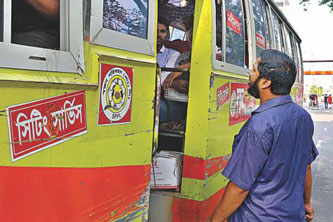
As a regular commuter of Dhaka city, this scribe also like others is a victim of every profit motive of bus owners, drivers and conductors. So, any decision favouring the passengers from the governing authority comes as drops of rain in the hot and humid weather. Such a decision came recently regarding the traffic in our busy city. All premium seating or gate-lock bus services were banned, though later it was withdrawn. This scribe tends to delve deep into the problem. The analysis starts from finding the reasons why bus owners opt for seating or gate-lock services in the first place. The most apparent answer is: making higher profit by charging the passengers higher fares. But is it feasible that only by charging higher fares, the premium bus owners can get higher profits than those who do not offer such services?
The profit of the bus owners depends on the fare rates, the number of passengers and the cost of operating the buses. Undoubtedly, premium services allow them to charge premium fares, so the rate per passenger is high. Does it push the total revenue higher? That depends on the number of passengers. In Dhaka city, from the viewpoint of both capacity of the buses and the capability of the passengers, the number of commuters enjoying premium services is low. Therefore, the total revenue (=higher fare × lower premium customers) will not be much higher but not less than the local bus service providers earn due to much higher fares. To operate a premium bus service, more buses are required to be there that means an increased cost to pay for fuel, maintenance, drivers and other staffs. Therefore, the cost is high for the premium bus service providers resulting in a moderate profit for them. The higher revenue motive, less operational hassles for drivers and conductors and the demand among the customers wanting hassle-free transport services prompt the bus owners to operate such seating and gate-lock buses.
On the other hand, the local passengers (constituting majority of the passengers) get crammed into local buses. The number of local buses also falls as more buses are required for offering the premium services. With fewer buses there, the number of passengers of local buses grows unbearably. This generates a higher amount of revenue for each local bus. In both the scenarios presented here, the premium bus service providers and local bus service providers all generate revenue for themselves. But the commuters bear the brunt. Both the number of roads and buses are increasing, but the sufferings of passengers because of traffic jams, lack of buses, road accidents etc. are not abating. People wait at the bus stops but cannot board any, because the seating service buses pass them keeping the gate locked while local buses pass them jam-packed. Women, sick and older passengers are the worst sufferers in such a situation.
What we need is: devising a way so that the increasing number of premium buses can carry more passengers at lower fares-distribution of passengers between the local bus system and the premium bus system. It is very simple: take some passengers from jampacked buses to those providing seating services. Though the passengers of seating service buses will be disturbed to some extent, that will not be a great deal in consideration of easing the sufferings of most local passengers. This is what exactly the government tried to do by banning all the seating and gate-lock services. But later the decision was halted. If there is no so-called seating or gate-lock bus services charging high fares, all the commuters will enjoy the same benefits. This will push up the number of passengers for the previously premium buses and this will help fetch a moderate amount of revenue for all of them. Then the increasing number of buses will accommodate a growing number of commuters. So, the revenue will also be higher in the medium to long term. Then the revenue, expenses and facilities will get distributed evenly among the bus owners.
If this can be done, that will help ease the chockablock of the local buses with no unjustified high fares. Then a less number of buses will be required and thus the roads will be freed. This will entail no big profit loss and the overall welfare of the society will get maximised.
The bus owners have reacted against the ban. But in the short run they needed to sacrifice some profits. They could not realise the benefits in the long term. So they did not accept the decision. When they do not agree, the general people land in trouble. Victimising the public, the bus owners forced the authority to halt the ban decision. This situation is recurring and every time such a decision is taken, we, the people, get punished.
As it will take time for the bus owners to understand the benefits of such decisions, the authority needs to do a little more in implementing this policy. Taking legal initiatives is not a permanent solution to this problem. People will tend to deviate from the path of rule all the time as by deviating they can get benefit. Here the control should be taken off from them. A digital bus fare collection system can also be introduced. Here the bus fare needs to be uniform and it has already been taken care of by BRTA. Here, the technology can be used to collect the fares. If every bus is equipped with any distance measuring equipment and rent collection machine and passengers are provided with prepaid cards for payment, it will be easier for people to commute from one place to another. So, the bus owners will not be losing any revenue and the passengers will not pay any unjustified charges. Both parties will be happy. We can implement this system using our existing infrastructure. The BRTA can direct the bus owners to implement such a system. People will be happy to use them as we have seen in the event of rapid spread of Bkash services. None required any training to get used to Bkash.
myshakil@live.com