
FROM OIL ROUTES TO RICE FIELDS
The hidden cost of war for Bangladesh
Ravi Nandi and Wais Kabir | Monday, 16 March 2026
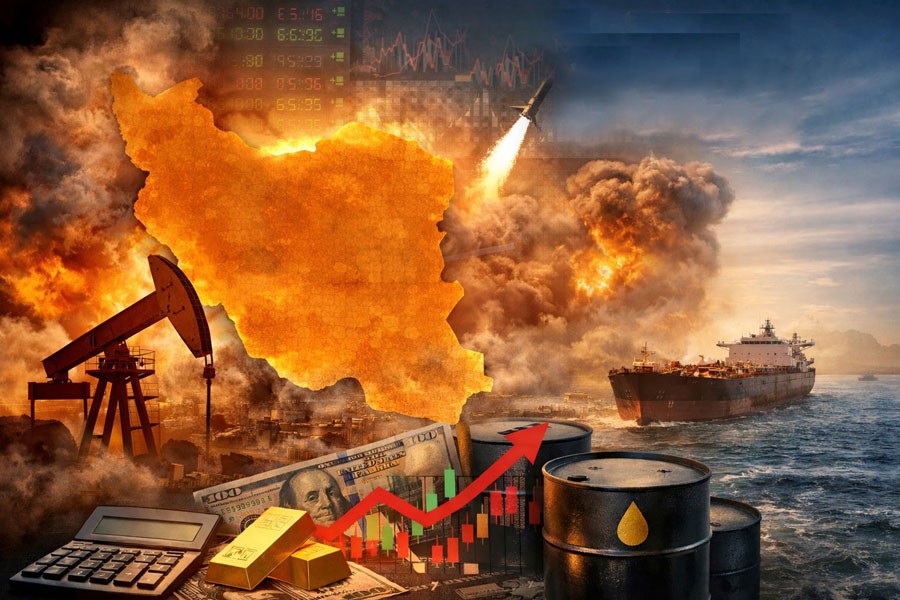
Wars fought thousands of miles away often feel distant from Bangladesh. But in today's interconnected economy, conflict in one region can quickly affect daily life in another. Rising tensions around the Strait of Hormuz, a narrow corridor through which about 30-40 per cent of Bangladesh's fuel and LNG imports pass, show how closely food security is tied to global shipping routes. When that route becomes risky, the impact can reach Bangladesh's rice fields faster than diplomacy can react.
For Bangladesh, the impact is straightforward: when the Gulf becomes unstable, energy prices, freight charges and insurance costs rise. Fuel prices rise, and transport costs increase across the food supply chain. In an import-dependent economy like Bangladesh, the cumulative result is inflation at the market stall.
To address these challenges, the government must recognise that this is not merely an energy issue. It is a food security issue. And the most vulnerable point in that system is irrigation.
IRRIGATION-THE WEAK LINK: The most fragile point in Bangladesh's food system is not the port or warehouse; it is the irrigation pump. Bangladesh operates about 1.6 million irrigation pumps, nearly 80 per cent of them powered by diesel; much of this irrigation supports water-intensive boro cultivation. Dry-season boro rice, the backbone of national production, depends heavily on irrigation because rainfall is scarce.
Diesel is the most consumed fuel in the country, accounting for around 73 per cent of the country's total fuel consumption. When diesel prices rise sharply, the costs of irrigation, transport, and farm mechanisation services increase immediately. Farmers either pay more for water or reduce irrigation hours to manage expenses. For small farmers already operating on thin margins, this is not theoretical. Higher fuel prices mean delayed watering and lower yields. Some farmers may reduce production, leading to higher imports. The implications for the national food supply are serious. Boro rice production has been central to Bangladesh's progress toward food self-sufficiency. If irrigation becomes unreliable due to rising fuel prices or uncertain supplies, the consequences will be felt across both production and prices.
The government must therefore treat irrigation fuel as a strategic priority during this crisis.
Ensuring an uninterrupted diesel supply for agricultural regions during irrigation seasons should become an explicit policy objective. Strategic reserves and targeted distribution can help prevent supply disruptions from cascading into crop losses.
FERTILISER - THE SECOND SHOCKWAVE: Fertiliser markets are closely linked to global energy and shipping networks. When geopolitical tensions disrupt supply routes or raise freight costs, fertiliser prices can rise dramatically. Bangladesh imports large quantities of fertilisers, including urea, diammonium phosphate, triple superphosphate, and muriate of potash. Disruptions in shipping routes through the Gulf or surges in transport costs can quickly push up import prices. This not only increases the government's subsidy burden and farmers' input costs, but also has ripple effects across other sectors. Beyond rice cultivation, fertiliser price shocks also affect maize production, a key component of poultry and livestock feed. As Bangladesh's expanding poultry sector relies heavily on maize-based feed, rising feed costs soon drive up the prices of eggs and chicken, placing additional strain on household budgets.
What begins as a maritime security issue can quickly become a nutrition crisis.
WHY THE POOR SUFFER FIRST: Price shocks do not affect all households equally. Poor families suffer the most because food takes up the largest share of their household budget. Higher diesel prices raise costs throughout the supply chain from irrigation and harvesting to transport and distribution. If fertiliser prices rise simultaneously, farmers may reduce input use or take on more debt, both of which increase the risk of lower yields. At the consumer level, low-income households have little room to adapt. They cannot stockpile food or switch to premium suppliers. Instead, they reduce food consumption or substitute cheaper, less nutritious options.
This is how distant wars quietly translate into hunger at home.
WHAT THE GOVERNMENT MUST DO NOW: The government must act quickly to reduce these risks. Four priorities stand out. These recommendations are:
First, protect irrigation continuity. Fuel supply planning must prioritise agricultural irrigation during critical cropping seasons. Strategic fuel reserves and targeted distribution mechanisms can help ensure that farmers have uninterrupted access to diesel.
Second, strengthen fertiliser procurement strategies. Bangladesh should diversify import sources and secure supply contracts early, before geopolitical shocks drive prices even higher. Timely procurement can prevent panic buying during market peaks.
Third, expand targeted consumer protection. Market interventions, food assistance programs, and cash transfers can help protect vulnerable households from sudden spikes in food prices without imposing unsustainable fiscal costs.
Fourth, integrate freight and insurance risks into macroeconomic planning. Rising shipping costs directly affect import bills for fuel, food and agricultural inputs. Economic policy must anticipate these shocks rather than react after prices surge.
BUILDING RESILIENCE FOR THE FUTURE: Emergency measures alone will not protect Bangladesh from future global disruptions. Structural reforms are equally important.
The most important long-term solution is reducing dependence on diesel irrigation. Solar and grid-powered irrigation can lower farmers' exposure to volatile fuel markets while supporting climate commitments. However, these programs must be designed carefully to avoid groundwater overuse and ensure equitable access for small farmers.
Second, improving input efficiency in agriculture can reduce vulnerability to fertiliser price shocks. Conservation, precision agriculture practices and improved nutrient management can lower fertiliser use while maintaining yields. Input use efficiency is lower in Bangladesh; it must be enhanced to reduce loss.
Third, strengthening mechanisation services and agricultural extension systems can help farmers maintain productivity even when labour or input costs rise.
Finally, digital early-warning systems and better agricultural advisory services can allow farmers to respond more effectively to changing conditions, reducing crop losses and improving decision-making.
Bangladesh cannot control conflicts in the Middle East, but it can prepare for their economic consequences. Energy shocks often turn into food shocks, hitting the poorest hardest. To protect food security, the government must act early through strategic fuel planning, reliable fertiliser supply, targeted social protection, and stronger agricultural resilience.
Dr Ravi Nandi, Policy and Food Systems Economist, CGIAR CIMMYT, Bangladesh. r.nandi@cgiar.org. Dr Wais Kabir, former Executive Chairman, BARC. waiskabir@hotmail.com