
The looming disaster
Babui Salsabil | Monday, 5 June 2017
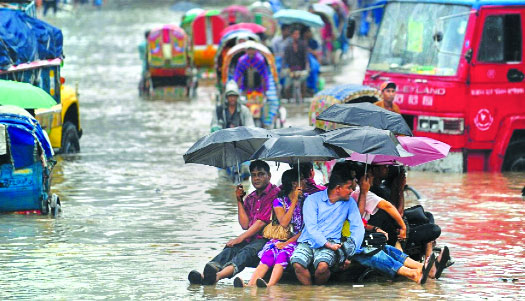
Today Bangladesh is standing at the crossroads of economic development. On one hand, there is the lure of advancement towards the economic gains of the modern world, whereas, on the other, there exist a plethora of challenges that impede its progress towards that development. Among various other challenges that Bangladesh faces on its road to development, the impact of the global climate change is of particular prominence.
What Is Climate Change?
Climate change is a much talked about issue worldwide that concerns the overall well-being of the globe both environmentally as well as economically. The global climate has been going through constant change over time. However, recently, the global temperature has been increasing more rapidly than before. Scientists hold a rapid human-induced warming accountable for this. While this human-induced temperature increase had initially been set off by the Industrial Revolution, humans continue to add to the natural greenhouse effect with gases released from various industrial and agricultural activities, which further contribute towards the increasing temperature. The emission of excess carbon dioxide is one of the primary causes of the rise in global temperature and, if not controlled, will badly impact the global climate. This phenomenon of increase in the world's temperature is known as global warming and will have grave consequences on the global climate, if not taken care of immediately. Global warming will result in climate change in numerous aspects such as rising in sea-levels, frequent and severe storms, droughts, and could even lead to the extinction of some species. The lesser developed countries of the world would be the worst victims since they are least prepared to face these challenges.
How Does Climate Change Affect Bangladesh?
Bangladesh is a low-income country that is making slow, yet steady strides towards a stronger and more stable economy. However, as stated earlier, the impact of climate change poses a major threat towards Bangladesh's environmental as well as economic well-being. Although Bangladesh is among the least significant contributors of the emissions steering global warming (only 0.3%); it will be one of the worst sufferers of the global warming effects. In fact, we are more vulnerable to climate change than many other countries given our geographical setting as well as limited economic status.
Bangladesh is one of the largest deltas in the world which is extremely susceptible to natural disasters. Its low-lying landscape, high population density, and inadequate resourcefulness are some of the major factors that make it one of the major victims of the global climate change. For example, one consequence of global warming includes the rise of sea-level. Being adjacent to the Bay of Bengal, Bangladesh will be directly hit by this sea-level rise, particularly in the coastal areas. Scientists believe that rising temperatures will also lead to more extreme weather conditions, including more frequent cyclones in the Bay of Bengal, as well as floods. With almost 80% of its total area prone to flooding, once again, the country will be badly hit. Finally, since Bangladesh is largely dependent on agriculture, the other impacts of climate change, such as, severe temperature, droughts, and salinity intrusion etc. could adversely impact its crop production.
Though not adequate, Bangladesh does have some measures to face the challenges of global warming. For instance, the country has developed an early-warning system and also built numerous storm and cyclone shelters, that have reduced the casualties. However, a lot more needs to be done in the upcoming years not only to face the disasters caused by climate change but to also device ways to slow down the process altogether.
Therefore, at present, given the country's geographical drawbacks and limited resources and infrastructure, the global climate change will have severe adverse effects on the people of Bangladesh. It will be extremely difficult for the country to face the climate change-led disasters as well as to rehabilitate the victims afterwards.
The Paris Climate Deal Effect:
In December 2015, the Paris Climate agreement came into being, in which most of the world's countries had agreed to this first global treaty aimed towards reducing the emissions of greenhouse gases. This was supposed to be a stepping stone towards the long and arduous process of decelerating climate change. The countries had set their individual plans for limiting emissions and also agreed upon regular meetings to assess progress.
The idea behind the Paris climate agreement was that all the countries country, whether rich or poor, would proactively try to avoid the adversities of climate change. However, as the world's largest economy, the United States of America, has recently decided to pull out of this process, it could turn out to be a major impediment in all the other nations' efforts to prevent global warming, particularly the poorer ones. This is because not only is America responsible for emitting about one-third of the world's excess carbon dioxide, but it had even started the process of industrialization, and thus, carbon emission, long before most other countries. Therefore, if such an old and major contributor of global warming steps aside from the collective attempt to curb out its effects, the newer and less prominent contributors might have little incentive to carry on their own endeavors. However, this may not necessarily be the case. In fact, the United States' withdrawal from the deal could conversely also drive the remaining nations to intensify their efforts towards stalling climate change. Only time will show, however, what the real outcome will be.
Additionally, a crucial element of the Paris deal involved the developed countries to offer financial aid to the poorer countries to help them get better equipped to fight climate change as well as deal with its adverse effects. The underlying idea was that the world's richest nations -incidentally also the largest contributors to global warming- would help the world's poorest ones to deal with the damage caused by climate change - a process which was largely catalyzed by them. The United States had promised to donate USD 3 billion in aid to the poorer countries under the deal. Although the Obama administration had already disbursed some of the promised amount, the Trump administration has decided to stop all future payments. This move could severely discourage the developing countries in their own efforts to reduce global warming.
In the context of Bangladesh, as in the case of many developing countries, therefore, the withdrawal of the United States from the Paris Climate deal could serve as a huge impediment towards the reduction of global climate change.
Recommendations and Way Forward:
While Bangladesh has made some progress towards fighting the adverse effects of climate change-induced disasters, however, a lot more needs to be done, particularly in terms of the preventive measures.
One key initiative could be introducing alternative energy sources rather than the traditional sources that contribute to greenhouse gases. The Bangladesh government has already taken initial steps towards this direction. In general, carbon emission should be reduced wherever possible to restrain the greenhouse effect. In order to achieve these, the government could take various measures, such as: encourage the use of energy efficient electronics through reduced taxation, impose tax on companies emitting greenhouse gases, drive mass awareness campaigns for people to understand the true impact of global warming and teach ways to avoid it.
Global warming and climate change are a national and global concern. What affects the world affects our country, what affects our country affects our homes and family. It poses threat to each of us. Therefore, while we have expectations from the national and global leaders to address this impending peril, it is also our individual responsibility to do what is possible within our capacity to combat this universal risk. Even small steps can lead towards concrete impacts if the effort is collective.
The writer is Principal Business Consultant Monitoring & Results Measurement, Swisscontact Katalyst
babui.salsabil@swisscontact-bd.org