
The Maracanazo: Brazilian Tragedy and the 1950 World Cup
Wednesday, 9 July 2014
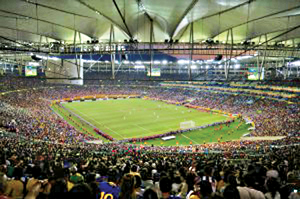
Any study of Brazilian football reveals that football is inextricably linked to Brazilian society. When the British introduced Brazil to football in 1894, it was impossible to predict that football would become a key aspect of its culture.
However, during the following decades, football became Brazil's national pastime, almost a religion, and Brazilian soccer players created a style of play distinctively Brazilian and different from other styles of play around the world.
As a result, Brazil was proud to be chosen by FIFA as the host of the World Cup in 1950, only 56 years after the first Brazilian football match took place. It seemed that there was no candidate more deserving of the chance to organise the World Cup than Brazil. Everyone recognised the talent of the Brazilian national team, and the team's fans had confidence in its ability to win-so much confidence that many citizens celebrated the victory before the match had even taken place.
This presumptuousness was a grave error; to Brazil's embarrassment, the team was defeated at home and on the largest stage in the world at the hands of Uruguay, Brazil's comparatively diminutive neighbour. The Brazilian people were stunned: the entire country had been invested in the success of its team, and it was not emotionally prepared for a defeat.
The World Cup of 1950 will certainly be on the minds of Brazilians during this World Cup tournament, but, given the humiliation and pain of 1950, it is unlikely that they will want to discuss it. To truly appreciate the significance of the World Cup this time, foreigners must understand the World Cup of 1950 and its influence on the Brazilian psyche.
The Brazilian people excitedly looked forward to the final match between Brazil and Uruguay in 1950. The fact that this World Cup was the first since the twelve-year interruption caused by World War II also contributed to the anticipation.
Brazil should triumph on its own pitch, in front of the 200,000 Brazilian fans in the Maracanã stadium, the largest stadium in the world.
The Maracanã had been specifically constructed in preparation for the 1950 World Cup. The objective was to construct a stadium that would be a testament to the success of Brazilian football and the victory of the Brazilian national team.
In practice, the Maracanã was constructed to serve as a temple of Brazilian football. Due to the enormity of the stadium, construction was delayed and many people feared that it would not be ready to host the finale.
Although the construction of the Maracanã was not completely finished until 1965, the stadium opened its doors for a friendly match between Sao Paolo and Rio one week before the 1950 World Cup.
After much anticipation, the final match took place on July 16. After a scoreless first half, Friaça, a Brazilian striker, scored a goal during the 47th minute. It seemed that victory was Brazil's destiny, and the 200,000 fans cheered uproariously. During the 66th minute, the Uruguayan winger Juan Schiaffino scored a goal to tie the match.
Given the results of previous matches, a tie was sufficient for Brazil to win the championship. Then, another Uruguayan winger, Alcides Ghiggia, scored a goal during the 79th minute. Uruguay had surpassed Brazil. The Maracanã was silenced, and the 200,000 fans in the stadium were instantly overcome with disbelief.
After the final whistle, a distressed fan committed suicide, and three others died from heart attacks. The defeat also influenced the Brazilian team itself, which did not participate in matches for two years or play in the Maracanã for four years following the World Cup.
Finally, the most visible consequence of the defeat was the fact that the national team adopted yellow and green shirts instead of the white shirts that it had worn during the match.
The defeat also had an emotional and psychological impact on the Brazilian people as a whole and on Brazilian society in general. The match against Uruguay, nicknamed the "Maracanazo," is considered to be a national tragedy and is sometimes compared to the bombing of Hiroshima.
The Maracanazo was particularly tragic because all of Brazil-and a large part of the world-watched the World Cup. Brazilians were emotionally invested in their team and, as a result, the entire country suffered from the defeat. The Maracanazo was also tragic because it hampered Brazil's efforts to show the world that it was a country worthy of the respect and admiration of its peers.
This World Cup 2014, the Maracanazo will preoccupy Brazilians during the World Cup. It is reasonable to expect that a victory would permit Brazil to overcome the painful memory of the Maracanazo. This year's World Cup presents Brazil with another opportunity to win the World Cup in the Maracanã, and to demonstrate its glory to the world.
(Write-up by Matthew Schorr. Translation from the original French version)