
The mirage of a brave new world
S Iftikhar Murshed from Pakistan | Monday, 10 November 2014
Nawaz Sharif, Imran Khan, Tahirul Qadri, Altaf Hussain, Asif Ali Zardari and an assortment of other power-obsessed leaders profess to be agents of change. There is certainly evidence of a transformation - the silhouette of a 'new Pakistan' is gradually emerging but this has little to do with the shallow rhetorical outbursts of the political leadership. It is because of the indomitable spirit of the people in the face of formidable threats. This was in evidence earlier in the week.
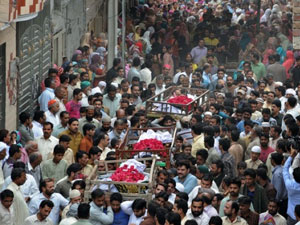
Last Sunday (November 02) tragedy visited the country yet again. A suicide bomber from one of the TTP (Tehrik-i-Taliban Pakistan) splinter groups detonated his deadly load at the Wagah check-post on the Pakistan-India border, where hundreds of people witness the crudely dramatic flag-lowering ceremony every evening. The devastating impact of the blast took the lives of 60 blameless spectators and left more than a hundred injured.
In a rare act of defiance no less than 2,000 civilians attended the ceremony the next evening. They refused to be intimidated as they roared like wounded lions, "Long live Pakistan! Death to the terrorists!" Never before has there been such a spontaneous outpouring of public anger against terrorist outfits.
The charged atmosphere at the Wagah border that evening brought to mind the words of Miranda in Shakespeare's The Tempest: "O brave new world, that has such people in't!" There has been change and it is remarkable. The people are convinced that the war against terrorism is their own and not one imposed on them by the US. It signifies their resolve to stand by the soldiers of the Pakistan armed forces in the military onslaught against extremist groups in the tribal regions of the country.
But that is only one side of the story. Barely 24 hours later, on Tuesday (November 04), the poisonous vapours of distorted religious beliefs took the lives of a young Christian couple, Shehzad and his wife Shama at Kot Radha Kishan, about 60 kilometres southwest of Lahore. They were dragged from their home, beaten to death and their remains were burnt at the same brick-kiln where they laboured daily to earn a few rupees.
The hideous incident was triggered by the local cleric who announced that the couple had allegedly desecrated pages of the Holy Quran. Can there be a greater blasphemy than murder in the name of a merciful God? But it is the ideology of extremist violence that is espoused by the Taliban which is ascendant.
The question that arises here is whether the leaders of the political parties, who rant endlessly about their ability to transform the country, have been able to change themselves. In March the PTI (Pakistan Tehreek-i-Insaf) chief Imran Khan publicly said that the "Taliban do not want to enforce Shariah on gunpoint and only want to liberate us from America's war."
Earlier that month he insisted that the TTP should be allowed to establish an office in one of the major cities of the country as that would facilitate the talks which were ongoing at the time. This was not surprising because the PTI chief's views on the Taliban are widely known.
For instance, in an article carried by one of the major newspapers last year, Imran Khan equated the military presence in Khyber Pakhtunkhwa and Fata (Federally Administered Tribal Areas) to the disastrous army action in the former East Pakistan and the TTP to the Viet Cong. The absurd implication was that the Taliban were waging a war of liberation in the same manner that the Viet Cong had fought the US occupation forces in their country.
This is the mindset that has to change if a 'new Pakistan' is to emerge. But Imran Khan is not exclusively at fault. Seldom has any political leader stooped lower than the chief minister of Punjab, Mian Shahbaz Sharif, when in March 2010, he implored the TTP to spare Punjab from terrorist violence. One wonders whether in moments of solitude he is assailed by remorse especially after the public outrage on the suicide bomb attack at the Wagah border.
Yet the inexplicable and horribly unpleasant truth is that the entire leadership of the country, whether in government or in opposition, has been complicit in according the mantle of legitimacy to the murderous TTP. The shameful resolution of September 09, 2013 adopted by the All Parties Conference acknowledged the outlawed group as a "stakeholder" and authorised Prime Minister Nawaz Sharif to initiate negotiations with the TTP "forthwith." The reason, as I was told, was that there were no major ideological differences between the Taliban and the mainstream parties.
All politicians solemnly affirm their commitment to 'the ideology of Pakistan'. As recently as Wednesday (November 05), Imran Khan and the Jamaat-e-Islami chief, Sirajul Haq addressed a joint press conference after their meeting that evening. The PTI chairman declared that "Pakistan was created in the name of Islam" and that the two parties shared the same ideology.
The political leaders of the country are not even aware that not once did Quaid-e-Azam use the phrase 'ideology of Pakistan.' In fact for the first 15 years after its emergence, the country's ideology was not even defined. This is elaborated by Justice Muhammad Munir (1895-1978), the controversial second chief justice of Pakistan, in his book From Jinnah to Zia: "The ideology of Pakistan was not known to anybody" and it was in 1962 that "a solitary member of the Jamaat-e-Islami" used the words for the first time when the Political Parties bill was being discussed (p.28).
He explained that during the debate, a member of the legislature moved an amendment "proposing that no party be formed the object of which was opposed to the ideology of Pakistan." Fazal Ilahi Chaudhry (1904-1982), who became the figurehead president of Pakistan from 1973 to 1978, objected to the use of the term as it had never been thought through but was firmly told by the person who had tabled the amendment, Maulana Abdul Bari of Lyallpur (now Faisalabad), that the ideology of Pakistan was Islam. The debate then came to an abrupt end because "nobody can say anything to the contrary where Islam is mentioned." (pp. 25-26).
But perhaps the most telling comment in the book was that of an interview given to Nawa-e-Waqt by a female student "named Mahwash, who...had stood first among girl students in (the) BA examination in 1977." She was asked whether education should be subjected to an ideology. Her reply was that the subordination of education to any ideology is to destroy the purpose of education (p. 26).
These were words of wisdom indeed. Mahwash, then a young student, must now be nearing her 60s, but what she said 37 years ago is relevant to our times. When not even the supposedly "learned divines" according to the Munir commission report on the Punjab disturbances of 1953 were able to agree on a definition of Islam, the emphasis on the promotion of an ideology based on the religion is preposterous.
When imposed on education, it breeds a nation of bigots. The ongoing PTI-JI (Jamaat-e-Islami Pakistan) joint enterprise aimed at the revision of school textbooks in Khyber Pakhtunkhwa has resulted not only in the distortion of history and the inclusion of Quranic verses in the science syllabus but also in the glorification of jihad. This is what lies at the heart of ghastly incidents such as the carnage at Wagah, the collective madness at Kot Radha Kishan and Thursday's (November 06) axing to death of man accused of blasphemy by a policeman in Gujrat.
The obsession with ideology has infected the entire education system of the country like a deadly virus. On October 28, the executive director of the Higher Education Commission wrote to all vice chancellors and rectors of universities reminding them that it was their responsibility "to promote nationalism, dispel confusion and infuse beliefs" that foster harmony in society. The atrociously drafted letter ended with the admonition that they should "remain very vigilant and forestall any activity that in any manner challenges the ideology and principles of Pakistan."
This has to change or else the quest for 'a brave new world' will be as futile as chasing a mirage. But the leaders of the country will first have to transform themselves. There is no other alternative.
The writer is the publisher of Islamabad-based Criterion Quarterly. iftimurshed@gmail.com