
The necessity of apathy test for accountants
Dipok Kumar Roy | Saturday, 26 April 2014
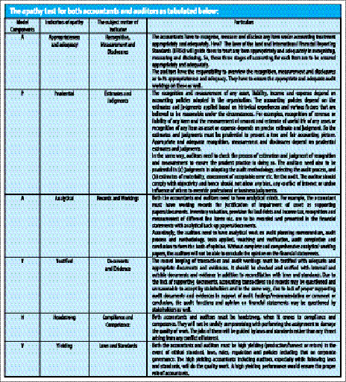
Accountants, of course, the chartered accountants (CAs) working as auditors also, should think about where they should move before taking a single step ahead. In their every step ahead they should be fully alert to their professional assignment before achieving any professional accomplishment. A lot of complaints are in the air about the profession ranging from bad accounting to accounting engineering. Bad accounting concerns any kind of omission and wrong and misleading information and disclosures in financial statements. On the other hand, accounting engineering concerns any improper and unreasonable accounting treatment. Different quarters' fingers are pointed at the accountants despite other factors working there affecting the practice of accounting and auditing leading to different scams. In view of the legal aspect, accountants are primarily responsible for any such scandal. When it comes to policies and principles, they should be headstrong in respect of compliance so that such factors do not affect their role leading to any accounting scandal.
What are the roles of accountants? In a broad sense, the accountants work for maximisation of wealth for an enterprise aiding national and social development. In other words, the value addition services of accountants have a multiplier effect on the nation and society by helping enhance wealth and improve the living standard. They help keep records of business entities' performance and also serve as a management tool for future planning in any favourable or unfavourable circumstances. So any appropriate and effective role of accountants may help register a rational increase in wealth and their lapses may lead to any negative growth or loss of wealth. Unless accounting is proper and gives the true pictures, it will not be possible to draw up an appropriate national plan encompassing both private and public sectors for spurring growth and development. Worldwide the role of accountants is deemed important for their respective sector and the nation as a whole. To make sure they play their roles effectively, the Financial Reporting Act (FRA) and the Financial Reporting Council (FRC) have been introduced in different countries despite a lot of complaints about their effectiveness in ensuring professional enrichment and development. Considering the FRA/FRC as a faulty model for bringing financial reporting transparency, the National Financial Reporting Authority (NFRA) has been introduced or is in the process of being introduced to ensure transparent financial reporting. So, reasonably the accountants engaged in accounting and auditing should do quality work in all respects complying with applicable laws, rules, regulations and standards and thus present the best picture of both private and public sectors.
If we look at the work of accountants, especially in the event of poor performance in the areas of accounting and auditing, we see some sort of their apathy to ensure quality financial reporting. As stated earlier, many driving factors may work behind the apathy of accountants to do the right thing under the related laws and standard. The interpersonal relationship, fee structures for audit, conflict of interest, financial interest, inducement, interference of stakeholders etc. may make them apathetic. A code of ethics of an organisation and strict compliance with it, internal control and compliance, internal audit and proper functioning of an audit committee may reduce the risk of apathy of a person doing the accounting work. In the case of auditors, the professional guidance and standards issued by the institute (for Bangladesh, the Institute of Chartered Accountants of Bangladesh), the strict compliance with those laws and standards by members of that institute and the governing laws for the practitioners as auditors like by-laws of their professional institution, the Companies Act, Securities laws and a strong judicial system may ensure a proper account and audit assignment. So, apathy is a great risk for accountants and auditors. They need to pass the apathy test to qualify for performing their duty properly and thus present quality accounting to the nation.
The word 'apathy' means the lack of interest, concern or energy or the absence of passion. The accountants must not have apathy in doing the right thing when on an assignment and hence they have to present themselves as apathetic to any illegal or undue interest or emotion or excitement and do the assignment with due professional care, objectivity and integrity.
In performing the assignment on accounting and auditing, they have to test themselves in line with each component of the apathy test. Dropping any component or showing any flexibility may put the role and whole assignment of accountants to question. The accountants have an appropriate and adequate legal and standard framework of work in a country. Their work is guided by the country's laws and the standards set by their professional institute. The best output depends on capacity and capability of the accountants, performance with professional competence and due care by following an ethical standard, monitoring by a professional institute on strict compliance with laws and standards and finally making them accountable in the event of substandard performance and malpractice. Under a standard legal and institutional framework, the accountants who pass the apathy test would help ensure quality financial reporting that will attract national and foreign investments apart from creation of an opportunity to maximise wealth aiding national and social development in the country.
The writer is an Associate Member of ICAB and
Head of Finance of Venture Investment
Partners Bangladesh Ltd. (VIPB)
roy_dipok@yahoo.com