
The Rohingya's path to self determination
Syed Muhammed Showaib | Saturday, 22 November 2025
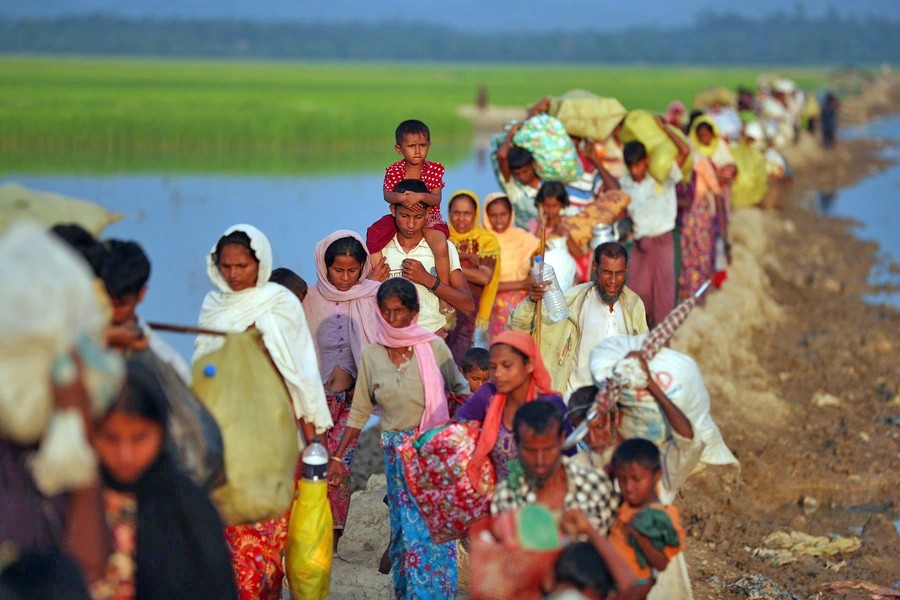
During last Ramadan, standing beside UN Secretary General Antonio Guterres in a refugee camp, Professor Muhammad Yunus expressed his hope that the Rohingya community would be able to offer their next Eid prayers in their homeland of Arakan. His words kindled a fragile expectation among a persecuted people driven from their ancestral land and condemned to statelessness. With less than four months remaining until the Eid, that promise now rings hollow. Repatriation remains a distant prospect while the situation in Rakhine State grows more volatile by the day. Far from returning, more 150,000 Rohingya have crossed into Bangladesh this year alone, bringing the total number of refugees in the country to over 1.5 million.
For the Rohingya population, tragedy is a legacy passed down through generations. It began in 1784 when the Burmese king Bodawpaya invaded Arakan, unleashing mass killings that forced about 200,000 Rohingya to escape to Chittagong. The pattern repeated in 1942 when Burmese nationalist forces, under the Japanese occupation, initiated a new wave of ethnic slaughter, driving another hundred thousand to flight. This recurring cycle of pogroms, sexual violence and arson pushed entire communities of successive generations into Bangladesh where many gradually settled and blended into local society. The Myanmar army recognised the convenience of this phenomenon and continued to weaponise terror as a means to empty the land of those they viewed as unwanted.
Emboldened by past impunity, the military launched its most savage campaign yet in 2017 under the guise of a "clearance operation." This unprecedented barbarity led to an estimated 25,000 Rohingya deaths and forced over 740,000 to flee to Bangladesh. The United Nations is now investigating these events as a genocide. This violence, encouraged by extremist monks like Ashin Wirathu, has also tarnished the global perception of Buddhists as a peace-loving community. Time magazine aptly described Wirathu as "the face of Buddhist terror" which is a choice of powerful words given how rarely the terms "Buddhist" and "terror" are conjoined.
Bangladesh is having a very hard time supporting this massive refugee population with its limited resources. A densely populated country facing serious economic pressures cannot indefinitely absorb an ever-growing influx from a neighbour, which makes repatriation an unavoidable policy priority. Yet this goal is constantly undermined by a narrative from Myanmar's ruling elites and ultranationalists that portrays the Rohingya as recent Bengali interlopers. This is a deliberate act of historical erasure because the Rohingya community has long been rooted in the history and society of Arakan. Historical records show that in 1430, the founder of the Mrauk U dynasty, Min Saw Mon, reclaimed the Arakanese throne with military assistance from the Sultan of Bengal and ruled as Sulaiman Shah. Muslim influence in the Arakan court became significant since then, and the community known today as the Rohingya flourished. Over the next two centuries, eighteen Muslim aqas held prominent administrative roles. Even during Burma's struggle for independence, Rohingya leaders such as Abu Gafur and Sultan Ahmed worked alongside General Aung San in the pre-independence constituent assembly and contributed to drafting the country's foundational constitution. Despite this legacy, the community has been stripped of citizenship and denied recognition.
Hope for a solution briefly rose when foreign affairs advisor Md. Touhid Hossain took office, especially since he had written extensively and thoughtfully about the crisis. It was expected that his expertise would translate into tangible progress. But reality has proven otherwise. In his earlier work, he stressed the importance of engaging with the Arakan Army (AA) and anticipated that it would become the dominant force in post-war Rakhine. He had also cautioned against any action the AA could perceive as hostile since their position would heavily influence the chances of any future repatriation arrangement.
However, the way things are now shows that optimism was misplaced. While the AA has been successfully contesting the military and controls significant territory in Rakhine, its stance on the Rohingya is unequivocally hostile. The AA's ideology is built upon a Rakhine nationalist vision that outline a sovereign Rakhine state that explicitly excludes the Rohingya. The AA has shown no interest in integrating Rohingya into its ranks or accepting their return. Its leader Twan Mrat Naing has even accused Bangladeshi authorities of applying new pressures, an allegation that suggests a deteriorating relationship and tragically echoes the military's own propaganda. This leaves the Rohingya in a limbo. The global Rohingya population exceeds two million. It is remarkable that a community of this size, having faced genocide, rape and oppression in their homeland, has been unable to mount an effective resistance. This stands in contrast to the Arakan Army which, representing an ethnic Rakhine population of roughly the same size, is successfully challenging the military junta.
In the refugee camps of Bangladesh, the Rohingya are deprived of both dignity and a future. Forced to survive on minimal rations, they are barred from legitimate business and other income generating activities that could give them a measure of independence. This idleness and hopelessness have predictably led to a rise in criminality such as drug trafficking and theft. The Rohingya children are denied formal schooling because of the fear that education will lead to integration. A community trapped in such conditions, stripped of education and opportunity, cannot reasonably be expected to develop the leadership required to unite its people and defend their rights.
This reality demands a new and honest assessment. When diplomacy serves only to prolong an injustice and oppression never lets up, what choices are left? Throughout history, many peoples have struggled for self-determination, often with external support. Even our own Mukti Bahini received essential assistance during the Liberation War of 1971. The Rohingya have endured centuries of persecution and their only response thus far has been to run. But those who are now confined to camps, their lives slipping away, must consider that acceptance of their fate is not the only option. The path to self-determination, though fraught with peril, may be the one that leads away from perpetual victimhood. The international community must understand that a political solution requires not just talking with the oppressors, but empowering the oppressed with the means to claim their rightful home. In absence of bold action, the cycles of displacement and violence will continue and the burden on Bangladesh will never end.
showaib434@gmail.com