
The Singapore experience: An ethical society thriving on good governance
Thursday, 27 November 2014
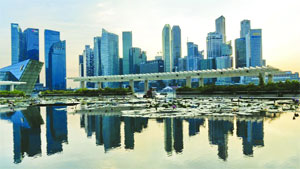
Located on the southern tip of the Malayan peninsula, the phenomenal rise of Singapore or the 'Lion City' during the 20th century has been a striking example of how a multicultural society can transform itself into one of the power-houses of global economy through hard work, ethical living and good governance. Originally a British colony that became independent after separation from Malaysia on August 9,1965, Singapore has successfully created a sense of national identity and ethos among its disparate population of immigrants. Its quest for survival and prosperity successfully utilised its strategic location in global trade as well as governance innovation and a favourable global economic order. With an area of just 718 square kilometres or 277 square miles and a population of around 5.5 million (population density of 7,615 per sq. km.), Singapore can now boast of having one of the highest per capita incomes in the world (per capita nominal GDP of US$ 55,182 in 2013) and is consistently placed at the top rung in global rankings in the areas of education, healthcare, social indicators and economic competitiveness. The World Justice Project's Rule of Law Index ranked Singapore in 2011 as among the top countries in the fields of 'Order and Security', 'Absence of Corruption' and 'Effective Criminal Justice'. The 2013 Index of Economic Freedom ranks Singapore as the second freest economy in the world.
Singapore is separated from Malaysia by the Strait of Johar and from the Indonesian Islands by the Strait of Singapore. The country consists of the diamond-shaped main island (Singapore city, occupying all but about 20 square miles of the country) and some sixty small islets. It is a unitary multi-party democratic republic with a unicameral parliamentary system of government. The People's Action Party has won all elections since the start of self-government in 1959, thereby ensuring for the nation long-term political stability - often considered vital for sustained economic growth. Around 61 per cent population of Singapore was its citizens and 39 per cent was permanent residents or foreign workers/students or their dependants as of mid-2014. According to the 2009 census, 74 per cent of the population was of Chinese origin, 13.4 per cent of Malay and 9 per cent of Indian descent. Religion-wise break-up was 34 per cent Buddhists, 18 per cent Christians, 16 per cent non-religionists, 14 per cent Muslims, 10 per cent Taoists, 5 per cent Hindus and 3 per cent followers of folk traditions. The four official languages of Singapore are English, Malay, Mandarin Chinese and Tamil. English, however, is the language of government and business as well as the medium of instruction in educational institutions. Most Singaporeans are bilingual in English and another official language and Mandarin Chinese is spoken by almost half of the population as the native tongue.
The Singapore Experience:
The launching of the Suez Canal in 1869 led to a swift increase in trade between Asia and Europe, thereby helping the then British colonial port Singapore to turn into one of the busiest and largest in the world. A combination of massive foreign direct investments and state-sponsored drive for industrialisation after independence in 1965 facilitated the rapid and sustained growth of its economy and made Singapore one of the four Asian Tigers alongside Taiwan, Hong Kong and South Korea. Singapore is known all over the globe as one of the freest, most competitive, innovative, most business-friendly and least corrupt countries in the world.
According to the renowned former chairman of the famed Economic Development Board (EDB) of Singapore Chan Chin Bock, economic development of Singapore had progressed in a staggered manner. As far as investment promotion was concerned, the focus during the first three years after independence (1965-68) was policy review and policy formulation. The targeted investors during this period were local bankers and traders, and the industrialisation drive was facilitated by the Malaysian import substitution projects. The next phase from 1968 to 1973 against the backdrop of pre-1973 oil crisis was characterised by random job creation, when US multinational companies including semiconductor firms like General Electric and Hewlett Packard came in with FDIs. The period 1974-84 shifted the focus on precision engineering companies and saw the arrival of companies like Timex (USA), Philips (EU) and Seiko (Japan). A foundation was thus laid for the machine tools industry during the period. The following decade (1985-95) was marked by strides beyond the industrial arena -- in the services and education sectors. US multinationals like Fedex and UPS arrived during the period and Asian campuses of top universities as well as hospitals were set up. After that, there was an emphasis on capital-intensive investments and a focus on process industries during 1990-2000, when companies like Sumitomo Chemical, BASF, Bayer etc. made heavy investments. This was followed by the decade of 2000-2010, when investments in biomedical products and services by companies like Baxter, Abbot and P&G provided the basis for research and development in these areas. The current focus (2010-2020) is on aircraft parts and services, logistics and data centres, with investments by companies like Rolls Royce, Prat &Whitney, GE, IBM and NTT Communications, geared towards Aerospace Park, data analytic firms etc.
According to another ex-stalwart of the famed EDB - Daniel Selvaretnam, the major industrial clusters of Singapore can be classified as follows: petroleum/petrochemicals,ship repair/shipbuilding/oil-rig fabrication, consumer electronics, engineering industries, pharmaceuticals and light industries. The petroleum/petrochemical industry started from a single small refinery in the 1960s, followed by expansion to several larger refineries during 1970s, diversification into petrochemicals in the 1980s and further expansion alongside formation of Jurong island (through land reclamation) exclusively for the sector during the 1990s. Consumer electronics comprised light industries during the 1960s, followed by semiconductors (e.g. Texas Instruments) during the 1970s, rapid expansion into radios, televisions, computer peripherals and components in the 1980s. This cluster, however, started to fade during the 1990s due to rising wages and costs but Singapore still retains higher-end functions including research and development, headquarters and technical support.
Daniel Selvaretnam identifies good location, good infrastructure, good administration, hardworking people, Malaysian market with protections and federalism and above all good, strong and honest leaders in the government as the major factors contributing to Singapore's rapid rise as an industrial power. At the very outset, national strategic plans for various industries were devised, attractive incentives offered for investments, preferences accorded to local industries and investors, performance-oriented culture in government and strong enforcement of transparency and accountability ensured in the discharge of governance, all of which contributed to industrial growth. National policies and strategies were constantly revised and updated by the Singapore government, led by the legendary Prime Minister Lee Kuan Yew for around three decades up to 1990, in the light of domestic and external realities. Within ten years of independence, there were important policy shifts, including a switch to export-driven, MNC (multinational companies) strategy. Local investment criteria were dropped for almost all investments and privatization included major infrastructure sectors like power and telecommunications. The Economic Development Board (EDB) undertook aggressive marketing drive for FDIs at various corners of the globe, more open immigration policy was announced to meet skill and labour shortages, skills training programme was also conducted by the EDB to teach higher skills.
The strategies pursued by Singapore for industrial development included welcoming foreign investments even in previously closed sectors, active interventions by the EDB without investing directly and active manpower planning for all technical and professional skills at the national level. Long-term national plans were applied for land, infrastructure, healthcare and other important areas as well as the industrial clusters. The EDB ran a number of foreign investment promotion offices, which regularly contacted potential investors proactively. The EDB also offered an attractive incentive programme alongside a highly competitive corporate tax rate of 17 per cent.
The Singaporean government follows a segmented approach to the domestic small and medium enterprises (SME) sector. The effort is led by the Singapore Productivity and Innovation Board (SPRING), and industry-based supports are offered for productivity enhancement, technological issues and skill upgrading. Resources used by SPRING include workers' levy of 0.25 per cent of all workers earning less than $ 4,500 per month channelled to a fund managed by SPRING, subsidising government and private sector consultants, sharing the risks of financial loans offered by private banks, and providing tax incentives and grants. Industry-specific approaches followed by the Singapore government for foreign companies include investment promotion offices abroad, general tax incentives and loans, cluster development plans, specialised manpower training schemes, project facilitation and close liaison with foreign chambers of commerce and industries. The linkages programme for local and foreign investors include the Light Industry Upgrading Programme (LIUP) and the outsourcing of components and parts.
According to Daniel Selvaretnam, Singapore has improved its position and capacity gradually over the years. This could be achieved incrementally by paying attention to problems brought up by the industries and then fixing them. The Singapore government has been working on improving efficiency on a continuous basis in all areas. For example, Singapore's container-port and airport have the fastest turn-around time in the world now and the EDB proactively fixes problems, though actual work may be done by other departments. The government recognizes the importance of business-friendly environment and supports this fully which is illustrated by the fact that visiting CEOs of leading companies get the opportunity to meet the country's prime minister.
Strategic plans and their successful implementation have played a key role in the industrial transformation of Singapore. Mention may be made here of the Winsemius Plan of the 1960s, formulated by a 15-member team led by a former Dutch permanent secretary. The main focus of the plan was on job creation and a new agency called the Economic Development Board (EDB) was singled out as the main implementing agency with an initial funding of S$ 100 million. For EDB, its scope of work included industrial estates, technical support services, management of new incentives and overseas investment offices. There was slow progress during the first ten years, mainly centred around low value-added industries like timber, garments, food processing, metalwork and plastics, with the companies mostly coming from Hong Kong, Taiwan and Japan. The breakthrough came in the 1970s with the arrival of American companies who assembled semi-conductor and electronics products. Thereafter, there was an explosive growth and unemployment problem was solved within a mere 12 to 13 years.
Despite numerous constraints including excessively high population density, limited lands and dearth of other natural resources, Singapore has gone on to set a unique example in the world by showing development-aspiring nations all around including Bangladesh how a resource-poor country can rise to the top purely by dint of its hard work, good governance and ethical living.
Dr. Helal Uddin Ahmed is a senior civil servant and former editor of Bangladesh Quarterly.
E-mail: hahmed1960@gmail.com