
By ‘invitation only’
The subtle rise of Dhaka’s supper club culture
MUMTAHINA RAHMAN TAJREE | Wednesday, 15 July 2026
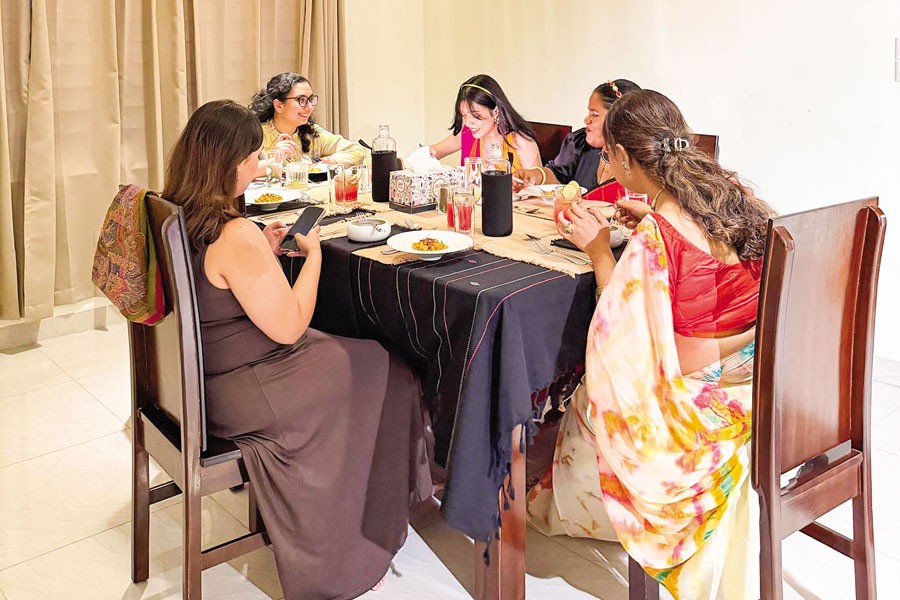
Somewhere in Dhaka, a small group of people who have never met are sitting down to eat food they did not choose, at an address they received only hours ago, in a room that will not appear on any review platform tomorrow. No menu on the wall. No walk-ins. No background noise competing for the conversation. Just a table, a fixed number of seats, and the deliberate decision to be present for an evening built entirely around intention. This is the supper club, and Dhaka, quietly but unmistakably, has developed a taste for it.
A concept that was never available to everyone
The idea was not foreign to Bangladesh. Private dining experiences, chef’s tables, and invitation-only dinners had existed for years within the city’s more affluent circles: in Gulshan’s drawing rooms, or practised in Baridhara apartments, confined to social networks most people were never invited into.
For Dhaka residents, it was effectively inaccessible, not because it was impossible, but because nobody was talking about it in a language they could hear.
That changed when Your Li’l Cook aka Kumkum Kalam started posting.
A Bangladeshi chef and a food content creator based in Australia, she built a following on warmth, precision, and a visual sensibility that treats cooking as something worth documenting carefully.
When she began sharing her candlelit, multi-course supper clubs celebrating Bengali heritage, art and life, her Bangladeshi audience encountered a whole new philosophy: the idea that hosting could be an art form, and that an intentional meal with strangers could produce something a restaurant cannot replicate.
Followers begged her to bring the concept to Bangladesh, but distance made it impractical. Instead, the curiosity she sparked migrated.
Dhaka’s home chefs, food stylists, and independent cooks began quietly advertising their own curated dining experiences on social media.
The term quickly entered the mainstream, transforming an exclusive concept into something a wider audience was suddenly searching for, signing up for, and talking about.
What the experience actually is
A supper club is not a restaurant. There is no à la carte menu, no casual entry, and no tables squeezed together. Instead, these small gatherings of six to twelve guests are built around a fixed menu, a curated setting, and an atmosphere where something beyond eating is expected to happen.
The location is often secret, the menu blind, and phones are silenced once the evening begins. None of this is arbitrary; it is the exact structure required to slow a Dhaka evening down enough for it to mean something.
Within this framework, each club has carved out a distinct identity. Sumaya Khan’s The Supper Club treats dinner as a narrative. It offers creative reinterpretations of South Asian nostalgia, such as bhorta sushi and beetroot rosogolla.
Adhara Mercy Tripura’s Table for Her, Bangladesh’s first women-only club that hosts eight seats with a rotating menu of indigenous Chittagong Hill Tracts and global cuisines, drawing a waitlist of over 2,000 women.
Chef Farhana Chowdhury’s Tablore weaves traditional Bengali art and literature into evenings in which the table itself becomes part of the experience.
Shera Radhuni runners-up, Nupur and Anisha of The Supper Pair, transform home flavours into refined multi-course dining, complete with a take-home gift.
At the most technically ambitious end, Arpon Changma’s Open Plate Studio leverages his Le Cordon Bleu Dusit training to build progressive tasting menus from locally sourced indigenous ingredients, turning every course into edible storytelling.
And these are just the established names. Mother Daughter Kitchen is preparing its first Secret Supper Club. At the same time, Alvina Tamjid’s Tasty Table in Dhanmondi just announced a new women-only dining experience. What began with a handful of pioneers has accelerated into a definitive movement.
What lands on the table
The cuisine across Dhaka’s supper clubs resists easy categorisation, and that resistance is deliberate. A guest might find nostalgic South Asian home cooking reconstructed into something completely new, or sit down to an indigenous CHT menu one month and a Korean spread the next. 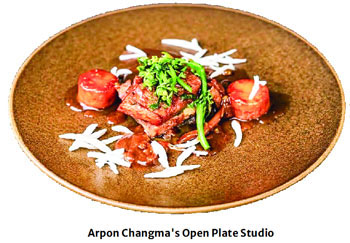 At Open Plate Studio, rarely encountered Bangladeshi ingredients are elevated through international fine dining techniques into courses that argue for what this country’s cuisine is capable of becoming.
The Supper Pair’s first event moved through coastal prawn and mango, crunchy, slow-braised beef pita, Kashmiri Rogan Josh, butter chicken, Nargisi Kofta, and kulfi.
This range matters. Dhaka’s supper club movement is not performing a Western format for social credibility. It is using that format to ask serious questions about what Bangladeshi food is, what it could be, and who gets to celebrate it.
The cost of a seat and who is still waiting
A supper club evening in Dhaka currently ranges from BDT 4,000 to BDT 7,500 or more per guest.
This places the experience firmly in ‘upper-middle-class’ territory. Yet the interest extends considerably beyond those who can currently afford a seat.
Across social media, Bangladeshis from a much wider range of backgrounds are watching, saving, and waiting, drawn to the concept but priced out of it for now.
Could a tiered model emerge in which mid-range curated dinners bring the experience to a broader group of foodies without sacrificing the intimacy that defines it?
The appetite clearly exists across different income groups. Whether Dhaka’s culinary entrepreneurs choose to meet it will determine whether supper clubs remain a beautiful niche or grow into something that genuinely reshapes how this city eats together.
Do we need a table like this?
Dhaka is a city that does not naturally slow down. Its social gatherings are often obligatory; restaurants are loud; evenings are crowded with noise, making genuine conversation an effort.
The supper club may offer what the city’s mainstream dining culture structurally cannot: intentionality, a reason to dress with care, to arrive somewhere specific, to eat food someone chose for you, and to stay off your phone for two hours.
Things one has to check before making bookings
Securing a seat is not as simple as finding an empty chair. Most hosts run reservation-only systems with their own set of requirements; guests are expected to follow the house rules, submit their details via the host’s website, and communicate clearly before a booking is confirmed.
It is a two-way process, designed as much to protect the guest’s privacy and safety as the host’s space. The exclusivity, in other words, is as aesthetic as it is intentional.
Dhaka’s supper club scene is still young. The seats are deliberately few, the hosts a growing handful of individuals operating on passion rather than infrastructure. But the momentum is unmistakable; new tables are being set every week, new names are entering the conversation, and the waiting lists are only getting longer.
From the outside looking in, many are drawn to this exact promise of presence, the rare chance to trade digital noise for genuine connection over a shared meal. Whether Dhaka’s culinary entrepreneurs rise to meet that wider appetite will determine whether the supper club becomes a permanent fixture of this city’s social fabric or remains a beautiful privilege for the few. Either way, something has shifted.
tajree.m.rahman@gmail.com