
The sunny side of the budget
Syed Muhammed Showaib | Saturday, 13 June 2026
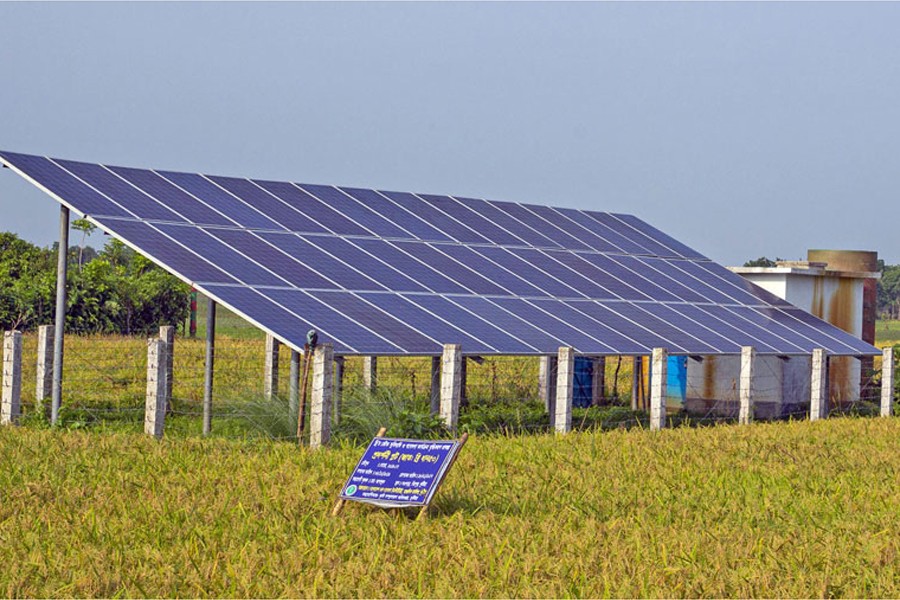
The budgetary decision to slash import duties on rooftop solar equipment is one of those rare fiscal moves that is simultaneously good economics and long overdue application of common sense. A total tax incidence of around 60 per cent on solar panels and associated equipment had long suffocated the renewable energy sector. Reducing that burden significantly while offering tax holidays for rooftop solar investors suggests that policymakers have finally begun to treat the country's energy future as a serious fiscal priority as it ought to be.
Energy self-reliance is a fundamental necessity for any nation seeking stable economic growth, and few countries are as naturally endowed to pursue it as Bangladesh. Situated in a region blessed with over 300 days of sunlight each year, the country receives an average of four to five kilowatt hours per square meter per day of solar radiation. Yet despite this abundance, it has barely tapped the potential after years of plans, committees and announcements leaving the sun's treasure untouched. Under the current structure of Bangladesh's economy, energy costs are so high that they have become a primary determinant of production costs across the economy. Manufacturers cannot run factories at full capacity because of gas shortages and erratic power supply and the bills they do pay eat significantly into margins. Farmers have watched how diesel price hikes render paddy cultivation unviable. Households continue to confront periodic increases in electricity tariffs also. At the same time, heavy dependence on imported fossil fuels leaves the country vulnerable to disruptions and price shocks originating far away from its borders. The war raging in the Middle East has once again demonstrated how perilously uncertain such dependence can be.
The high tariff regime Bangladesh maintained for so long on solar power components made no sense even on its own terms. The standard justifications for import duties on manufactured goods are revenue earnings and the protection of domestic industry, but neither holds up here. Between 90 and 95 per cent of renewable energy components in Bangladesh are imported, and there is no domestic solar manufacturing base of any real scale to protect. Some panels are assembled locally using imported cells, but most finished panels are imported directly as well, along with batteries and inverters that are almost entirely foreign. Keeping duties at 60 per cent did not nurture an infant industry. It simply added cost, slowed adoption and kept everyone more dependent on the very fossil fuel that drain foreign exchange reserves and require expensive subsidies to manage.
This subsidy dimension also makes little sense from a fiscal standpoint. The government currently spends between Tk 350 billion and Tk 400 billion a year subsidising conventional electricity generation. Average production cost of conventional electricity stands at roughly Tk 12 to 13 per unit whereas solar energy can be generated at Tk 8.0 to 9.0 per unit even under the previous punitive tax regime. Clearly public funds are sustaining a more expensive source of electricity while a cheaper alternative faced significant fiscal barriers. The revenue collected from solar-related import duties, meanwhile, is a mere few billion taka. Preserving such a negligible revenue stream at the expense of wider solar adoption, while still continuing to shoulder an enormous subsidy burden, amounts to a clear failure of fiscal prioritisation.
A look at international experience adds weight to the case for rapid expansion of solar energy. Across the world, solar power has become the fastest growing energy technology, and it is remarkable how countries with far less favourable climatic conditions have still achieved such results. Germany, despite receiving substantially less sunshine than Bangladesh, derives a significant share of its electricity from renewable sources. Vietnam used feed-in tariffs to guarantee long-term purchase prices, lifting its solar capacity from a negligible 86 megawatts to 19 gigawatts in just a few years. India established dedicated institutions coupled with massive financial incentives for rooftop installation and solar powered agricultural pumps. Pakistan presents perhaps an even more striking example of a grassroots energy transition. Faced with a 155 per cent increase in electricity prices over three years, Pakistani households and businesses imported massive quantities of solar panels without any government subsidy. That decentralised surge shielded the country from the worst impacts of recent global fuel shocks and even drastically reduced agricultural grid demand.
Bangladesh has previously attempted to promote solar energy multiple times, but those initiatives suffered from poor design and weak implementation. Requirements imposed on buildings often resulted in token installations intended merely to satisfy regulatory conditions, and low-quality equipment became widespread, delivering little practical value. Such experiences understandably created scepticism. Yet conditions today are fundamentally different. Solar technology has become dramatically cheaper over the past decade with costs falling by roughly 80 per cent. What was once extremely expensive has now become increasingly competitive.
That being said, reducing tariffs alone is not enough to transform energy mix. Solar powered irrigation, piloted in some areas, also needs to be scaled up aggressively given that agriculture accounts for enormous diesel consumption and that farmers are among those most visibly squeezed by fossil fuel price volatility. Factories that currently run on expensive grid power and captive generators have strong economic incentives to shift towards rooftop solar, but they need clear grid interconnection rules and reliable purchase agreements that make the initial investment worthwhile.
Sure, Bangladesh must make its way to a larger solar base and for now that is the right trade since importing panels is far more sensible than importing oil. But genuine energy self-reliance obviously requires domestic manufacturing capability, not just domestic installation. The budget measures are a proper first step, but real seriousness will be measured by whether they are followed through into the institutional and industrial frameworks needed to build that capability.
showaib434@gmail.com