
PARLIAMENT PASSES 24 BILLS, ONE ON LOCAL GOVT
Three interim ordinances involving SC, HR repealed
New act rescinds provision of local polls on party symbol
FE REPORT | Friday, 10 April 2026
Interim government's three key ordinances on reforms regarding the Supreme Court and the National Human Rights Commission were repealed as parliament Thursday passed a raft of 24 bills. 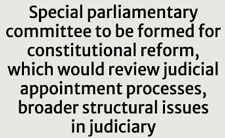 One major bill rescinds the provision for contesting local-government polls
on party symbol, opening up local elections for aspirants from all sections of society.
The 12th sitting of the first session of the 13th National Parliament saw the railroading of 24 bills, including the repeal of the ordinances related to the apex court and the rights body.
A total of nine ordinances issued by the post-uprising interim government were approved unchanged and enacted into law, while three were repealed, marking a significant legislative shift in judicial and human-rights governance.
The bills passed by keeping the interim government's ordinances intact are:
• National Sports Council (Amendment) Bill 2026
• Bangabandhu Sports Welfare Foundation (Amendment) Bill 2026
• Sheikh Hasina National Youth Development Institute (Amendment) Bill 2026
• Bangladesh Energy Regulatory Commission (Amendment) Bill 2026
• Public Procurement (Amendment) Bill 2026
• Overseas Employment and Migrants (Amendment) Bill 2026
• Bangladesh Labour (Amendment) Bill 2026
• Local Government (Union Parishad) (Amendment) Bill 2026
• Legal Aid Services (Amendment) Bill 2026
• National Freedom Fighters Council (Amendment) Bill 2026
• Land Use Control and Agricultural Land Protection Bill 2026
• Bangladesh Telecommunications (Amendment) Bill 2026
• Bangladesh Gas (Amendment) Bill 2026
• Human Organ Transplantation Bill 2026
• Foreign Donations (Voluntary Activities) Regulation (Amendment) Bill 2026
• Prevention and Suppression of Human Trafficking and Migrant Smuggling Bill 2026
• Forest and Tree Conservation Bill 2026
• Bangabandhu Sheikh Mujibur Rahman Novotheatre (Amendment) Bill 2026
• Bangabandhu Science and Technology Fellowship Trust (Amendment) Bill 2026
• Zila Parishad (Amendment) Bill 2026
• Local Government (Municipality) (Amendment) Bill 2026
• Supreme Court Secretariat (Repeal) Bill 2026
• National Human Rights Commission (Repeal and Re-enactment) Bill 2026
• Supreme Court Judges Appointment (Repeal) Bill 2026
The parliament repealed two ordinances concerning the judiciary. The Supreme Court Judges Appointment Ordinance 2025 was annulled through the Supreme Court Judges Appointment (Repeal) Bill 2026. The Supreme Court Secretariat Ordinance was also annulled through a separate bill.
Lawmakers also voted out the National Human Rights Commission (Amendment) Ordinance 2024, restoring the original National Human Rights Commission Act of 2009 through a new repeal-and-revival bill.
This reinstates the earlier legal structure for the functioning of the statutory human-rights body.
All bills were passed by voice vote in the presence of both treasury and opposition members, with Speaker Hafiz Uddin Ahmed in the chair.
Speaking in parliament, Law Minister Asaduzzaman stressed the need for transparency and independence in judicial appointments. He criticised past practices, alleging that politically aligned individuals had been appointed to the judiciary during the previous regime.
In response to opposition lawmaker Akhtar Hossain's criticism that the ruling party does not want transparency in the judiciary, the law minister said, "The government aims to establish a transparent and merit-based judicial system, ensuring that the Supreme Court becomes a trusted institution for justice."
The minister also reiterated plans to form a special parliamentary committee for constitutional reform, which would review judicial appointment processes and broader structural issues in the judiciary.
Highlighting the need for cooperation, the minister urged both government and opposition members to engage in constructive dialogue.
He emphasised that "laws are not immutable" and can be amended, if necessary, encouraging a collaborative approach to reform.
Meanwhile, at 5:56pm, Opposition Leader Dr Shafiqur Rahman announced a walkout from the House.
The Jamaat chief said, "It is unfortunate but true that despite the opposition's justified objections, several anti-people bills have been passed today. We do not want to take responsibility for them. Therefore, we are walking out of parliament."
Earlier, the opposition had staged walkouts from the parliament session twice. The first was on the opening day of parliament on March 12, and the second on April 1.
During the session, the Local Government (Municipality) (Amendment) Bill 2026 was tabled and later passed by voice vote. In response, Shafiqur Rahman stood up and announced the walkout.
Following the walkout, Home Minister Salah Uddin Ahmed took the floor and said, "I rise to express my thanks. They (the opposition) assisted in the law-making process during the first reading, second reading, and third reading.
"Some even raised their hands in support. After participating in the entire process, whether a walkout makes sense is something to consider. I thank them for taking part in the whole process. I hope they will return to participate again after Maghrib prayers."
mirmostafiz@yahoo.com