
Three Ps hold the key to economic progress
Md Shafiul Alam | Saturday, 31 January 2026
Economic development and good governance depend not merely on the availability of resources, but on how efficiently, transparently, and effectively those resources are planned, managed, and utilized.
In this context, the three Ps-Public Financial Management (PFM), Project Management (PM), and Public Procurement Management (PPM)-form the backbone of an effective public sector delivery system. These three interrelated domains hold the key to fiscal discipline, value for money, and sustainable economic growth. The concept, definitions, and features of the three Ps demonstrate how their integrated application can significantly accelerate economic progress.
However, to ensure transparency and accountability, accounts and audit should function as separate entities, which is unfortunately not the case in the country at present.
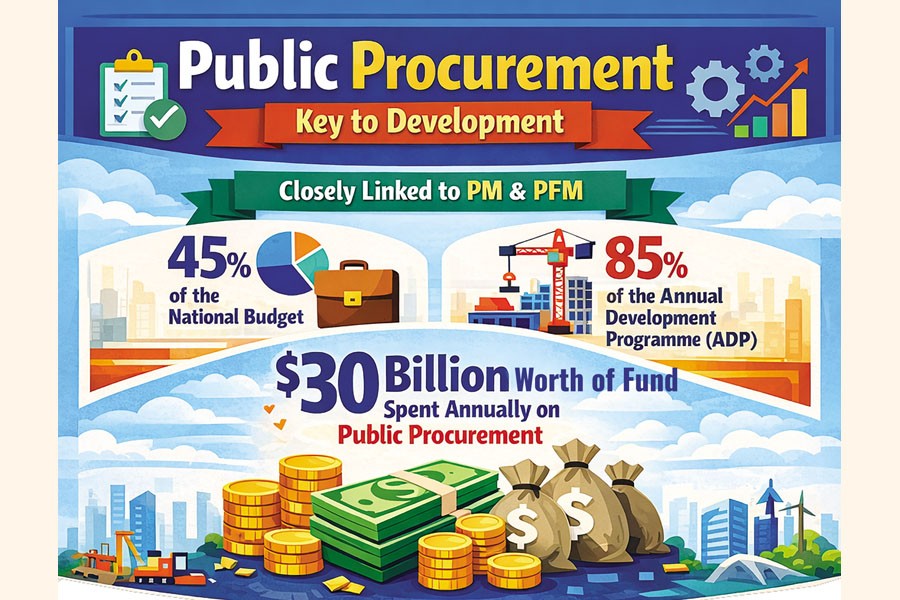
Public procurement is closely linked to both PM and PFM. It accounts for about 45 percent of the national budget and nearly 85 percent of the Annual Development Programme (ADP). An amount equivalent to approximately 30 billion US dollars is spent on public procurement every year. Public procurement constitutes the major component of most development projects. Therefore, the efficient and timely implementation of any project largely depends on the effective and efficient execution of public procurement.
Such a large volume of expenditure inevitably involves public financial management, which requires careful, professional, and efficient handling.
On average, there are about 1,300 projects under the ADP each year. Ironically, project directors (PDs) often lack adequate training, expertise, and experience in the three Ps. The government has identified this capacity gap as a major obstacle to the efficient and effective implementation of projects. Therefore, PDs need to be equipped with the necessary skills in all three areas. Combined and integrated training on the three Ps for PDs before their assignment has become a demand of the time.
1. Public Financial Management (PFM)
Public Financial Management refers to the system through which the government mobilizes, allocates, spends, and accounts for public resources to achieve policy objectives and deliver public services effectively.
Key features of PFM include budget formulation aligned with national priorities, fiscal discipline and macroeconomic stability, efficient allocation of resources, financial accountability and transparency, and robust audit, reporting, and oversight mechanisms.
Relevance to the Economy
Strong PFM ensures that scarce public resources are used prudently, leakages are minimized, and public confidence in state institutions is enhanced. In Bangladesh, effective PFM is critical for maintaining fiscal sustainability and achieving desired development outcomes.
2. Project Management (PM)
Project Management is the systematic application of knowledge, skills, tools, and techniques to plan, execute, monitor, and complete projects within defined scope, time, cost, and quality parameters.
Key features include clear project planning and design, time and cost control, risk identification and mitigation, performance monitoring and evaluation, and outcome- and results-based management.
Relevance to the Economy
Poor project management leads to cost overruns, delays, and suboptimal outcomes-challenges frequently observed in large public infrastructure projects. Strong PM capacity ensures that development projects deliver intended benefits on time, contributing to productivity, employment generation, and improved public services. Effective PM is therefore essential for maximizing returns on public investment.
3. Public Procurement Management (PPM)
Public Procurement Management involves the process of acquiring goods, works, and services by public entities in a manner that ensures value for money, fairness, transparency, and competition.
Key features include open and competitive bidding processes, legal and regulatory compliance, transparency and accountability, value for money and life-cycle costing, and the adoption of e-GP and sustainable procurement practices.
Relevance to the Economy
Public procurement is the single largest channel of public spending in Bangladesh. Efficient PPM reduces corruption risks, ensures quality infrastructure and services, and supports private sector growth. The introduction of electronic Government Procurement (e-GP) and the move toward Sustainable Public Procurement (SPP) have further strengthened governance and efficiency in this critical area.
Inter-linkages among the three Ps
The three Ps are not isolated silos; rather, they are deeply interconnected. PFM provides the financial framework and budgetary discipline, PM ensures that funded projects are implemented effectively, and PPM translates project needs into contracts and delivers outputs.
Weakness in any one of these areas undermines the others. Conversely, strong integration among the Three Ps creates a virtuous cycle of efficiency, accountability, and development impact.
How Skills and Performance in the three Ps Drive Economic Progress
Enhanced skills and strong performance in PFM, PM, and PPM can deliver multiple macro- and microeconomic benefits for Bangladesh, including:
• Improved quality of public investment
• Faster and more cost-effective
infrastructure delivery
• Reduced waste, delays, and corruption
• Increased investor and development
partner confidence
• Stronger private sector participation
and job creation
• Accelerated achievement of national
development goals and the SDGs
The Three Ps-Public Financial Management, Project Management, and Public Procurement Management-collectively form the engine of effective public service delivery and economic transformation. Strengthening institutional capacity and professional skills in these areas is not merely a technical necessity but also a strategic imperative for Bangladesh's journey toward sustainable growth, good governance, and upper-middle-income status.
The writer is a senior journalist shafiul.alam.sac@gmail.com