
Three-wheelers ruin orderly traffic flow on Dhaka roads
Sunday, 18 January 2026
SM NAJMUS SAKIB
Unsafe battery-run three-wheelers reign supreme on the roads in Dhaka destroying the traffic order for other formal vehicles, taking opportunity of a lack of regulation, oversight, or intervention by the authorities, observed experts and sufferers.
The locally-modified and manufactured auto-rickshaws and easy-bikes are plying the city's roads as well as the highways across the country in absence of specific policies, they noted while talking to the FE.
Thus other modes of formal transport are incurring financial losses due to drop in their daily trips.
During a recent visit to Kamalapur Railway Station, battery-powered vehicles, including easy-bikes and auto-rickshaws, were seen offering long-haul rides to passengers, in addition to CNG-run vehicles near the parking area.
Taking the chance of the government's indifference, these unsafe three-wheelers are moving on the capital's roads and highways, creating serious traffic chaos, Manzurul Islam, a passenger waiting outside the platform, told The Financial Express.
The unruly prevalence of these battery-run vehicles is also forcing other formal modes of transport to incur sizable financial losses.
Belal Hossain, 38, a ride-sharing bike driver, recently told the FE in the city's Agargaon area that he could make as much as Tk 2,000-3,000 income daily about a year ago, but now it has come down to as low as Tk 1,500.
"A bike requires less space on roads. Passengers tend to use a ride-sharing bike when they need to reach their destinations fast and during unusual traffic jams. But now battery-run vehicles occupy every corners of the roads," he explained.
Therefore, the number of passengers has dropped, he said expressing frustration on the face.
A report by the Centre for Policy Dialogue (CPD) last month said the same, stating that formal transports were experiencing a revenue drop in the city.
For motorbikes, Tk 37,000-42,000 was the monthly income in 2023, which reduced to Tk 25,000-28,000 in 2025.
CNG-run vehicles' income dropped to Tk 14,500 in 2025 from Tk 30,000 in 2023.
Md Hadiuzzaman, a professor of civil engineering at the Bangladesh University of Engineering and Technology (BUET) and a road transport expert, told the FE, "In the absence of policies, we do not have a clear direction on road hierarchy. Thus, we do not have order in the roads for all sorts of vehicles running on the main and primary roads."
Ride-sharing services and other formal public and private vehicles are facing traffic chaos and income drop, he said.
"These slow and faulty-designed vehicles cannot be allowed on the primary roads. The unregulated battery-run three-wheelers have created a complete disorder on the streets," he added.
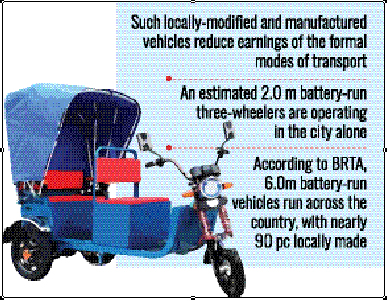
An estimated two million battery-run three-wheelers are operating in the city alone.
This type of vehicle was not viable for any city, especially Dhaka, as it was already facing lots of problems due to unplanned development, explained Hadiuzzaman.
Highlighting the messy situation on the city roads, he questioned the capacity of the regulatory bodies of the government.
The city residents make about 20-25 million trips every day, including on foot and transports. But the formal transports in the city cannot afford such a big number of trips. So people search for alternative informal modes of transport, according to him.
"The city has only 7.5 per cent road capacity, and only 2.5 per cent of it is available for public transport. So, we cannot allow such unscientific battery-run vehicles in the public transport area," he said.
The battery-run three-wheeler owners earlier started the business because of unemployment, but now it has become a profitable and uncontrolled business. There are so many people who are illegally running garages and own dozens of battery-run rickshaws and easy bikes.
According to Bangladesh Road Transport Authority (BRTA), around six million battery-run vehicles operate across the country, with nearly 90 per cent of them locally manufactured.
They are responsible for about 21 per cent of the road fatalities.
Besides, five per cent of the country's total electricity consumption with 48,136 illegal charging points in the city alone is attributed to them, according to the CPD.
These vehicles use about 78 per cent of the total lead batteries, with severe environmental effects.
Hadiuzzaman claimed that black money was increasingly being injected into battery-run three-wheelers as there was no regulation and licence required to buy or introduce these on the streets.
"There is a Tk 200-250 billion battery industry development centring it. So, it will be difficult to eliminate or control it. The government must act to control the sources where battery-run three-wheelers are manufactured," he suggested.
CPD's Research Director Khondaker Golam Moazzem told the FE the supply side must be cut off to control it.
"We cannot withdraw them from the roads suddenly. It could create chaos. We need to control the sources - where they are being manufactured, where lead batteries are coming from, and where illegal electricity connections are being provided," he explained.
Then, the number of such vehicles must be limited upon their authorised and scientific design. The authorities would then issue licences and put them under strict regulation. With this, they can be regulated, he added.
Moazzem warned that this "last-mile vehicle" must not be allowed on the main roads.
Neelima Akhter, executive director at Dhaka Transport Coordination Authority, told the FE by coordinating all the government agencies concerned, the local government ministry had finalised a policy to regulate the battery-run three-wheelers.
She said the vehicles were causing problems on the streets. The policy would soon be made public and implemented accordingly, she added.
nsrafsanju@gmail.com