
TI seeks transparency in RMG units
FE Report | Tuesday, 25 November 2014
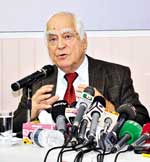
Visiting Transparency International (TI) founder Dr Peter Eigen said on Monday the government, private sector and civil society members must work collectively for sustainable growth of RMG (readymade garment) industry here.
Placing the concept of GITI (Garment Industries Transparency Initiative) at a press briefing at the TIB's (Transparency International Bangladesh) conference room, he said the triangle of cooperation would help sustain profitability of apparel manufacturers and improve labour conditions in the global garment supply chain.
"GITI is a multi-stakeholder initiative and a framework for collective action, which involves government, producers, buyers, trade unions and civil society both at national and international levels," he said.
He said GITI follows the model of the Extractive Industries Transparency Initiative (EITI), set out as a joint approach of governments, business sector and civil society in both producing and consuming countries.
Dr Peter Eigen, also co-founder of the EITI that is being successfully implemented in 48 countries having oil, gas and mineral resources, took the move in 2013 after the tragedy of Rana Plaza that killed 1,130 people at Savar, Bangladesh.
He said he has discussed with the apparel makers, government officials and trade unions about the initiative and they received it well.
"It's a magic triangle of cooperation that will uphold mutual interest of the stakeholders," he said, adding that they don't want to increase the cost of production for apparel manufacturers for the sake of global competitiveness.
Factory owners, workers, government and media should try to create a system that would ensure availability of credible information about various aspects of the garment sector. And that's what GITI is trying to do in Bangladesh with the assistance of multi-stakeholder working groups, Mr Eigen said.
"The initiative can be put into operation in a year if everything goes properly," he said.
He reminded that the existing global governance is failing and that a holistic approach should be in place for governance of the globalised economy.
He also tabled a new formula of a 'Golden Triangle', involving the government, private sector and civil society to tackle growing menace of corruption around the world.
Executive Director of TIB Dr Iftekharuzzaman said they have started making list of the leading global clothing retailers, who have business ties with Bangladesh.
He said it aims at finding agreement between the involved parties with regard to comprehensive standards on labour conditions. These may include minimum wage, the right to organise and actively participate in trade unions, and a ban on child labour.
Involved parties will jointly monitor the implementation of these standards and disclose their findings, he added.
At the end of 2013, a multi-stakeholder advisory board was formed and it advised the GITI team in April 2014 to conduct two feasibility studies in Bangladesh and Myanmar. The purpose of the studies is to assess the preconditions for possible GITI pilot processes in both nations, according to the TIB officials.
The feasibility study suggested that a GITI process in Bangladesh would be possible and could generate a meaningful impact if a consensus among the stakeholders regarding its set-up and the participation of international buyers could be ensured.
jubairfe1980@gmail.com