
MAHESHKHALI UPAZILA OF COX'S BAZAR
Tidal surge, rain inundate Matarbari coastal areas
Sunday, 26 July 2026
OUR CORRESPONDENT
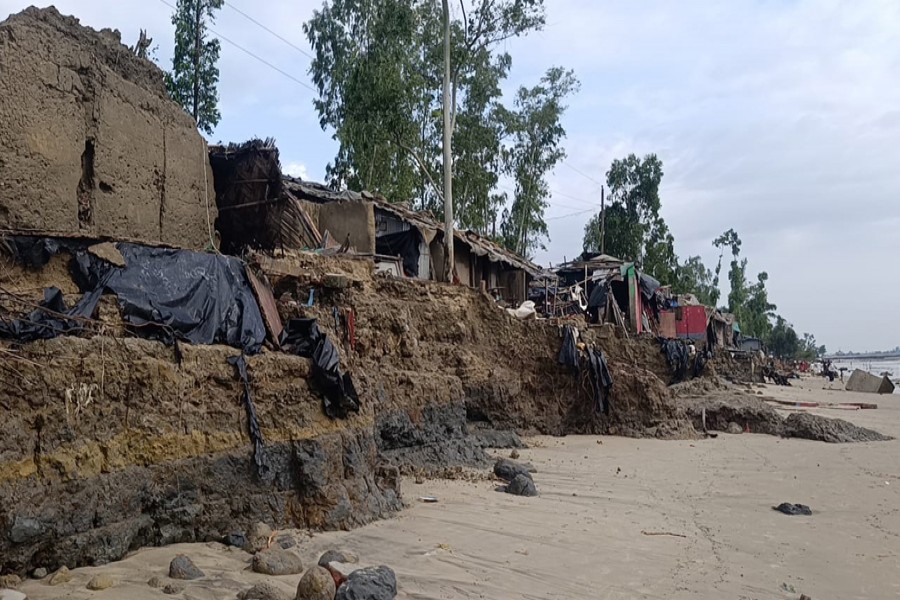
COX'S BAZAR, July 25: High tides and recent heavy rainfall have inundated the western coastal areas of Matarbari in Maheshkhali upazila of Cox's Bazar, leaving at least 600 families residing there in hardship.
Around 200 families have already been affected by the recent flooding. Many homesteads have been submerged or washed away by seawater, while paddy fields, vegetable gardens, fish enclosures and other croplands have also suffered extensive damage.
Local residents said tidal waves, rising four to five feet, regularly enter the locality by overtopping weak and damaged embankments. As a result, homesteads, agricultural land and fisheries are being severely affected.
Many families who have lost their homesteads are now living in uncertainty.
According to sources at the Bangladesh Water Development Board (BWDB), three to four kilometres of the approximately eight-kilometre embankment in the Sairardail and western coastal areas of Matarbari are currently unprotected. The condition of the embankments is particularly fragile in Sitepara, Jaliapara and Baharpara.
New areas are being inundated almost every day due to strong tidal currents, locals said. Residents claimed that such regular inundation by tidal water was not seen in Matarbari before the coal-fired power project began operations. Over the past 12 to 13 years, many homes have been washed away by coastal erosion and tidal surges. Some one-storey and two-storey houses now lie beneath the sea.
The coal-fired power project authorities, however, have denied that the project is responsible for the erosion. They said erosion had been taking place in the area even before the project began and that sand had been extracted from the sea in a planned manner for the project.
Sajedul Islam, a resident of Sitepara, said, "We want the benefits of development. But if people become homeless because of that development, the state must also take responsibility for rehabilitating the affected families."
According to information gathered during the investigation, the first embankment in Matarbari was built in 1985 at the initiative of then chairman Mostak Ahmed. After erosion affected the embankment, it was renovated around 2001. Since then, the western coastal embankment of Matarbari has reportedly been repaired and renovated almost every year. Matarbari Union Parishad Chairman S M Abu Haider said assistance had been provided to at least 700 affected families by the union parishad and the coal-fired power project authorities.
He said around 200 homes were submerged by recent heavy rainfall and tidal water, causing extensive damage to paddy, fish enclosures and other crops.
"Of the eight-kilometre embankment, three to four kilometres remain unprotected. Between 500 and 600 families living near the embankment are at extreme risk," he said.
H M Faridul Alam Shaheen, joint convener of the Cox's Bazar district unit of the environmental
organisation Dharitri Rokkhae Amra (Dhara), said extraction of soil and sand from the sea for the project had caused serious damage to the coastal environment and ecosystem.
"The natural course of the sea can never be changed. If anyone tries to control or dominate the sea, nature will eventually respond in a devastating manner," he said.
However, S K Sazzad, manager of the coal-fired power project, said the project was not responsible for the erosion. Erosion had already been taking place in the area before the project began. Sand extraction also did not create any problem. Sand was extracted from the sea in a planned manner for the project," he said.
Mohammad Nurul Islam, executive engineer of the Cox's Bazar office of the Bangladesh Water Development Board, said 6.5 kilometres of the total 32-kilometre embankment in Matarbari and Dhalghata were at extreme risk.
tahjibulanam18@gmail.com