
Time to focus on roof top solar power development
Mushfiqur Rahman | Saturday, 6 May 2023
As the temperature increases (in Dhaka it feels like 40 degree celsius during day time, in Chuadanga temperature touched 39.6 degree celsius on April 12, 2022), demands for electric energy grows (mainly because of air conditioner use). Bangladesh Power Development Board (BPDB) generated record 14,932 MW. BPDB's published reports suggest that a total of 23,332 MW grid connected generation capacity has been installed so far. Published report indicates that BPDB can enhance its production to a maximum of 15,182 MW (as on April 12, 2023). The remaining capacities can not be made fully operational at this stage for various reasons related to generation and transmission-distribution of electricity (the Kaptai Hydro electric power plant's installed capacity 230 MW limits its generation to 25 MW due to shortages of water; 2,139 MW installed capacity power plants have been undergoing maintenance works). In addition, fuel supply shortages compel BPDB idling 2,536 MW (gas and liquid fuel based 2,407 MW and coal based 129 MW capacity power). 49 per cent power plants of the country are dependent on natural gas as fuel followed by 26 per cent on furnace oil, 12 per cent on coal, 6 per cent on diesel, 1 per cent on hydro and 1 per cent on grid solar sources. BPDB currently meets 5 per cent of its electricity supply from import sources.
In the backdrop of rising imported fuel (LNG, Furnace Oil and Diesel) costs in the international market, Bangladesh Power Development Board's power generation and supply in the country remain hugely government subsidy-dependent. BPDB had to pay on an average Taka 8.84 per unit of electricity as generation costs compared to its sale price of Taka 6.61 per unit during the fiscal year 2021-2022. A report recently published by the Institute for Energy Economics and Financial Analysis (IEEFA) considers that Bangladesh would require US$4.45 billion as fuels cost for importing liquid fuels for securing uninterrupted power supply in February-June 2023 period. The report further says that BPDB needed Taka 297 billion subsidy from the government to balance its operational losses in the fiscal year 2021-22. Despite repeated power price hikes, the government still needs to allocate huge subsidy for power sector in the coming years. On the contrary, IEEFA study considers that approximately US$1.71 billion annual investment until 2041 may require achieving 40 per cent renewable energy capacity development. The said institute strongly advocates for renewable energy capacity building to reduce significant subsidy burden for power sector as well as for moving away from fossil fuel import dependency for power generation.
The RE energy expert Mr. Dipal Barua informs that at present 9 utility scale solar power projects have been completed in the country and a total of 261 MW solar power sources have already been connected to the national power grid line. 8 more such solar projects with a capacity of 551 MW have been under implementation stage. He further informs that 2,873 solar irrigation pumps have so far been installed with a capacity to generate 54 MW electricity. Solar irrigation pumps potentially may eliminate remaining 1.3 million diesel irrigation pumps operational in the country and generate approximately 6,500 MW power.
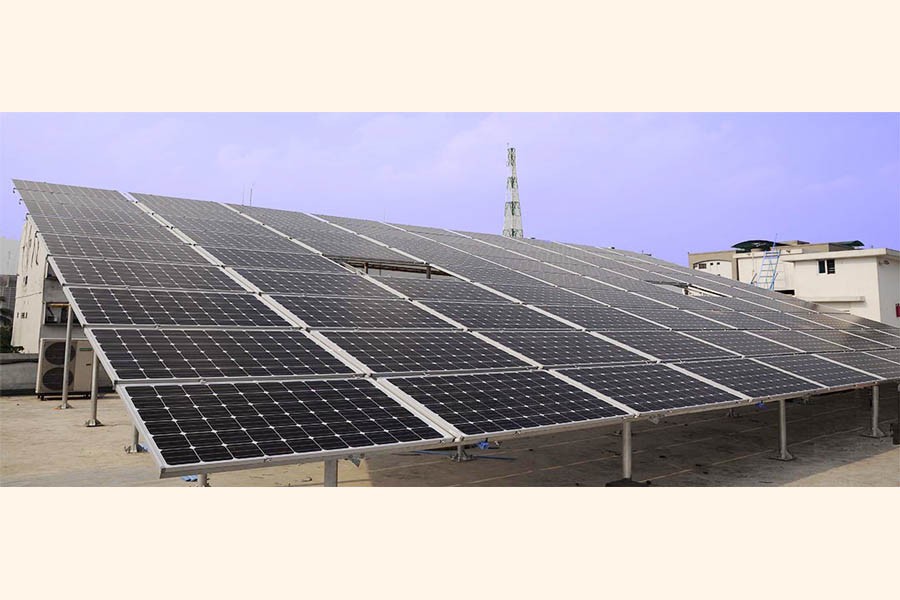
For enhancing solar power capacity, roof top spaces over industries, offices and commercial buildings, educational institutes and places of worship can be utilised. The land hungry and densely populated country like Bangladesh can truly minimise its challenges for making available lands for grid connected solar PV based power generation. By utilising roof tops for installation and exploitation of solar energy, the country can meaningfully add RE energy share in its power basket.
The business community may find it feasible to scale up solar power generation, with special focus on the roof top space uses taking into consideration the increased electricity tariff and the government's intention for further subsidy reduction for power and energy sector. A thumb rule estimate suggests that solar power generation cost per unit can be ensured at Taka 6 per unit. Also, solar power generated at the factory and office roof tops can easily reduce dependence on the costly and vulnerable grid power supply dependency.
The government has already approved Net Metering Policy in 2018 and the entrepreneurs and community groups can develop rooftop 'solar power plants' and save cost of electricity consumption. Mr. Dipal Barua estimates that 4,369 MW solar power can be generated by the roof top plants if the potential spaces are utilised. Increased use of solar (grid connected) 'power plants' will help reduce fossil fuel dependency and import burdens. Utilising the roof tops for generating grid connected solar power will help to scale up country's electricity production and ensure green environment.
To attain the government targets for RE generation and its utilisation, the government needs to prepare year wise action plans and effective monitoring mechanisms to track the progress. Experts also feel that the necessary restructuring in the Power, Energy and Mineral resources Ministry with appropriate resource allocations and empowering SREDA (Sustainable and Renewable Energy Development Authority) will be needed to enable accelerated RE growth in the country.
Mushfiqur Rahman is a mining engineer, and he writes on energy and environment issues.
mushfiq41@yahoo.com