
Total compliance in RMG key to global market access
Shahabuddin Rajon | Wednesday, 26 November 2014
The ready-made garment (RMG) industry is one of the important pillars of our economy and a catalyst for development of the country. We take pride in the sector that has been fetching billions of dollars as export earnings and creating jobs for millions of people. The 'Made in Bangladesh' tag has also brought glory for the country, making it a prestigious brand across the globe.
Bangladesh, which was once termed by cynics a 'bottomless basket' has now become a 'basket full of wonders.' The country with its limited resources has been maintaining 6.0 per cent annual average GDP (gross domestic product) growth rate and has brought about remarkable social and human development.
In the RMG business arena, there is a very strong correlation between the business sustainability and the term 'total compliance'. Here 'Total Compliance' (a new concept) means the way of achieving international standard through eco-compliance, environmental compliance, effluent treatment system (ETP), occupational safety and health (OSH), labour standard, chemical safety management, fire safety and building integrity. Lowest wage alone cannot ensure business sustainability. Without proper implementation of total compliance, it is almost impossible to survive in global market competition.
Despite the epic growth of our RMG industry and its bright prospects, challenges are still there. One of the biggest challenges, currently faced by the RMG industry, is to ensure workplace safety and better working conditions for millions of garment workers. Two major accidents, the Tazreen fire and the Rana Plaza collapse, have brought the issue of workplace safety to the fore and led all stakeholders to act accordingly. Following the unfortunate incidents, various platforms such as the Bangladesh Accord on Fire and Building Safety, the Alliance for Bangladesh Worker Safety and National Plan of Action have been formed to improve building and fire safety in Bangladesh's garment industry.
All members of the Bangladesh Knitwear Manufacturers and Exporters Association (BKMEA) and the Bangladesh Garment Manufacturers and Exporters Association (BGMEA) are making all-out efforts to carry out the corrective action plans recommended by the Accord, the Alliance and the National Plan of Action. So, to ensure sustained global market access, there is no way but to enforce an effective total compliance system. Of all the initiatives, implementation of total compliance is the key to market access. All the factors are inter-related and inter-dependent. All of our competitors have an advantage in infrastructure, compliance and lead time. They are in a better position in the area of compliance and price bargaining too. Our main competitiveness is in low wage which alone cannot guarantee business growth and sustainability.
Bangladesh needs to fully comply with international labour standards and ensure workers' rights to retain access to the world market. In this, compliance and sustainability go together. They are parts of the same picture. So long things go well and we work through reforms in accordance with total compliance, our market access will be there.
There are a number of compliance issues that still need to be addressed as most of the industry managements do not know what total compliance is. Some are educated about the matter and they are working to implement it in the factory level. So the Bangladesh RMG owners, with assistance from the government, have to improve labour standards and factory conditions further to be able to continue enjoying the benefits of generalised system of preferences (GSP). Because, market access can't go forward without sustainability. If the foundation for success is solid, Bangladeshi RMG market is not going to encounter these problems.
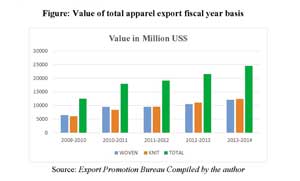
Currently, apart from the USA and Canada, the European Union (EU) is Bangladesh's single largest export market: in fiscal 2013-14, the country's exports to the EU hit a record high at more than $16.4 billion. This accounts for more than 54 per cent of Bangladesh's total exports. The duty-free market access under the GSP has been a tremendous opportunity for Bangladesh. It is to be noted that no developing country has leapt as much forward as Bangladesh did. This shows that Bangladesh's workers and managers have got the right skills. Besides, the quality of Bangladeshi products is good enough to access the market and create jobs, wealth and prosperity for the future.
In July last year, Bangladesh signed the time-bound agreement with the EU and the International Labour Organisation to improve labour, health and safety conditions for workers and to encourage responsible behaviour by businesses in the garment sector. Later, the US also joined the Compact. As part of promises made under the Sustainability Compact, Bangladesh has progressed a lot, but more needs to be done. It is not over yet. We have to keep working to ensure sustainability.
All factories must be safe. There must be better labour relations and workers' safety. It also means all workers should be allowed to associate freely and bargain collectively whether it is in factories inside or outside the export processing zones or the BSCIC. The good message is that labour and factory conditions in Bangladesh have improved notably. This is absolutely a positive sign in any reform process. Making a start and moving ahead, this process will have to continue.
There is no denying of ensuring workers' rights and compliances and structural safety; at the same time, it is also crucial to ensure workers' job security. Concerted efforts need to be taken by the government, factory owners and buyers to confront emerging risks like cancellation of orders, closure of factories and laying-off of workers in implementing various measures to improve compliances. The government has to accelerate its efforts to establish a Garment Village to relocate vulnerable factories and ensure timely implementation of initiatives that the stakeholders have taken for sustainable development of the RMG sector.
With challenges remaining on one side, a more glittering future is awaiting the ready-made garment industry of Bangladesh, on the other. At least, facts and figures have made us believe so. A recent study, jointly conducted by the United States Fashion Industry Association (USFIA) and the University of Rhode Island (URI), has made us more optimistic about the potential of our RMG industry.
According to the study, the US-based fashion companies are expected to boost their sourcing from Bangladesh in the next two years. McKinsey, a global management consulting firm, has described Bangladesh as the next hot spot in apparel sourcing. The renowned firm forecasts export-value growth of 7-9 per cent annually and our apparel export will double by 2015 and nearly triple by 2020 provided that we can successfully overcome a few challenges including developing infrastructure and skilled workforce.
The RMG sector in our country has so far been witnessing price competitiveness. The minimum wage in our country is still the lowest among our competitors. Cheap labour does not help if the workers are not efficient. Garments-related technical education from the government-end can play a vital role in overcoming the challenges. Without combined efforts and firm commitment from all concerned, a risk-free RMG sector is impossible. Without absolute 'total compliance' management, only wage competitiveness cannot ensure sustained global market access and business sustainability.
The writer is Assistant Secretary (Fire and Safety), BKMEA.
rajonbkmea@gmail.com