
Toy makers eye greater global mkt share
MONIRA MUNNI | Tuesday, 21 June 2022
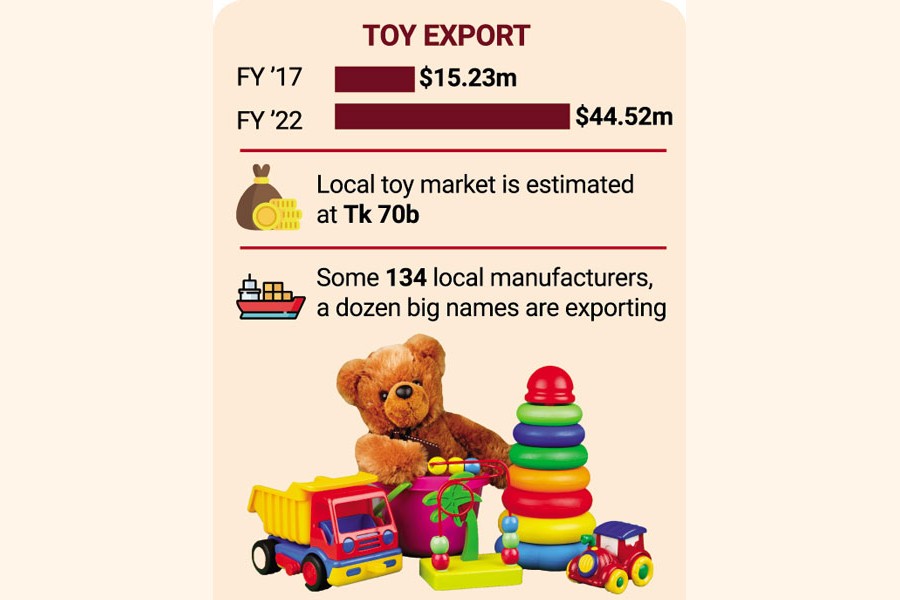
Local toy industry, which meets the majority of the domestic demand, has a huge potential to boost its global market share provided that the required policy support is ensured.
Just a decade back, Bangladesh was largely dependent on imports to meet its demand. But over the years, local toy makers have overcome this dependency.
Now, some 134 manufacturers, located mostly in export processing zones, economic zones, Keraniganj, Gazipur and Old Dhaka, are meeting the majority of local demand, said the industry people.
Of the total, some of the big names - Bengal Plastic, RFL (export), SK Plastic, Wonder, Talukder, Gazi Group, Aman, Zihan and Premia Flex - are already exporting toys, they noted.
Industry insiders, however, said the local toy makers, having investment of more than Tk 200 billion, mostly supply the non-branded remote control and battery operated 3D cars, friction, and learning toys to the domestic market.
With availability of cheap labour and a large workforce here in the country, the plastic sub-sector has a potential to raise its export earnings to billion dollars in the next few years, industry people believe.
According to Business Initiative Leading Development (BUILD), the local toy market is estimated at Tk 70 billion.
The global toy market is projected to reach more than US$110 billion by 2026 as household income and the people's purchasing power are rising.
It is not possible to sustain the country's competitiveness on global scale unless the sub-sector gets government's required policy support, including withdrawal of supplementary duty (SD) on all types of toy components, withdrawal of VAT on local sales, 20 per cent cash incentive, credible testing and certification facilities and generating skilled workers, observed the industry insiders.
In the fiscal year (FY) 2016-17, the country fetched $15.23 million from toy exports which stood at $44.52 million in FY 2021-22, according to the Export Promotion Bureau (EPB) data.
Tricycles, scooters, pedal cars and similar wheeled toys, and dolls are the most exported items - shipped to mostly Spain, Italy, France, Japan, USA, UK and Germany, EPB data showed.
Though the toy export witnessed a 12 per cent negative growth in FY 2019-20 due to Covid-19, the industry later recovered and grew fast, according to BUILD.
Talking to the FE, Kamruzzaman Kamal, director (marketing) at Pran-RFL Group, said Bangladesh mostly produces low-priced plastic-based and non-branded toys in absence of required backward linkage industry.
Most of the raw materials and mechanical parts are imported paying a high duty, he said, adding that they supply branded items both for local and export markets.
He, however, said the toy industry has a huge opportunity to grow further, as the country is densely populated with a significant portion of kid generation.
"Toys play an important role in child development both in and outside the country," observed Mr Kamal.
Taking into consideration the business potential both in and outside the country, Aman Plastic Toys Industries is investing fresh TK 80-100 million to set up two new units that will create employment for additional 350-400 people.
Started in 2008, Aman Plastic already has three factories with direct and indirect employment for some 2,000 people, said its owner Aman Ullah.
"The duty of imported toys was 50 cents to $1.50 per kg in 2008-09 which later gradually rose to $9.0 per kg. This duty protection helped the local toy industry grow and meet majority of the local demands," he said.
In the new units where he mainly plans to assemble the parts will go for production in November next and workers can do their jobs from home.
Aman factories produce almost all kinds of cars, motorcycles, airplanes, toy pistols, fishing games and so on.
"Cheap labour and large workforce are among the major strengths of the industry," he noted.
He, however, said molding machines and molds imported from China increase the production cost and the materials available in the country don't have a good finishing.
Technical support is needed to develop the backward light engineering industry that can supply raw materials, thus helping reduce import dependency, he said.
Talking to the FE, Sirajul Islam, managing director of Tajul Plastic Toys Industries, said 20-30 spare parts are needed to make a toy and almost all are imported from China.
The import duties of raw materials are very high and these should be reduced, in order to help boost the industry, create more employment and increase export earnings, he observed.
Mr Islam, who currently supplies toys only to the local market, has a plan to export within one or two years.
"For export, we need to increase our production capacity. Three of our factories supply toys to the local market," he added.
While explaining the potential of the industry, Federation of Bangladesh Chambers of Commerce and Industry (FBCCI) President Jashim Uddin said the local toy makers meet 90 per cent of the country's domestic demand.
Mr Uddin, also vice chairman of Bengal Group of Industries, said the plastic industry during its initial stage was known for toys while it later expanded to other diversified plastic products.
China is doing better in toy export as their industry is cluster based and that helps sourcing all required materials from one place, he said, adding that Bangladesh also needs the same.
Also, the country needs to formulate sector-based policy to identify the problems and the way outs, he said.
Terming the relocation of plastic industries from Old Dhaka an 'issue', he also called upon the government authorities concerned to reduce the land price so that small industry can relocate to the proposed industrial park for plastic industry and thereby ensure compliance.
When asked, Shamim Ahmed, president of Bangladesh Plastic Goods Manufacturers and Exporters Association (BPGMEA), said toys are innovative products as each toy has a variety.
Toy industry needs the government's policy support for expansion, he said.
Being a labour intensive sector, more women can be employed here, he said, adding that the sector has the opportunity to turn itself into the one like the country's readymade garment industry.
The local toy industry has created employment for some 0.2 million people, said Mr Ahmed.
"Though the national revenue board reduced duty on some toy components, it has imposed supplementary duty on some other items," he said, urging the authorities concerned to withdraw the duties.
He, however, proposed increasing the tariff to $20 per kg instead of existing $7.5 per kg on import of toys, to help protect the local industry.
China, Vietnam and Taiwan are leaders of technology while Bangladesh still lags far behind in terms of technological development, he added.
Belal Ahmed, managing director of Golden Son Ltd, alleged that they cannot receive export orders due to complexities related to HS codes.
Different buyers ask for different types of toys using a wide range of components, including digitally and robotic controlled ones, he said, explaining that they can't import all the parts as these are not included in bond licenses.
The issue has to be resolved, he said, urging the government to allow imports of accessories as per work orders and bond license import accessibility according to machine production capacity.
Industry people, however, said toy makers are divided into two groups, thus hindering the growth of the sub-sector.
There are two associations - BPGMEA and Bangladesh Toy Merchants, Manufacturers and Importers Association (BTMMIA) - claiming their respective roles in promoting development of the industry.
They blame each other - one group says BPGMEA is for the plastic sector while the other says BTMMIA is protecting the interests of importers.
Jahidul Haque, general secretary of BTMMIA, said they have around 300 members - of them, 100 are manufacturers, 50 importers, and the remaining ones are merchants.
Talking to the FE, Shahjahan Majumder, president of BTMMIA, claimed that it is their association that helped reduce dependency on imported toys.
He said importers turned themselves into toy makers and only 10-15 per cent of the local demand is met through import.
Unless a local backward linkage industry is developed to supply raw materials which are mostly imported from China, the industry can't be competitive despite huge global and local demand, he observed.
munni_fe@yahoo.com