
Trade deficit drops drastically in FY\\\'14
Thursday, 15 May 2014
Trade balance of the country in the first eight months of the fiscal year (FY) 2014 recorded a sharply lower deficit of US$ 3.561 billion compared to the deficit of $ 4.599 billion in the corresponding period of FY 2013, the Metropolitan Chamber of Commerce and Industry, Dhaka (MCCI) said Wednesday.
"The rise in export earnings as well as the fall in import payments contributed to the improvement in trade balance. Remittances, on the other hand, dropped 6.6 per cent year-on-year to $ 9.138 billion and the deficit in services trade also increased", it said.
It also found that the current account surplus still increased to $ 2.020 billion in July-February of FY' 14 from $ 1.995 billion in the corresponding period of FY '13, mainly because of the large improvement in trade balance", the MCCI said in its review of Economic Situation in Bangladesh during January-March 2014 (Q3 of FY 2014), said a press statement.
In the quarterly review, the MCCI also said the foreign direct investment (FDI) rose slightly by 3.7 per cent to $ 1.148 billion during July-February of FY '14, compared to $ 1.107 billion during the same period in the previous fiscal.
According to industry insiders, a large number of foreign or joint venture companies are supposed to invest in the country for fresh or re-investment but, in the absence of political stability, they are lukewarm in taking decisions over investment.
On the other hand, a number of foreign investors are showing interest in telecom, automobile, paints, pharmaceutical and other sectors for new or re-investment.
Power
The MCCI said the power supply situation improved in the quarter under review. The demand for power also shot up due to rising temperature as the summer approached and people were watching the ICC T20 World Cup cricket on TV at night.
The Bangladesh Power Development Board (BPDB) took special measures to produce adequate power during the T20 World Cup, when there was no shortfall in power generation. As of March 31, 2014, total actual generation during peak hours was 7,155 megawatt (mw) against the actual demand of 6,603 mw. The maximum generation in 2014 was 7,356 mw on March 30, 2014 and it was also the maximum generation in BPDB's history.
Industry
The MCCI said it is very likely that the country's industrial sector growth in the quarter under review was much below the achievement in the past fiscal.
Short supply of energy, both power and gas, is taking its toll on production in the country's industry sector, after the sector suffered the brunt of the impact of shutdowns and blockades during the second quarter of FY 2014. In FY 2013, the broad industrial sector managed to grow by 8.99 per cent, but due to the above reasons, production in many industrial units is now well below their capacities.
Exports
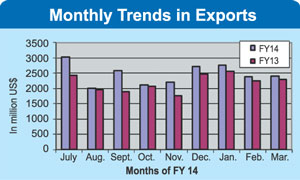
Country's exports grew by only 1.05 per cent month-on-month in March, 2014 and export earnings stood at $ 2,414 million in the same time. It is 10.19 per cent below the monthly target of $ 2,660 million.
However, exports rose 4.82 per cent year-on-year in March 2014. The overall exports in the first nine months of FY '14 registered an increase of 12.88 per cent to $ 22,242 million, compared to the corresponding period of FY '13.
But, because of the political unrest, export earnings in the third quarter of the fiscal witnessed a lower growth of 6.38 per cent, compared to 11.87 per cent and 21.23 per cent growth in the second and first quarters respectively.
According to the EPB data, knitwear items registered a growth of 16.40 per cent in July-March of FY '14, exceeding the strategic target by 5.44 per cent.
Services Sector
The economic review of the MCCI shows, the heightened political unrest in the three months prior to the quarter under review harmed the services sector more than any other sector of the country's economy. There are indications that activities of most of the nine sub-sectors under the broad services sector, such as, transport, hotels & restaurants, community & social services, financial intermediation, education, and wholesale & retail trade suffered heavily due to the political unrest.
The financial sector suffered badly because there were no new investments due to the unrest and the demand for bank loans declined. As a result, most of the banks suffered decline in profits and the number of debt defaulters increased. Tourism activities were hit hard because of non-stop shutdowns and blockades. The arrival of domestic tourists at resorts declined by a margin of about 90 per cent and many foreign tourists cancelled their tour programmes at that time.
Imports
Import payments in the first eight months (July-February) of the fiscal year 2014 rose by 16.42 per cent to $ 26,115 million from $22,432 million in the corresponding months of the previous fiscal. Imports increased during the period mainly due to higher imports of food gains, particularly rice and wheat, apart from capital machinery and industrial raw materials. In February 2014, imports stood higher by $ 410 million or 15.72 per cent at $ 3,018 million, against $ 2,608 million in February 2013.
Remittances
The review says the inflow of remittances witnessed a mild recovery, growing by 0.11 per cent in the quarter under review, from the negative growth of 8.12 per cent and 8.87 per cent in the first and second quarters of the present fiscal. In the first nine months of the fiscal (July-March of FY14), country's remittances fell 5.63 per cent to $ 10.495 billion from the same period of FY '13 ($ 11.121 billion). The lower outflow of migrant workers in the past fiscal is mainly responsible for the declining trend in remittance inflow.
Overseas Employment Situation
Overseas employment of Bangladesh migrant workers has been witnessing a slow trend since August 2012 following suspension of visa issuance by the United Arab Emirates (UAE) to Bangladeshi workers.
The MCCI said only 96,068 Bangladeshis entered the international markets with jobs during January-March of the calendar year 2014. Of them, 34,200 went in January, 28,510 in February and 33,358 in March, according to Bureau of Manpower, Employment and Training (BMET). In 2013, some 409,253 Bangladeshis got overseas jobs while the number was 607,798 in 2012.
Foreign Aid
According to the Economic Relations Division (ERD) data, the disbursement of foreign aid during July-February of FY '14 increased by $ 147 million or 8.75 per cent to $ 1.827 billion from $ 1.680 billion in the corresponding period of the previous fiscal year. Out of the $ 1.827 billion received by government, $ 0.318 billion was in grants and $ 1.509 billion in loans. The disbursed $ 1.827 billion included mainly: $ 668 million from the World Bank, $ 348 million from the ADB, $ 224 million from China, $ 223 million from JICA and $ 71 million from India. While in February 2014, the disbursement increased by 32.28 per cent to $ 250 million from $ 189 million in the previous month of the present fiscal (January 2014).
Agriculture
The review says, full data on agricultural production for the third quarter of the present fiscal (Q3 of FY14) is yet to be available.
But, it said, steady growth in Aus and Aman production, strong growth of horticulture, and good growth (13.4 per cent) in the exports of agricultural products in the first nine months of the present fiscal indicate that, despite political unrest in the past months, the growth of the agriculture sector in FY '14 will be higher than that of the last fiscal.
Besides, the agriculture sector employs about 47.5 per cent of the country's total labour force and accounts for about 18.7 per cent of its GDP.
Food Grains Situation
The Department of Agricultural Extension (DAE) had set the food grains production target at 35.89 million tonnes (mt), of which individual targets for Aman, Aus, Boro and wheat were 13.28 mt, 2.41 mt, 18.92 mt, and 1.28 mt respectively.
Besides, as of April 3, 2014, about 375 thousand tonnes (tt) of rice was imported (mainly by the private sector). Over the same period last year, total imports of rice amounted to 25.8 tt, of which 86 per cent was by the private sector.
Construction
The construction sector experienced problems in the quarter under review despite an apparent improvement in the political situation since the January 5, 2014 elections. Continued downtrend in sales severely affected the realtors, which also has had its incidental effects on the overall economy. Various professional firms, labourers and suppliers connected with the sector are facing serious problems with their livelihood. The problems intensified as the flow of bank credit to the sector almost stopped.
Manufacturing Industries
The MCCI experts say the manufacturing industries which contribute nearly 20 per cent to the country's GDP, have long been experiencing difficulties in production due to power and gas shortages. There are over 0.24 million large, small and medium-size manufacturing units in the country, but due to the shortage of gas and electricity these units can utilise only 60 per cent of their overall capacity.
Fisheries, Livestock and Poultry
MCCI referring to the BBS data says the fisheries sector now contributes 4.4 per cent, and livestock and poultry sectors around 2.5 per cent to GDP, which, respectively, account for 22.8 per cent and 13 per cent of the total agricultural GDP.
Industrial Term Loan
Data on industrial term loans are available only up to the 2nd quarter (October-December) of the current FY. According to BB data, the disbursement of industrial term loans during October-December of FY '14 stood just 3.7 per cent higher at Tk 126.85 billion, compared to Tk 122.33 billion during the corresponding quarter of the previous fiscal.
SME Loans
Data on SME loans are not available for Q3 of FY '14. According to the Bangladesh Bank data, total SME loans by all banks and non-bank financial institutions increased by 14.9 per cent to Tk 1,158.84 billion at the end of December 2013 from Tk 1,008.13 billion at the end of December 2012.
Public Finance
The review says, in the first eight months of the current fiscal (July-February of FY '14), the National Board of Revenue collected Tk 683.14 billion or 54.7 per cent of the downsized revenue target set for the entire fiscal year. The government had initially set a collection target of Tk 1,360.90 billion for FY '14 for the NBR but as the growth in revenue collection remained slow, the target was later downsized at Tk 1,250 billion.
Public Expenditure
The implementation of the Annual Development Programme (ADP) failed to pick pace in the first nine months of current fiscal (July-March of FY14) as the implementation rate was 43 per cent, 6 percentage points below the implementation rate achieved in the corresponding period of the previous fiscal (49 per cent).
All the implementing ministries and agencies utilised Tk 284.28 billion during July-March of FY '14, out of the total ADP outlay (except self-financed) of Tk 658.72 billion.