
Trade deficit in Jul-Feb widens on falling exports
JASIM UDDIN HAROON | Friday, 10 April 2026
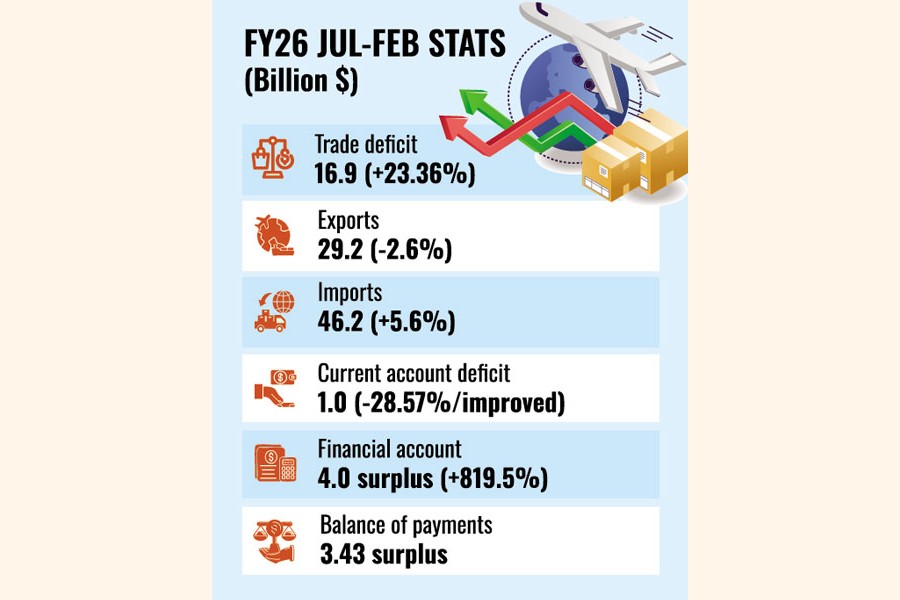
Bangladesh's trade deficit widened significantly during July-February of the current fiscal year as merchandise exports declined while imports increased.
The trade deficit stood at $16.9 billion during the period under review, up from $13.7 billion in the same period a year earlier, according to balance-of- payments (BoP) data prepared by the Bangladesh Bank.
It said the export receipts fell 2.6 per cent year-on-year to $29.2 billion, while imports rose 5.6 per cent to $46.2 billion.
Despite the wider trade gap, the current account deficit narrowed due to stronger remittance inflows during the period.
The current account deficit stood at $1.0 billion, compared with $1.4 billion in the same period a year earlier.
Workers' remittances increased by more than 21 per cent during the period.
The financial account, another key component of the balance of payments (BoP), recorded a surplus of $4.0 billion, sharply higher than $435 million during the same period of the previous fiscal year.
As a result, the overall balance of payments registered a surplus of $3.43 billion, reversing a deficit of $867 million recorded during July-February of the previous fiscal year.
Economists say the trade deficit widened primarily because of falling exports and rising imports.
However, stronger remittance inflows helped narrow the current account deficit, they add.
They also add that the overall BoP surplus helped support the country's foreign exchange reserves.
"Trade deficit has worsened significantly because of a decrease in merchandise exports and an increase in merchandise imports," said Dr Zahid Hussain, an independent economist.
The impact of the higher trade deficit on the current account balance was partly offset by strong remittance growth, he said.
"The financial account surplus increased significantly due to a large rise in trade credit owing to the lag between import shipment and payment," Dr Hussain went on.
"The foreign currency assets of the banking system declined, while their foreign currency liabilities increased. This also contributed to the rise in the financial account surplus," he said.
Looking ahead, the trade deficit may widen further due to the impact of the war in the Middle East, the economist warned.
Remittances may cushion the impact on the current account balance in the short term, but this cannot be guaranteed in the medium term.
Dr Hussain said a flexible exchange rate and a tight monetary policy stance were the key measures the Bangladesh Bank could adopt to mitigate risks to external stability under such circumstances.
"Fiscal austerity needs to be strengthened to reduce pressure on demand for foreign exchange arising from higher import prices," he added.
jasimharoon@yahoo.com