
Trade gap narrows yet pressure mounts on balance of payments
July-Nov current-account deficit stood at $5.7b
FE REPORT | Tuesday, 3 January 2023
The country's trade deficit with the rest of the world was reduced slightly in the first five months of the current fiscal year. Slower growth in import coupled with higher growth in export contributed to reduction in the trade gap.
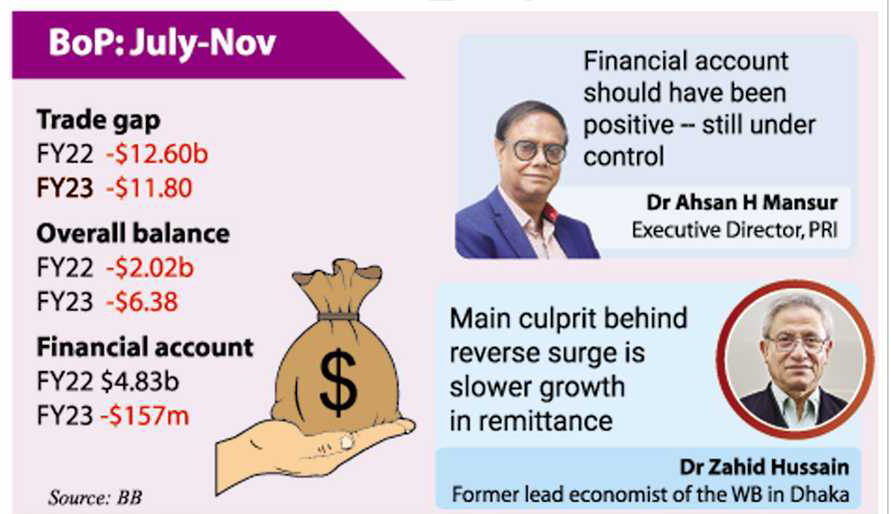
The county's current-account deficit also reduced during the period. Nevertheless, the overall balance-of-payments position shows $6.4 billion worth of deficit during the period. It was just $2.0 billion during the same period a year before.
The latest statistics of balance of payments (BoP), released by the central bank on Monday, showed that deficit in trade in goods stood at US$ 11.80 billion in July-November period of FY23, which was $12.60 billion in the same period of FY22.
Imports grew by 4.4 per cent while exports expanded by 11.75 per cent during the period under review.
As central bank has put some restrictions on non-essential imports to ease the foreign-exchange reserves, growth in imports slowed down.
Current-account deficit amounted to US$ 5.7 billion in five months of the current fiscal through November against $6.22 billion in the first five months of FY22.
The central bank statistics also showed that the financial account, a vital component of the balance of payments, turned into a negative strand of $157 million. Usually it remains positive. The financial account was $4.83 billion surplus in July-November 2021.
Short-term and other debts are components of the financial account. This negative component means the net inflows were negative as Bangladesh paid off much more than its receipts during the period under review under the financial account.
Economists view that slower remittance inflow alongside higher import payments during the first three months of the current fiscal year is the main reason behind such balance upset.
They, however, say the deficit may remain under control as the Bretton Woods institutions -- the International Monetary Fund and the World Bank Group -- had a median estimate of $18 billion at the end of the fiscal year (2022-2023).
Dr Ahsan H. Mansur, the executive director of the Policy Research Institute of Bangladesh (PRI), told the FE that this is, more or less, still in a comfort zone.
The current-account deficit may expand to around $13 billion at the end of the fiscal year, he said, adding that the IMF and the World Bank forecast it would jump to $18 billion at the end of June 2023.
Dr Mansur feels that the financial account "should have been positive". He suggests that the government should take steps to keep the macroeconomic indicator positive.
Dr Zahid Hussain, a former lead economist at the World Bank Dhaka office, told the FE that the main culprit behind the reverse surge is slower growth in remittances.
The central bank data show that the growth in remittance inflow in July-November was 2.14 per cent or $8.8 billion during the period under review.
Dr Hussain echoes Dr Mansur's views that the financial account should be positive as Bangladesh itself is financing the account. "Usually we used to have higher net inflow from this account."
jasimharoon@yahoo.com