
\\\'Trade should be the key issue for policymakers\\\'
FE Report | Thursday, 24 April 2014
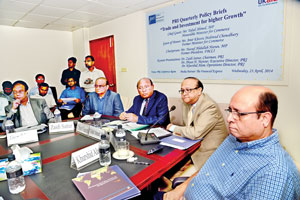
Commerce Minister Tofail Ahmed Wednesday favoured protection to domestic industries when the Policy Research Institute (PRI), private think-tank, suggested scaling down the level of protection offered to the same.
Mr. Ahmed, felt that protection had paid dividends and industries concerned were doing well.
Dr. Zaidi Sattar, chairman of the PRI, in his presentation on new directions for trade policy prepared by using cross-country evidences at a seminar held at the PRI conference centre, suggested a change in the protectionist stance in the case of domestic industries.
He said the government should institute a mechanism of time-bound protection for import-substitutes.
The commerce minister, while speaking as the chief guest at the seminar on 'Trade and Investment for Higher Growth', however, said a number of industries have been doing well because of the protection.
"During my previous tenure as commerce and industries minister, I offered protection to cold-rolled coil plants by imposing higher import duties."
The cold-rolled coil industries have been performing well and exporting a part of their production, he said.
Similarly, he said, the cement industry is now better performer due to the protection.
"Almost all major global cement producers are in operation in the country as Bangladesh is encouraging the industry by imposing comparatively lower rate of duty on the import of clinkers."
Yussuf Abdullah Harun MP, a PRI director and former president of the Federation of Chambers of Commerce and Industry (FBCCI) presided over the seminar.
Dr Selim Raihan, professor of Economics and Iftekarul Islam, founder and managing partner of Asian Tiger Capital Partners were designated panellists in the seminar.
PRI chairman Dr Zaidi Sattar in his paper said mainstreaming trade and trade policy should become a key agenda for policy makers and planners by taking trade-related issues into account when planning and executing broader development goals.
He said there is a need for replication of the RMG success in other labour-intensive production units.
"The facility of duty-free imported inputs must be provided even to firms that exports part of their total production," Dr Sattar said.
He said the policy of providing duty-free inputs for export production is not a privilege but a requirement for all export products in order to be on a level playing field with global competitors.
Dr Sattar noted trade and domestic policies had an anti-intermediate goods bias saying this needed to be changed as trade in intermediate goods is the fastest components of global trade.
While presenting the keynote PRI executive director Dr. Ahsan H Mansur said Bangladesh failed to cross 7.0 per cent GDP growth rate due to investment constraint.
He said the decline in private sector investment is a matter of great concern.
He said the modest increase in total investment is entirely on account of public sector investment with questionable quality. He said investment in infrastructure will help create immediate domestic demand and at the same time would lay the foundation for catalysing higher private sector investment.
"The project list needs to be expanded, prioritised and implemented," Dr Mansur said. He suggested alleviation of land constraint for industrialisation by establishing a serried of special economic zones in various parts of Bangladesh through Private and Public-Public Partnership (PPP) arrangement.
While presenting keynote paper, Dr Khurshid Alam noted there are too many institutions like the Bangladesh Economic Zone Authority, Private Export Processing Zone Cell, Hi-Tech Park Authority pursuing similar objectives leading to institutional challenges.