
Trade, transport connectivity can be a game-changer
Outgoing Indian HC Doraiswami observes
FE REPORT | Tuesday, 30 August 2022
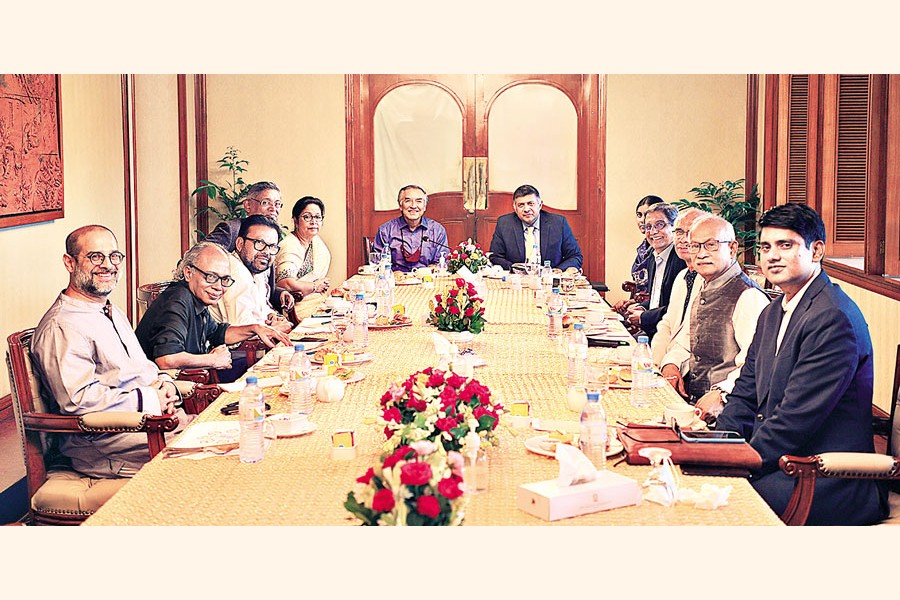
Improving trade and transport connectivity between India and Bangladesh, as well as other neighbouring countries can be a game-changer not only for the two countries but also for the entire region, said Indian High Commissioner to Bangladesh Vikram Kumar Doraiswami, according to a press release issued by the Sampadak Parishad.
He said currently the big challenge facing the trade between the two countries is high cost, as most of the trade happens through land route, which is inefficient and not environment friendly. A truck can carry not more than 15 tonnes of goods and that too mostly using one particular land route.
"This is one of the reasons why trade is so expensive and so difficult," Doraiswami said at a views exchange meeting with the Sampadak Parishad (Editors Council) at a city hotel Monday ahead of the Prime Minister's visit to India next week.
He spoke on various issues of bilateral relationship and the sub-regional cooperation. He said Bangladesh and India have resolved many major issues, including land boundary and maritime disputes, and the relationship is much more mature than what was 20 years ago.
Doraiswami, the departing Indian High Commissioner, suggested simplifying the logistics as well as diversifying the trade routes, the low-cost and environment-friendly ones.
India is also willing to allow Bangladesh to use Indian ports and railways etc., for export to the third countries like Nepal and Bhutan.
The Indian envoy said sub-regionalism is a need of time for greater good of the regional countries.
"It is important that we look at greater port, energy, and economic interconnectivity at least among the four to five countries that are willing. BIMSTEC is one such effort to reach it," he said.
However, the infrastructure is not fully ready for that. For example, energy connectivity is a long overdue that India is very keen about, but for that to happen, the transmission connectivity should be established.
The existing connectivity that is in place already completely booked. Presently, there is synchronized connection lines from Bahrampur to Bheramara for supplying about 1000 MW electricity from Indian grid. Another about 1160MW comes from Tripura. Except these lines, there is no other connectivity.
Doraiswami said India has been very keen to develop syncronized grid connectivity, which will seamlessly ensure grid stability. In that case, investments will also come including in renewable energy. It will also allow seamless power from Bhutan and Nepal.
He said India and Nepal currently have reciprocal motor vehicle agreement, while Bhutan has non-reciprocal motor vehicle agreement. For Nepal and Bhutan, the net benefit is comparatively small.
However, for Bangladesh and India, opening the transport connectivity benefit is huge, Doraiswami said.
"So, if we have transport connectivity for passenger and goods vehicles, we would do it for the benefits of both Bangladesh and India. Ninety percent of your land border is with us. so, it will open out transportation connectivity to the entire sub-region, he said"
This connectivity can also be expanded to much further, for instance maritime connectivity, he said adding that currently there is no direct shipping connectivity between Bangladesh and India.
"The goods that have to go by sea between Bangladesh and India go by the Port Klang or Singapore or Colombo. This is ridiculous," he said.
Doraiswami said it is important that the narratives of the bilateral relationship between the two countries are always right.
Mahfuz Anam, editor of The Daily Star and president of the Editors' Council, moderated the discussion. Prothom Alo Editor Matiur Rahman, Ajker Patrika Editor Golam Rahman, New Age Editor Nurul Kabir, Bhorer Kagoj Editor Shyamal Dutta, Ittefaq Editor Tasmima Hossain, Samakal Editor Mozammel Hossain, Bonik Barta Editor Dewan Hanif Mahmud, Sangbad Editor Altamash Kabir and Dhaka Tribune Editor Zafar Sobhan were also present.