
Traders agog for bonanza in Baishakhi economics
Arafat Ara | Thursday, 9 April 2015
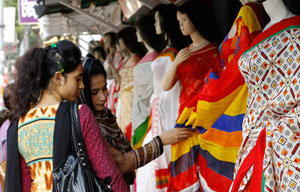
Fashion houses and shopping malls redecorate themselves with a plethora of newer products for seasonal buyers ahead of Pahela Baishakh - the largest traditional festival for the Bengalis that usually brings a business bonanza.
On a go-around, shops in the capital city were found displaying wide arrays of new collection of clothes and other necessities resplendent in multifarious colours and designs to attract fashion-loving people.
Salesmen said they were doing ever so well and the sales would pick up during the rest of the days leading to the Bangla New Year's Day to be celebrated on April 14.
"The start-up Baishakhi sales look good and I think this year we will get a big sale," said Shaheen Ahmed, vice- president Fashion Udyog, an association of fashion-house owners.
He noted that people are most fond of local dresses for celebrating Bengali festivals, including Pahela Baishakh that principally holds economic implications.
The new year was originally introduced on a concept of economics to mark the opening of new sales ledger by traders through settling accounts with their customers.
So local fashion houses will get good response from the customers, he hoped. There are 4,500 houses dealing in fashion wears across the country.
Mr Ahmed, also Anjan's chief executive officer (CEO), said he has in his collection festival clothes of reasonable prices so that people can afford.
The prices vary for Anjan's collections from Tk 700 to 3,000 for each piece of cotton sari while silk and others from Tk 1,500 to 5000.
The price ranges are for shalwar-kamiz Tk 1,500 to 5,000, Punjabi Tk 700 to 2,000 and kid's items Tk 300 to 2,000.
"We have used red-and-white fabrics for festival clothes with different designs and motifs like Jamdani and carpet," said Mr Ahmed
As it is summer so Anjan's has given priority to cotton fabrics for user's comfort.
Kay Kraft , a popular boutique house among the fashion- lovers, has used different designs on red, merun, orange, off-white, magenta-colour fabrics for drawing attention of the customers.
It has displayed exclusive shalwar-kamiz, 'fotwa', saris, tops, short Punjabi, Punjabi, and T-shirts in all its outlets.
For attracting customers Kay Kraft has offered 10 per cent discount for savers with different banks and grameenphone subscribers in all its branches bar Deshi Dosh, said Ashraf, a marketing officer.
"Trendy young girls are nowadays fond of long kamiz with 'churidar' shalwar so we are putting emphasis on the fashion," said a salesman of the boutique shop.
Rong has designed 'Shorachitra' Mukhash , Terracotta etc (the symbol of Bangla New Year) this year on festival apparels.
Besides, it has applied block print, hand and screen print, and embroidery on clothing items. It also put in its collection ornaments, bags and other accessories.
The price of shalwar-kameez varies from up to Tk 3,000, saris from Tk 13,000, Fotwa from Tk 1,100 each.
The salesmen said the customers were mostly buying cotton clothes priced between Tk 1,500 and Tk 2,000.
Some traders have, however, expressed their mixed reactions over the sales, saying that the present political environment is hampering their business.
Jashim Ahmed, a trader in the city's Malibagh area, said they were not getting response from customers as their economic condition is not good because of political turmoil-a common complaint from all sectors of the economy.
He said nowadays his sales fell by 70 per cent compared to that of last year.
The owner of Shuti, a Punjabi shop at Mouchak market, said the selling was not good yet, but it could increase over the rest of the days in the run-up to the grand gala.
Smriti, Ramani, Navilla, Ananna, Bailey Sari Kutir and other sari houses in Bailey Road also have brought Baishakhi saris in their shops.
Jamdani, Mirpur Katan, Rajshahi silk and Tangail cotton with bright colours are available in the shops.
Apart from local dresses, shopping malls have put on display Pakistani, Indian dresses, saris and other festival items to bank on buyers' penchant for a change from the usual rut in daily life.
Roadside shops are also prepared for receiving hundreds of customers. Middle-, lower-middle and low-income groups are looking for festival dresses in these makeshift markets.
arafat_ara@hotmail.com